
Are Hourly Employees Usually Non-Exempt?
Yes. Most hourly employees are non-exempt. That means they generally have the right to minimum wage and overtime pay when they work more than 40 hours in a workweek under the federal Fair Labor Standards Act (FLSA).
Hourly pay does not make someone non-exempt in every possible case. But it is a strong sign. Most overtime exemptions require an employee to receive a guaranteed salary and perform specific executive, administrative, or professional duties. A job title such as “manager” does not settle the question.
A few narrow exceptions can apply. For example, certain computer professionals may qualify as exempt while paid hourly under federal law if they earn at least $27.63 per hour and meet the required duties test. That is only a federal baseline; California and other states may require higher pay or stricter rules.
For Oakland workers, classification matters because California often provides stronger protections than federal law, including daily overtime rules. If your employer calls you exempt but tracks your hours, docks your pay, or expects you to perform mainly routine or manual work, the label may not match your legal rights.
Aiman-Smith & Marcy is a plaintiff-side employment and consumer fraud law firm representing individuals in individual, PAGA, and class actions involving workplace issues, including wage-and-hour misclassification.
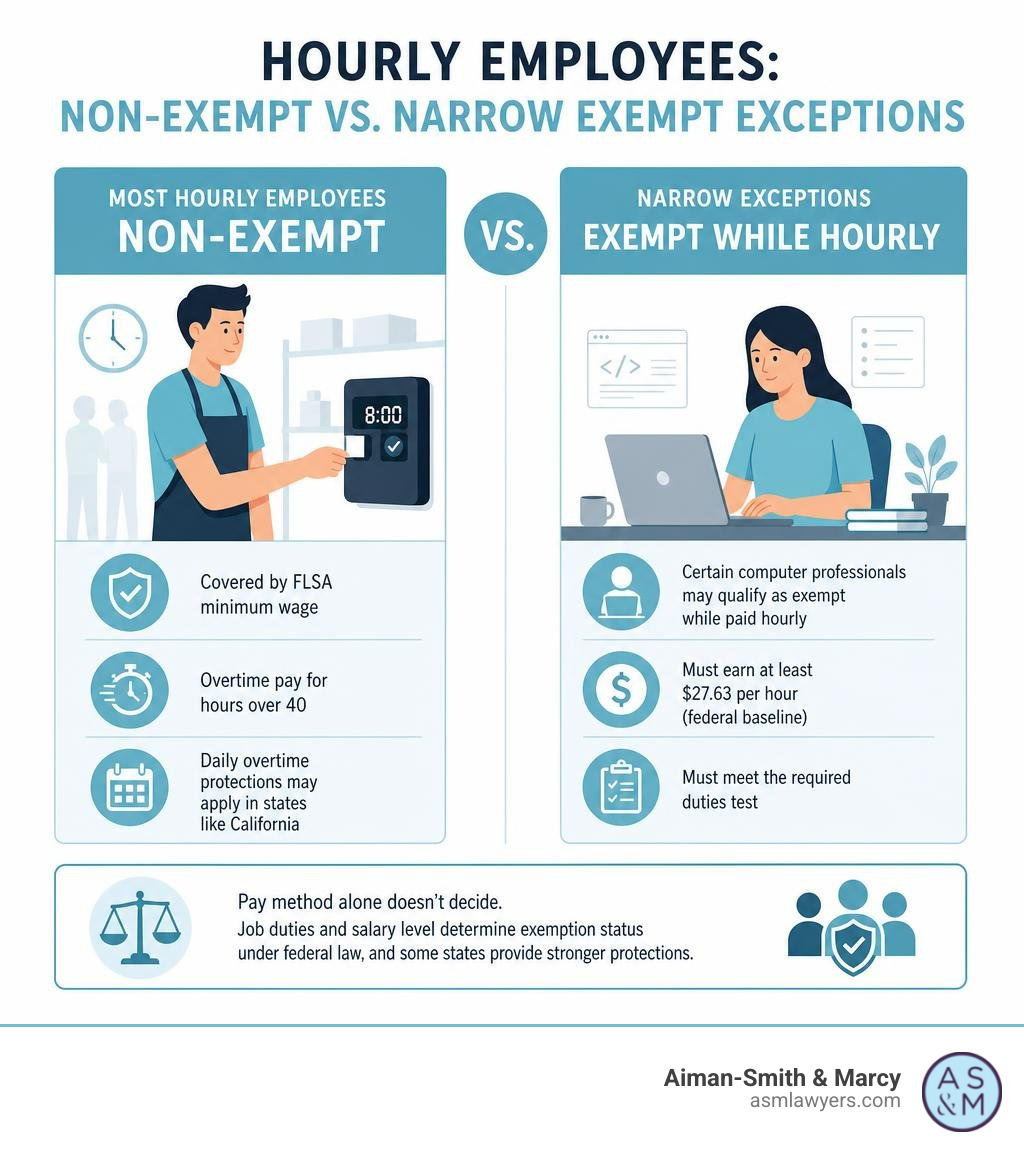
Are hourly employees non exempt terms made easy:
Are Hourly Employees Non Exempt? The Core Legal Framework
Under federal and state labor systems, non-exempt status serves as the legal baseline for all American workers. The Fair Labor Standards Act (FLSA), administered by the U.S. Department of Labor (DOL), guarantees that covered employees receive minimum wage protections and mandatory premium pay for long hours. When an employer claims a worker is excluded from overtime, the burden rests entirely on the employer to prove the worker meets every element of a statutory exemption.
As outlined in the Handy Reference Guide to the Fair Labor Standards Act | U.S. Department of Labor , the law covers employees engaged in interstate commerce or employed by commercial enterprises with gross annual revenue of $500,000 or more. Blue-collar trades, manual laborers, first responders, and frontline service personnel are always classified as non-exempt, regardless of how much money they earn or how complex their day-to-day craftsmanship might be.
Why Are Hourly Employees Non Exempt Under Federal Guidelines?
The legal reason hourly employees default to non-exempt status lies in how hourly compensation functions. Under the FLSA, establishing an overtime exemption usually requires passing three distinct legal hurdles: the salary basis test, the salary level test, and the job duties test.
When you earn an hourly wage, your gross compensation fluctuates directly with the total hours you log on the clock. If you work 32 hours, you get paid for 32 hours; if you work 45 hours, you get paid for 45 hours. This variable structure fails the federal salary basis test, which demands a fixed, predetermined minimum sum paid every week regardless of hours worked or quality of output. Because hourly compensation fails this threshold test immediately, analyzing job duties is rarely necessary. To understand how these legal criteria interact, review our Cheat Sheet to Determine FLSA Exempt vs Nonexempt Status.
FLSA Workweek Rules and Overtime Calculations
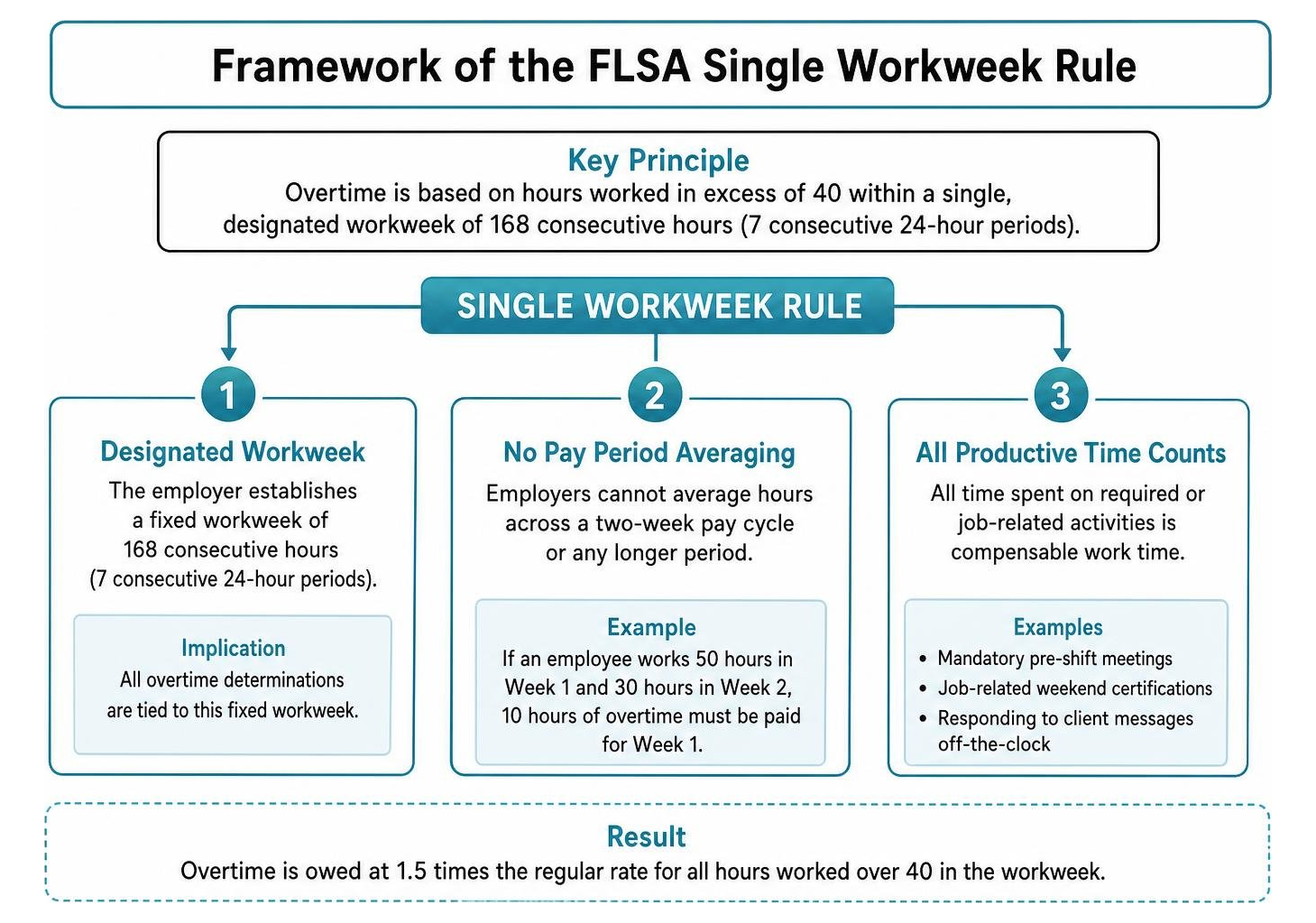
For non-exempt employees, federal law mandates overtime compensation at a rate of at least 1.5 times the employee’s regular rate of pay for all hours worked in excess of 40 within a single, designated workweek.
A workweek is defined under the FLSA as 168 consecutive hours (seven consecutive 24-hour periods) established by the employer. Crucially, federal law enforces a strict single-workweek rule:
- No Pay Period Averaging: An employer cannot average hours across a two-week biweekly pay cycle. If an employee logs 50 hours in Week 1 and 30 hours in Week 2, the employer must pay 10 hours of overtime for Week 1, rather than treating the period as an average of 40 hours per week.
- All Productive Time Counts: Time spent in mandatory pre-shift meetings, job-related weekend certifications, or responding to client messages off-the-clock constitutes compensable work time that must factor into weekly overtime thresholds.
The Three-Pronged Exemption Test Under Federal Law
Federal overtime exemptions—frequently referred to as “white-collar” exemptions—are established under Section 13(a)(1) of the FLSA. According to the Small Entity Compliance Guide , an employee must satisfy all three distinct criteria to be legally denied overtime:
- Salary Basis Test: The employee must receive a predetermined, fixed salary that cannot be docked based on variations in the quality or quantity of work performed.
- Salary Level Test: The guaranteed salary must meet or exceed the federal statutory floor of $684 per week ($35,568 annually).
- Job Duties Test: The worker’s actual daily tasks—not their formal job title—must primarily involve executive, administrative, or professional responsibilities as defined by federal regulations.
When evaluating compliance, we frequently see employers bestow inflated titles like “Operations Lead” or “Team Director” on workers who spend the vast majority of their days performing routine customer service, clerical data entry, or physical tasks. If your employer has assigned you a management title without genuine management authority, our analysis on Supervisors Mislabeling Exempt? Check Your Duties explains why daily tasks dictate legal classification.
| Exemption Category | Salary Requirement | Core Daily Duties Requirement | Common Misclassification Pitfalls |
|---|---|---|---|
| Executive | Predetermined salary of at least $684/week | Primary duty is managing an enterprise, department, or recognized subdivision; regularly directs two or more full-time staff; possesses authority to hire/fire or provides substantial input on personnel decisions. | Shift leads or “keyholders” who spend 80% of their shift working the register or stocking shelves while directing coworkers. |
| Administrative | Predetermined salary of at least $684/week | Primary duty is office or non-manual work directly related to management or general business operations; exercises independent judgment and discretion regarding matters of business significance. | Bookkeepers, administrative assistants, and data entry clerks carrying out established routines without autonomous policy discretion. |
| Learned Professional | Predetermined salary of at least $684/week | Primary duty requires advanced knowledge in a specialized field of science or learning acquired by a prolonged course of specialized intellectual instruction. | Technicians, paralegals, or support staff who hold undergraduate degrees but perform standardized operational procedures. |
The Salary Basis and Salary Level Tests
The salary basis rule protects workers from bearing the financial risks of an employer’s operational fluctuations. Under 29 C.F.R. § 541.602, an exempt employee must receive their full salary for any week in which they perform work, regardless of how few hours or days they log.
An employer destroys the salary basis test if they improperly dock pay for partial-day absences, weather-related business closures, or operational slowdowns. While narrow exceptions exist (such as full-day absences for personal reasons or major disciplinary suspensions for safety infractions), widespread unlawful docking strips the exemption across the entire job class, converting those salaried employees into non-exempt workers entitled to back overtime.
The Job Duties Test Requirements
Federal courts and labor regulators evaluate exemption disputes based on “primary duty”—defined as the main or most important responsibility the employee manages. To satisfy the administrative exemption, for example, a worker must have the autonomous authority to make decisions of significant business consequence without needing prior managerial sign-off. If every non-standard decision must be escalated to an executive, the worker is legally non-exempt.
Narrow Exceptions: When Can Hourly Workers Be Classified as Exempt?
While paying an hourly wage usually establishes non-exempt status, federal and state labor laws carve out a limited number of specific statutory exceptions. If you are questioning your classification, our guide on Are You Exempt? Really? explores how these narrow carve-outs operate in practice.
The primary white-collar professions exempt from both the salary basis and salary level tests include:
- Licensed Physicians and Medical Interns: Doctors actively engaged in the practice of medicine.
- Practicing Attorneys: Licensed lawyers engaged in the legal profession.
- Credentialed Teachers: Educators employed by certified public or private elementary, secondary, or higher educational establishments.
- Outside Sales Representatives: Salespeople who spend the majority of their working hours away from the employer’s physical premises securing contracts or customer orders.
Computer Professional Exemption Baselines
Under Section 13(a)(17) of the FLSA, high-level computer systems analysts, software engineers, computer programmers, and related IT professionals can be classified as exempt even if paid on an hourly basis. However, federal law establishes strict parameters: the employee must perform complex software architecture or systems design tasks and must receive a cash wage of at least $27.63 per hour.
It is critical to note that the $27.63 hourly figure is only the federal baseline and that state law may require higher pay rates to keep overtime rights intact. For example, California enforces its own computer professional exemption standard that requires a significantly higher hourly pay rate along with strict, specialized duties tests. Furthermore, routine technical support roles, hardware repair staff, and IT help desk technicians never qualify for this exemption regardless of their hourly pay rate.
Specific Industry Statutory Overtime Exceptions
Outside of white-collar exemptions, specific federal statutory provisions exclude certain specialized industries from standard FLSA overtime rules:
- Agricultural Workers: Specific agricultural field hands and harvesting personnel.
- Motion Picture Theater Staff: Front-of-house and projectionist staff employed by commercial cinemas.
- Interstate Transportation & Railroads: Certain interstate motor carrier drivers, rail workers, and airline crew members governed by separate federal regulatory frameworks like the Railway Labor Act.
Salaried Non-Exempt vs. Hourly Non-Exempt Employees
A frequent source of workplace confusion is the assumption that every salaried worker is automatically exempt from overtime pay. This is false. A worker can receive a fixed salary and still remain fully non-exempt under the law.

A salaried non-exempt employee receives a regular, guaranteed base salary for a standard schedule (such as 40 hours per week), but remains legally entitled to overtime whenever their actual hours exceed statutory thresholds. For an in-depth review of these pay structures, read The Great Classification Debate: FLSA Exempt vs Non-Exempt Explained.
Regular Rate Calculations for Non-Exempt Salaries
When calculating overtime for salaried non-exempt employees, employers must determine the true “regular rate of pay” rather than multiplying base wages blindly. The regular rate is calculated by taking the total compensation earned across the workweek—including nondiscretionary bonuses, performance incentives, and shift differentials—and dividing it by the total non-overtime hours the salary is intended to compensate.
If an employer promises an employee a $1,000 weekly salary for a standard 40-hour schedule, the base regular rate is $25.00 per hour. If that employee works 48 hours, the employer must compensate the 8 overtime hours at time-and-a-half ($37.50 per hour), resulting in $300 in overtime pay on top of the $1,000 base salary. Failing to fold nondiscretionary bonuses into this formula constitutes unlawful wage suppression under the FLSA.
Are Hourly Employees Non Exempt in State Wage Law Jurisdictions?
While the FLSA sets a federal regulatory baseline across the country, individual states have the constitutional authority to pass more protective labor standards. Where state law provides greater employee protections or higher wage recovery rights, state standards supersede federal guidelines.
According to the Overtime – California Department of Industrial Relations , California enforces some of the most rigorous worker protection standards in the United States. For August 2026, California wage benchmarks provide substantial protections:
- California 2026 Minimum Wage: $16.90 per hour.
- California Exempt Salary Threshold (2026): Under California Labor Code § 515(a), an exempt white-collar employee must earn a fixed monthly salary equivalent to at least twice the state minimum wage for full-time work, which calculates to $1,352 per week or $70,304 annually.
- California Daily Overtime Mandates: Unlike federal law, which only tracks weekly hours over 40, California requires employers to pay non-exempt hourly employees:
- Time-and-a-half (1.5x): For all hours worked past 8 hours up to 12 hours in a single workday, and for the first 8 hours worked on the seventh consecutive day of a workweek.
- Double Time (2.0x): For all hours worked past 12 hours in a single workday, and for all hours worked past 8 hours on the seventh consecutive day of a workweek.
- Strict Quantitative Duties Test: Under California Industrial Welfare Commission (IWC) Wage Orders, an employee must spend more than 50% of their actual working time engaged in qualifying exempt tasks. An employee who spends 55% of their day handling cash registers or stocking merchandise is non-exempt under California law, even if they earn well over $70,304 per year.
- Meal and Rest Break Protections: Non-exempt workers in California must receive a paid 10-minute rest break for every four hours worked (or major fraction thereof) and a 30-minute uninterrupted, duty-free meal period before the end of the fifth hour of work. Missing a compliant break triggers a mandatory statutory penalty of one additional hour of pay at the employee’s regular rate.
Consequences of Misclassification and Legal Remedies
Misclassifying non-exempt hourly or salaried employees as exempt carries severe legal and financial liabilities under federal and state law. Employers who misclassify workers face substantial financial liability when workers assert their legal rights.

When an employer fails to track hours and denies overtime pay, our firm represents workers in bringing statutory enforcement actions. Review our detailed guides on Misclassification and Overtime Pay Compliance with the Fair Labor Standards Act (FLSA) and Exempt Employee Misclassification to understand these legal mechanics.
Employer Liabilities and Audit Risks
When misclassification occurs, liable employers are exposed to multiple layers of statutory exposure:
- Unpaid Back Overtime: Liability for every hour of unpaid daily and weekly overtime worked over the statutory recovery period.
- Liquidated Damages: Under the FLSA, employees are entitled to recover liquidated damages equal to 100% of the unpaid back wages (effectively doubling the recovery), unless the employer can prove an objectively reasonable good-faith defense.
- Statutory Interest and Penalties: Interest accrues on all unpaid wages, alongside waiting-time penalties under state labor codes.
- PAGA Penalties in California: Under the California Labor Code Private Attorneys General Act (PAGA), employees can step into the shoes of state labor agencies to recover civil penalties for systemic wage violations across an entire workforce.
- Mandatory Attorney Fees: Federal and California labor statutes require non-compliant employers to pay all reasonable attorney fees and litigation costs incurred by prevailing employees.
Employee Legal Rights and Claims
Employees who suspect they have been misclassified possess strong legal protections. Under both federal law and the California Labor Code, employers are strictly prohibited from firing, demoting, cutting hours, or retaliating against any worker who inquires about overtime pay, files a wage claim, or consults an attorney.
Workers have the right to pursue individual wage claims, join collective actions under the FLSA, or lead comprehensive class actions representing all similarly misclassified colleagues across the enterprise. Claims can be supported using personal work calendars, email timestamps, badge-swipe data, and witness testimony when employers fail their legal duty to keep accurate timecards.
Frequently Asked Questions About Hourly Employee Classifications
Can an employer pay a fixed salary to avoid paying overtime?
No. An employer cannot escape overtime mandates simply by converting an hourly worker to a fixed salary. To lawfully withhold overtime, the employer must prove both that the worker earns at least the statutory minimum salary threshold ($684/week federally; $1,352/week or $70,304/year in California in 2026) and that their daily tasks satisfy the strict legal duties tests for executive, administrative, or professional exemptions.
Does high hourly pay make an employee exempt?
No. Earning a high hourly wage (even $80 to $150 per hour) does not eliminate overtime protections. Because hourly pay varies based on hours logged, it fails the mandatory salary basis test. Unless the role falls into narrow carve-outs like qualifying software professionals or licensed physicians, high-earning hourly craftspeople, electricians, and technicians remain fully non-exempt and must receive overtime pay.
Can part-time workers qualify as exempt employees?
While legally possible under federal law if a part-time worker performs exempt duties, they must still receive the full, non-prorated weekly salary threshold ($684/week federally; $1,352/week in California). An employer cannot pro-rate the salary threshold to match part-time hours. If a part-time employee is paid hourly or receives a salary below the statutory minimum, they are legally non-exempt.
Conclusion
Understanding worker classification is essential to ensuring you receive every dollar of compensation guaranteed by law. Hourly employees are non-exempt in nearly every work environment, entitling them to statutory minimum wage rates, detailed timekeeping records, and overtime premiums whenever their workday or workweek exceeds standard legal limits. If your employer has labeled you exempt, docked your hourly pay, or denied you overtime while assigning you routine operational tasks, that classification may violate federal and California labor statutes. To assess your workplace rights in detail, review our guide on Exempt vs Non-Exempt Classification Workers California.
Laws change over time and every situation is different. For advice about your specific circumstances, consult a licensed California attorney.
Talk to ASM Lawyers
Have questions about how California law applies to your situation? The team at ASM Lawyers offers consultations to help you understand your rights and options. Visit https://asmlawyers.com/contact/ to speak with an attorney about your case.
Attorney Advertising.
Legal Disclaimer
This article is for general informational purposes only and does not constitute legal advice. Reading this article or contacting ASM Lawyers does not create an attorney-client relationship.


