
Why FLSA Exempt vs Non Exempt Status Determines Whether You Get Paid for Overtime
Understanding flsa exempt vs non exempt status is one of the most important — and most misunderstood — areas of employment law in the United States.
Here is the short answer:
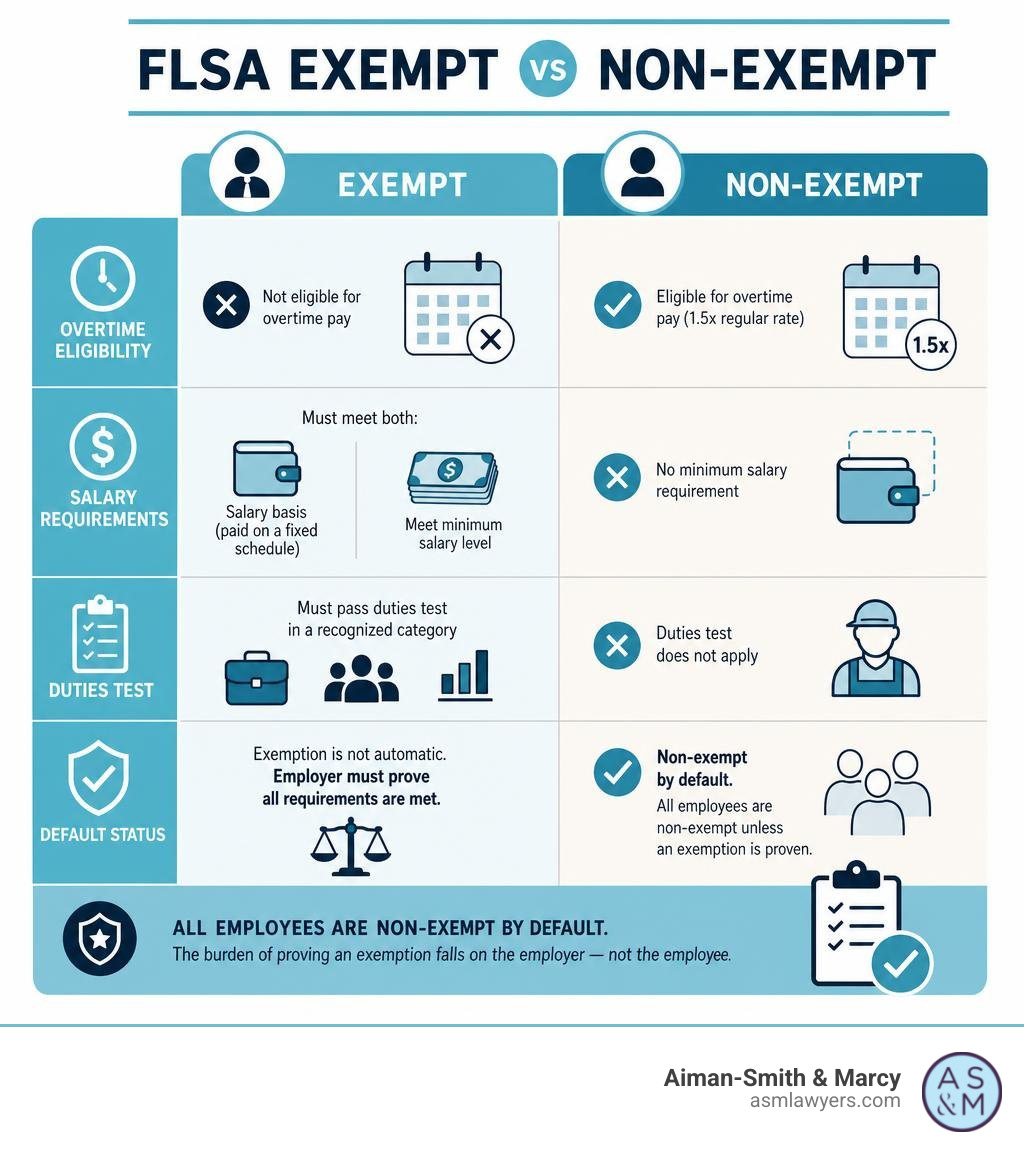
- Non-exempt employees are covered by the Fair Labor Standards Act (FLSA). They must receive at least the federal minimum wage and overtime pay (1.5x their regular rate) for every hour worked over 40 in a workweek.
- Exempt employees meet specific salary and duties tests that place them outside those protections. They receive no federally mandated overtime, no matter how many hours they work.
- All employees are non-exempt by default. The burden of proving an exemption falls entirely on the employer — not the worker.
- Your job title means nothing. What matters is your actual duties and your pay structure.
Here is the part that surprises most people: being paid a salary does not make you exempt. An employer must prove three things — salary basis, salary level, and specific job duties — before any exemption applies. Miss even one, and the worker is legally entitled to overtime.
This matters enormously. A misclassified worker could be owed years of unpaid overtime, plus an equal amount in liquidated damages, plus attorney’s fees. The stakes are real.
This guide walks through everything workers need to know about FLSA exempt vs non exempt classifications — from the three-part exemption test to the specific duties categories to what happens when an employer gets it wrong.
Understanding FLSA Exempt vs Non Exempt Classifications

At the heart of federal labor standards is a simple goal: ensuring that workers are paid fairly for their time. The Fair Labor Standards Act (FLSA), originally passed in 1938, sets the baseline rules for the American workplace. It establishes a federal minimum wage (which has been set at $7.25 per hour since July 24, 2009) and mandates overtime pay for hours worked beyond the standard 40-hour workweek.
However, the law does not treat every worker the same way. The FLSA divides the workforce into two broad categories: those who are covered by these protective wage-and-hour rules (non-exempt) and those who are excluded from them (exempt). To understand where you stand, it is helpful to consult official resources like the Handy Reference Guide to the Fair Labor Standards Act | U.S. Department of Labor .
The Core Differences: FLSA Exempt vs Non Exempt
The primary operational difference between these two classifications comes down to overtime eligibility and how hours are tracked.
For non-exempt employees, every minute of work counts. If a non-exempt employee works more than 40 hours in a single, fixed 168-hour workweek, they are legally entitled to overtime pay. This overtime rate must be at least one and one-half (1.5) times their “regular rate of pay.” Tracking hours is a strict legal requirement for employers of non-exempt workers; they must keep detailed records of daily and weekly hours to ensure exact payroll compliance.
Exempt employees, on the other hand, are paid to get a job done, regardless of how many hours it takes. Whether they work 35 hours or 65 hours in a week, their pay remains exactly the same. Employers do not have to track their hours for overtime purposes, and they are not entitled to overtime pay under federal law.
Because exemptions strip away vital workplace protections, the law defines them very narrowly. For a detailed breakdown of how these classifications play out in our home state, you can read our comprehensive guide on Exempt vs. Non-Exempt Classification of Workers in California.
| Feature | Exempt Employees | Non-Exempt Employees |
|---|---|---|
| Overtime Pay | Not eligible under federal law | Mandated 1.5x regular rate after 40 hours/week |
| Primary Pay Method | Salary or fee basis | Hourly, salary, commission, or piece-rate |
| Time Tracking | Generally not required by law | Strictly required by law |
| Default Status | None (must be proven by employer) | Yes (all workers are non-exempt by default) |
Common Misconceptions in FLSA Exempt vs Non Exempt Status
In our years of practicing employment law at Aiman-Smith & Marcy, we have seen employers make the same classification mistakes over and over. These errors usually stem from deeply ingrained workplace myths.
First, your job title does not determine your status. An employer cannot simply hand you a business card that says “Manager,” “Administrator,” or “Executive Assistant” and automatically stop paying you overtime. The Department of Labor (DOL) and the courts look entirely at your actual daily job duties, not the label on your email signature.
Second, being salaried does not automatically make you exempt. Many workers believe that transitioning from an hourly wage to a fixed salary means they have lost their right to overtime. This is flatly incorrect. A salaried employee who does not meet the strict duties tests is classified as a “salaried non-exempt” employee and is still legally entitled to overtime. If you have ever wondered about your own status, we encourage you to read our analysis: Are You Exempt, Really?.
Finally, you cannot agree to waive your overtime rights. An employee cannot sign a contract, handbook acknowledgment, or mutual agreement to be classified as exempt if they do not legally qualify. Overtime protections are non-negotiable public rights. Even if you happily agreed to a flat salary with no overtime, your employer is still violating the law if your actual job duties do not meet the federal exemption criteria.
The Three-Pronged Exemption Test
To legally classify an employee as exempt under the “white-collar” exemptions, an employer must prove that the position satisfies three distinct legal tests. If the job fails even one of these prongs, the employee is non-exempt. For small businesses trying to navigate these rules, the federal government provides a Small Entity Compliance Guide to prevent common mistakes.

The Salary Basis Test
The first prong is the salary basis test. This test requires that the employee be paid a predetermined, fixed salary that does not fluctuate based on the quality or quantity of the work performed.
Under this rule, an exempt employee must receive their full salary for any week in which they perform any work, regardless of the number of hours. If an employer makes improper deductions from an exempt worker’s pay—such as docking their salary for a half-day absence because of a slow business day—the salary basis test is violated.
There are very few permissible deductions, such as full-day absences for personal reasons or sickness (if covered under a bona fide sick leave plan). If an employer violates these rules, they risk destroying the exemption entirely. To understand your protections against unfair pay deductions, see our guide on What Your Employer Can’t Do If You Are Exempt (Part 1).
The Salary Level Test and the 2026 Landscape
The second prong is the salary level test, which establishes a minimum earnings threshold that an employee must meet to be considered exempt.
The legal landscape surrounding this threshold has seen significant courtroom battles recently. As of July 2026, the federal salary threshold for executive, administrative, and professional (EAP) exemptions stands at $684 per week (which translates to $35,568 annually).
You might recall that the Department of Labor issued a rule in 2024 that attempted to raise this federal threshold significantly (to $1,128 per week by January 2025). However, on November 15, 2024, the U.S. District Court for the Eastern District of Texas officially vacated that 2024 rule. As a result of this judicial decision, the federal threshold reverted to the 2019 level of $684 per week, where it remains today in 2026. For a deeper dive into this federal regulatory timeline, you can review the Exempt vs Non-Exempt Employees 2026: FLSA Classification Guide – Exempt vs Non Exempt Employees 2026 .
The Duties Test
The third and most complex prong is the duties test. Meeting the salary threshold is only the gatekeeper; the employee’s actual job duties must align with the specific legal definitions of an exempt role.
To pass the duties test, the employee’s “primary duty” must consist of exempt work. The DOL defines “primary duty” as the principal, most important, or most significant duty that the employee performs for the organization. While the amount of time spent on exempt tasks is an important factor, it is not the only measure under federal law. A shift supervisor who spends 70% of their time performing manual labor can still pass the executive duties test if their most important responsibility is managing the store and directing other employees during their shift.
Specific White-Collar Exemption Duties Tests

The FLSA outlines several specific categories of white-collar exemptions. Each has its own rigorous duties test. The Department of Labor provides detailed breakdowns of these categories in Fact Sheet #17A: Exemption for Executive, Administrative, Professional, Computer & Outside Sales Employees Under the Fair Labor Standards Act (FLSA) | U.S. Department of Labor .
Executive and Administrative Exemptions
The Executive Exemption is designed for true managers. To qualify, an employee must meet all of the following:
- Their primary duty must be managing the enterprise or a recognized department/subdivision.
- They must customarily and regularly direct the work of at least two or more full-time employees (or their equivalent in part-time workers).
- They must have the authority to hire or fire employees, or their recommendations regarding hiring, firing, advancement, or promotion must be given particular weight.
The Administrative Exemption is perhaps the most frequently abused classification. To qualify, an employee’s primary duty must consist of:
- Performing office or non-manual work directly related to the management or general business operations of the employer or the employer’s customers.
- Exercising “discretion and independent judgment” on matters of significance.
This second point is crucial. An administrative assistant who performs routine clerical work, files paperwork, or enters data is not exercising independent judgment on matters of significance. They are following established procedures. In contrast, a benefits administrator who negotiates insurance contracts or designs company policies is likely exercising true discretion.
Professional, Computer, and Outside Sales Exemptions
The Professional Exemption is split into two categories:
- Learned Professionals: Positions requiring advanced knowledge in a field of science or learning customarily acquired by a prolonged course of specialized intellectual instruction (e.g., doctors, lawyers, registered nurses, CPAs, and architects).
- Creative Professionals: Positions requiring work that is original and creative in a recognized field of artistic endeavor (e.g., actors, musicians, novelists, and graphic designers).
The Computer Employee Exemption applies to highly skilled computer systems analysts, programmers, software engineers, or similarly skilled workers. Under federal law, they must earn at least the standard salary or be paid an hourly rate of not less than $27.63 per hour. That hourly figure is only the federal baseline: state law may require much higher pay before an employer can deny overtime protection. For example, California requires $58.85 per hour, and Washington requires $59.96 per hour, so computer employees who satisfy the federal rate may still be non-exempt and owed overtime under stricter state rules. Their primary duties must involve systems analysis, software design, or program modification. Routine IT help desk support or hardware repair does not qualify.
The Outside Sales Exemption is unique because it has no minimum salary requirement. To qualify, the employee’s primary duty must be making sales or obtaining orders, and they must customarily and regularly work away from the employer’s place of business. Inside sales representatives who make cold calls from an office or home desk do not qualify.
Highly Compensated Employees (HCE)
The FLSA provides a streamlined, relaxed duties test for Highly Compensated Employees (HCE). Under federal rules, an employee who performs office or non-manual work and receives total annual compensation of $107,432 or more is exempt if they customarily and regularly perform at least one of the exempt duties of an executive, administrative, or professional employee.
Non-Exempt by Default: Excluded Workers and Salaried Non-Exempts
It is a common misconception that anyone who earns a high wage can be classified as exempt. In reality, the law explicitly protects certain categories of workers from ever being classified as exempt, regardless of their compensation. For HR professionals aiming to avoid these structural pitfalls, the FLSA Exempt vs Non-Exempt Classification: A Decision Guide for HR Managers in 2026 – Coggno serves as an excellent resource.
Categorically Non-Exempt Workers
The white-collar exemptions do not apply to manual laborers or “blue-collar” workers. These are employees who perform physical work involving repetitive operations with their hands, physical skill, and physical energy. This category includes:
- Carpenters, electricians, plumbers, and mechanics.
- Construction workers and manual laborers.
- Factory assembly-line workers.
No matter how highly paid a master electrician or specialized mechanic might be, they are always non-exempt under the FLSA and must be paid overtime.
Additionally, first responders are categorically non-exempt. This includes police officers, detectives, firefighters, paramedics, emergency medical technicians (EMTs), and hazardous materials workers. Regardless of their rank or salary, these public safety officers are entitled to overtime protections because their primary duty is to prevent, control, or extinguish fires, or to investigate and handle crimes.
The Salaried Non-Exempt Classification
Another critical category is the salaried non-exempt worker. This classification is a perfectly legal arrangement where an employee receives a fixed weekly salary but is still entitled to overtime pay if they work more than 40 hours.
Employers often utilize this structure for administrative staff who work predictable hours but occasionally need to stay late. In these cases, the employer must still track every hour worked. If the employee exceeds 40 hours in a week, the employer must calculate their regular hourly rate for that week and pay them 1.5 times that rate for the overtime hours.
The validity of choosing not to apply exemptions was reinforced recently. On January 5, 2026, the Department of Labor issued Opinion Letter FLSA2026-1, which clarified that employers are never legally required to classify an eligible employee as exempt. An employer can choose, as a matter of business judgment, to classify an otherwise exempt manager as non-exempt and pay them overtime.
The High Stakes of Misclassification and State Law Interplay
When an employer misclassifies a worker as exempt, they are not just making a technical paperwork error—they are committing a serious wage-and-hour violation. If you suspect your employer has misclassified your position, you can read more about the legal distinctions in our article on Exempt Employee Misclassification.
Consequences and Penalties of Misclassification
The financial consequences of misclassification can be devastating for a business. A worker who has been improperly classified as exempt can sue to recover:
- Unpaid Overtime Back Wages: Going back two years, or three years if the violation is proven to be “willful.”
- Liquidated Damages: An additional amount equal to the back wages (effectively doubling the recovery as a penalty).
- Attorney’s Fees and Court Costs: The employer must pay the employee’s legal fees if the employee wins.
- Civil Monetary Penalties: Assessed by the DOL for repeated or willful violations.
For a deeper look into compliance and the legal remedies available to workers, see our guide on Misclassification and Overtime Pay Compliance with the Fair Labor Standards Act (FLSA).
Federal FLSA vs. Stricter State Laws
This is where things get particularly interesting for workers in our home state of California. Under the FLSA, when federal and state laws conflict, employers must comply with the standard that is most protective of the employee.
California has some of the strictest wage-and-hour laws in the country, which completely overshadow federal baselines:
- The Salary Threshold: Unlike the federal threshold of $35,568, California requires exempt employees to earn a minimum salary equal to at least twice the state minimum wage for full-time employment. In 2026, California’s weekly salary threshold is $1,352.00 (an annual salary of $70,304.00).
- The Quantitative Duties Test: While federal law uses a flexible “primary duty” test, California uses a strict quantitative test. An employee must spend more than 50% of their work time actually performing exempt tasks to qualify for an exemption.
- Daily Overtime: Federal law only requires overtime after 40 hours in a week. California requires overtime (1.5x) after 8 hours of work in a single day, and double time (2.0x) after 12 hours in a day.
- No HCE Exemption: California does not recognize the federal Highly Compensated Employee exemption. A worker earning $150,000 in California must still meet the strict 50% duties test to be exempt.
Recordkeeping and Defending Classification Decisions
Under FLSA recordkeeping regulations (29 CFR 516), employers are required to maintain accurate records of hours worked and wages paid. If an employee challenges their exempt status, the burden of proof is entirely on the employer to defend their classification decision.
To build a defensible compliance file, employers should maintain:
- Detailed, accurate job descriptions that reflect actual daily activities.
- A dated “duties-test memo” analyzing how the role meets each prong of the exemption.
- Flawless payroll records demonstrating compliance with the salary basis and level tests.
- A clear, written policy prohibiting improper pay deductions, complete with a complaint procedure, to preserve the “safe harbor” rule under federal law.
Frequently Asked Questions about FLSA Classifications
Can an employer choose to classify an exempt employee as non-exempt?
Yes. As confirmed by the Department of Labor in Opinion Letter FLSA2026-1, the FLSA only prohibits misclassifying non-exempt employees as exempt. Employers are free to use their business judgment to classify any worker as non-exempt, track their hours, and pay them overtime, even if they meet all the criteria for an exemption.
Does paying an employee a salary automatically make them exempt?
Absolutely not. A salary is simply a method of payment. To be exempt, the employee must also meet the minimum salary level threshold ($684/week federally; $1,352/week in California) and their actual job duties must satisfy the specific executive, administrative, or professional duties tests.
What happens if an employer makes improper deductions from an exempt employee’s salary?
If an employer makes unauthorized deductions from an exempt employee’s salary (such as docking pay for partial-day absences due to lack of work), the salary basis test is destroyed. This converts the employee to non-exempt status for the period of the deduction, making the employer liable for unpaid overtime. If a pattern of improper deductions is found, the exemption may be lost for the entire job classification.
Conclusion
Navigating the complexities of flsa exempt vs non exempt classifications can be daunting, but understanding your rights is the first step toward ensuring you are paid fairly for every hour of your labor.
At Aiman-Smith & Marcy, we are an Oakland-based boutique law firm specializing in employment law. Our collaborative team of attorneys has worked together for more than 25 years, representing workers in workplace discrimination, unpaid wage disputes, and class action lawsuits throughout California. If you believe your employer has misclassified your position, denied you overtime pay, or made illegal deductions from your salary, we are here to help.
To learn more about how California’s strict laws protect your wages, explore our detailed guide on Exempt vs. Non-Exempt Classification of Workers in California or contact us today to discuss your situation.


