

California State Law for Sick Time: The Basics
Under the California state law for sick time, most employees who work at least 30 days for the same employer within a year can earn paid sick leave. This includes full-time, part-time, temporary, seasonal, and many staffing-agency workers.
Since January 1, 2024, eligible workers must receive at least 40 hours or five days of paid sick leave each year, whichever is greater. Employees generally begin accruing leave when they start work, but an employer may require them to wait until their 90th calendar day of employment before using it.
Paid sick leave can cover more than a worker’s own illness. It may be used for preventive care, a family member’s medical needs, and certain situations involving domestic violence, sexual assault, stalking, or other qualifying acts of violence. Employers also cannot punish, fire, or retaliate against workers for properly using protected sick leave.
Local rules can provide even more protection. For example, Oakland, San Francisco, and Los Angeles have local sick-leave ordinances that may require employers to offer more time than the statewide minimum.
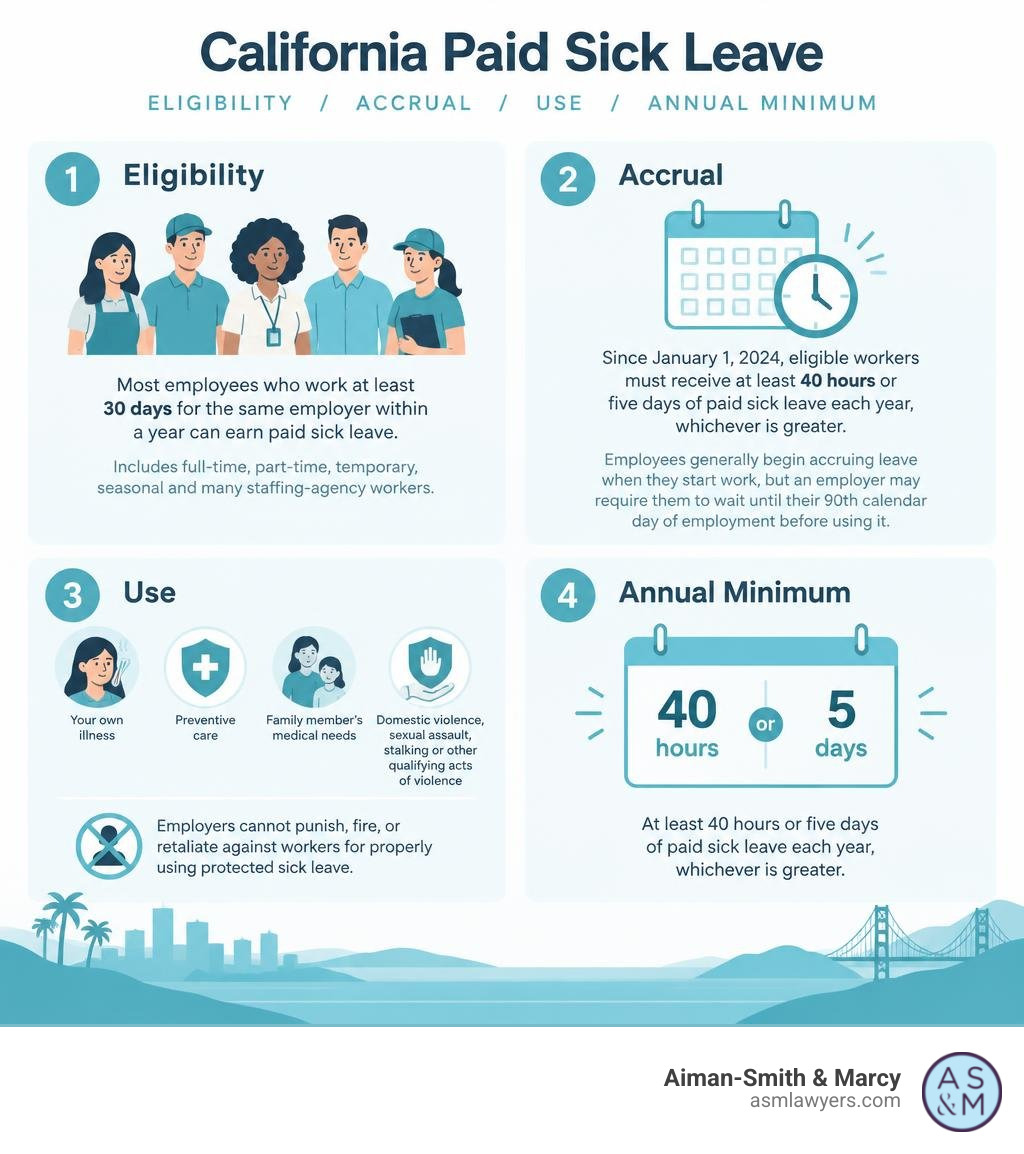
California state law for sick time vocab explained:
Core Requirements of California State Law for Sick Time
The foundation of California’s sick leave framework is built on ensuring that taking time off to care for your health does not jeopardize your paycheck. Governed by the Healthy Workplaces, Healthy Families Act of 2014 and codified under California Code, LAB 246., this statute guarantees baseline leave to nearly all workers in the Golden State.
Understanding how workers qualify for statutory leave comes down to two primary timeline milestones:
- The 30-Day Qualification Rule: An employee must perform at least 30 days of work in California for the same employer within a 12-month period. These 30 days do not need to be consecutive.
- The 90-Day Waiting Period: While accrual begins on your very first day of employment, an employer may legally require you to complete a 90-calendar-day employment period before you are permitted to use your accrued paid sick days.
This law provides universal coverage across private and public sectors, encompassing full-time, part-time, seasonal, and temporary employees. Only a few narrow categories are exempt from the statute:
- Certain employees covered by valid collective bargaining agreements (CBAs) that expressly provide equivalent paid leave, premium wage rates, and final binding arbitration.
- Construction industry workers covered by specific collective bargaining agreements.
- Certain airline flight deck or cabin crew members, provided they receive compensated time off equivalent to state minimums.
- Public sector retired annuitants.
If you do not fit into one of these strict exemptions, your employer is legally mandated to provide paid sick time.
Accrual vs. Up-Front Frontloading Methods Under California State Law for Sick Time
Employers are allowed flexibility in how they allocate paid sick leave, provided they meet or exceed statutory floors. Employers typically choose between the standard accrual method and the frontloading (up-front) method.
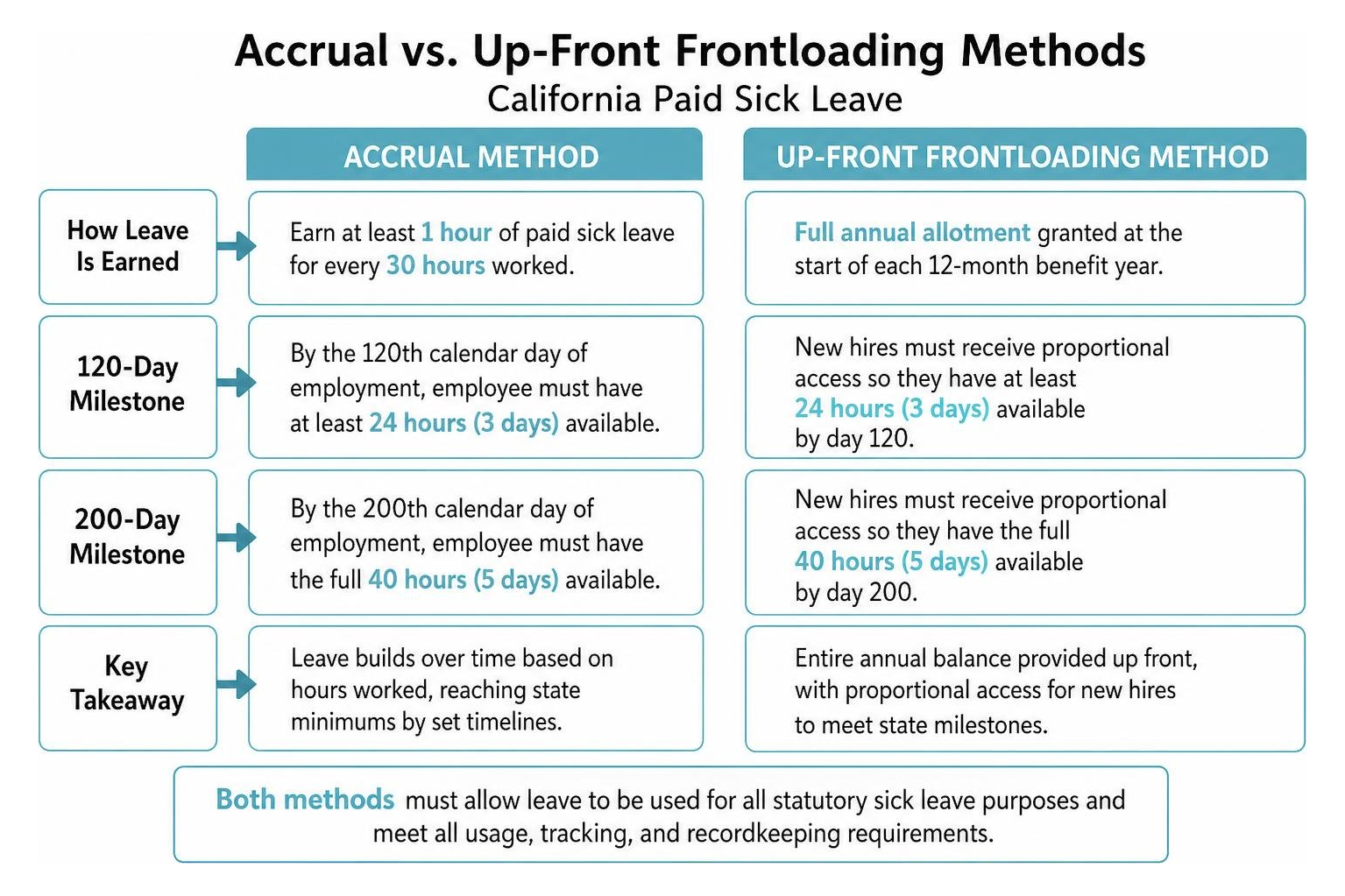
Under the statutory hourly accrual method, employees must earn at least one hour of paid sick leave for every 30 hours worked. Alternatively, employers may use a regular accrual system that operates on a different schedule, as long as the accrual is regular and guarantees the worker has at least 24 hours (or 3 days) of available sick leave by their 120th calendar day of employment, and the full 40 hours (or 5 days) by their 200th calendar day.
Under the up-front frontloading method, the employer bypasses hour-by-hour tracking by granting the entire annual allotment—at least 40 hours or five days, whichever is greater—at the start of each 12-month benefit year. For new hires, employers using frontload systems must ensure that workers receive proportional access satisfying the 120-day and 200-day thresholds.
Many companies fulfill their legal obligations by integrating sick leave with broader paid time off policies. A comprehensive PTO plan is fully compliant with state law as long as it allows leave to be taken for all statutory sick leave purposes, provides equal or greater accrual rates, and meets all usage and tracking requirements.
| Feature | Up-Front Frontloading Method | Hourly Accrual Method (1:30) |
|---|---|---|
| Initial Availability | Full 40 hours / 5 days granted at start of benefit year | Earned incrementally (1 hour per 30 hours worked) |
| Year-End Rollover | Not required if full amount is frontloaded annually | Unused hours must roll over to the next year |
| Annual Usage Limit | At least 40 hours or 5 days per year | At least 40 hours or 5 days per year |
| Accrual Cap | N/A (allotted in advance) | Employer may cap total accrual at 80 hours / 10 days |
| Administrative Tracking | Simpler; no pay-period accrual math | Requires tracking hours worked and earned time |
Annual Usage, Caps, and Carryover Provisions Under California State Law for Sick Time
While workers under an accrual model continue to earn leave as they log hours, employers are permitted to place reasonable caps on usage and bank balances:
- Annual Usage Limit: An employer may restrict an employee’s paid sick leave usage to 40 hours or five days per 12-month period, whichever is greater. For an employee working 10-hour shifts, five days equals 50 hours; the employer must permit 50 hours of use. For an employee working 6-hour shifts, five days equals 30 hours, but the employee remains entitled to use up to the full 40-hour minimum.
- Accrual Caps: If an employer uses the accrual system, unused hours must roll over from year to year. However, the law allows employers to impose an overall accrual cap of no less than 80 hours or 10 days.
- Minimum Use Increments: An employer can establish a reasonable minimum increment for taking sick leave, but state law limits this increment to no more than two hours. An employer cannot force a worker to take an entire eight-hour day off for a 45-minute dental checkup.
To explore how these carryover boundaries function across multi-year employment, review the rules governing annual rollover and caps, or consult the official California Department of Industrial Relations sick leave guidelines.
Qualifying Reasons for Taking Paid Sick Leave
Paid sick leave is designed to be versatile. Under California law, paid sick time is not limited to sudden bouts of illness. Under Labor Code § 246.5 protections, workers may utilize their accrued sick leave for:
- Diagnosis, Care, or Treatment: Managing an existing health condition, illness, or injury for yourself.
- Preventive Care: Routine checkups, dental cleanings, vision exams, vaccinations, and diagnostic screenings.
- Caring for Family Members: Attending to the health needs, treatment, or preventive appointments of covered relatives.
- Qualifying Acts of Violence: Seeking medical attention, psychological counseling, safety planning, legal assistance, or relocation assistance if you or your family member are victims of domestic violence, sexual assault, stalking, or other qualifying acts of violence.
- Agricultural Worker Protections: Agricultural workers may use paid sick time during state or locally declared emergency conditions involving severe heat, wildfire smoke, or flooding.
California defines “family member” expansively:
- Children (biological, adopted, stepchild, foster child, or legal ward)
- Parents (biological, adoptive, stepparent, or legal guardian)
- Spouses and registered domestic partners
- Grandparents and grandchildren
- Siblings
- A “designated person” chosen by the employee at the time leave is requested (employers may limit an employee to one designated person per 12-month period)
When unforeseen medical emergencies strike, knowing how the law shields your job is critical; see our guide on handling urgent absences and emergency leave.
How Sick Pay Is Calculated and Administered
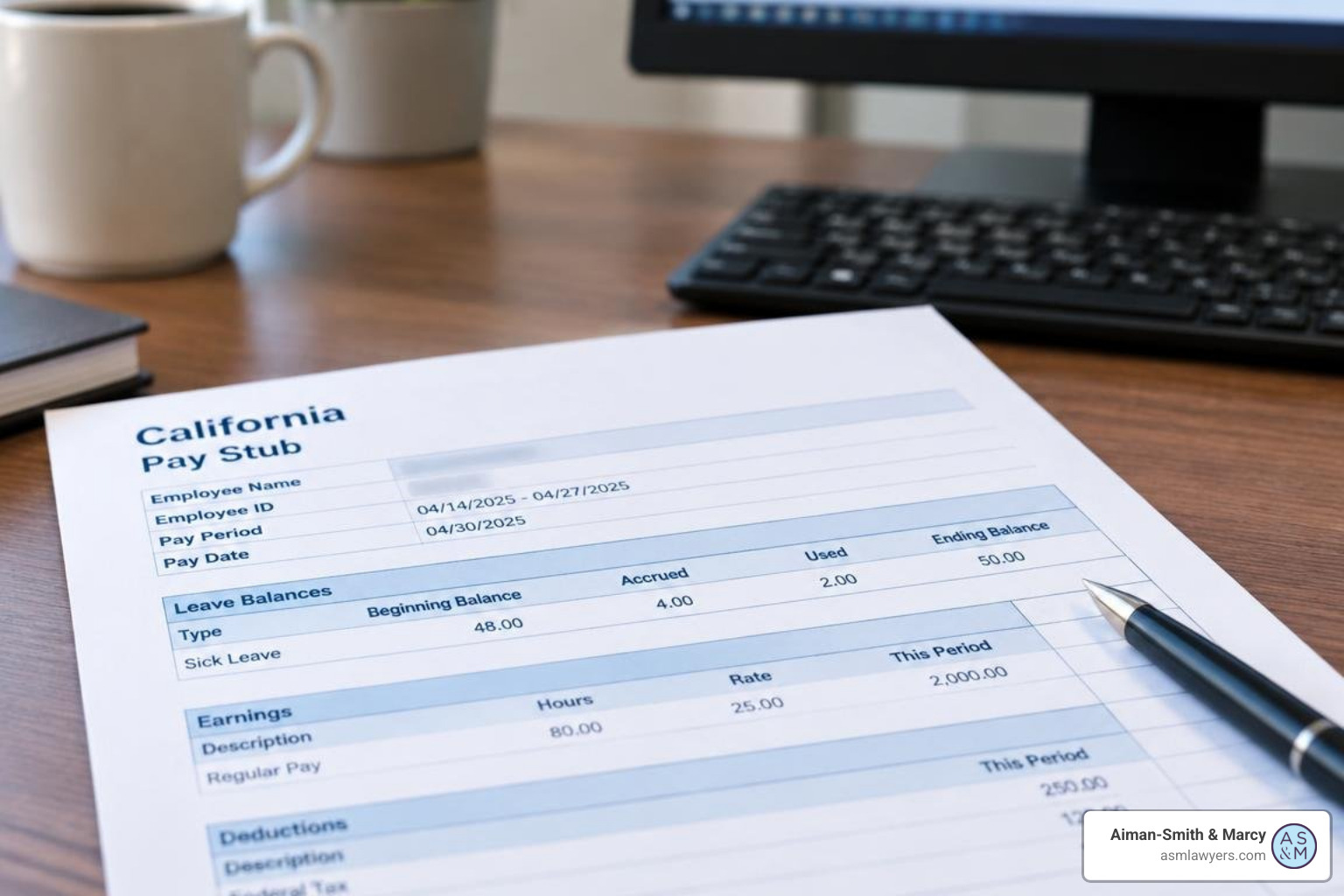
When you take a paid sick day, you must be paid accurately and on time. Sick pay must be distributed no later than the payday for the next regular payroll period after the leave was taken.
For non-exempt (hourly) workers, employers must calculate sick leave pay using one of two statutory methods:
- The Regular Rate Method: Calculating the employee’s regular, non-overtime rate of pay for the workweek in which the sick leave was taken.
- The 90-Day Lookback Method: Dividing total wages (excluding overtime premiums) by total non-overtime hours worked across full pay periods in the prior 90 days of employment.
For exempt (salaried) employees, sick leave is paid out in the same manner as regular base wages. In California, an exempt employee must earn a fixed salary equal to at least twice the state minimum wage for full-time work. With the California minimum wage set at $16.90 per hour in 2026, the minimum salary threshold for an overtime-exempt executive, administrative, or professional employee is $1,352 per week, which equals $70,304 annually. When evaluating specialized roles such as computer professionals, the $27.63 hourly figure found in federal materials reflects only a federal baseline; California law imposes significantly higher compensation standards to maintain exempt status.
Wage Statement and Recordkeeping Obligations
Transparency is mandatory under California law. Employers must comply with strict administrative rules regarding statewide time-off compliance rules:
- Paystub Itemization: On every wage statement (or in a separate written document provided on payday), the employer must display the amount of paid sick leave available to the worker. If the employer offers unlimited PTO, they may indicate “unlimited” on the paystub.
- Three-Year Record Retention: Employers must retain detailed records documenting hours worked, sick leave accrued, and sick leave used for a minimum of three years. If an employer fails to keep proper records, state regulators presume the employee is entitled to the maximum allowable leave hours under the law.
Employee Rights, Retaliation Protections, and Local City Ordinances
California offers some of the strongest worker protections in the country, ensuring that employees can exercise their statutory rights without fear of professional backlash:
- No Replacement Search: An employer cannot require an employee to find a cover worker or replacement as a condition for taking paid sick days.
- Strict Anti-Retaliation Shield: Employers are strictly prohibited from discharging, threatening to discharge, demoting, suspending, reducing hours, or discriminating in any manner against an employee for using accrued sick days or filing a complaint with state regulators.
- 30-Day Rebuttable Presumption: If an employer takes adverse action against a worker within 30 days of the worker taking sick leave, requesting sick pay, or opposing unlawful sick leave practices, the law creates a rebuttable presumption of unlawful retaliation under Labor Code § 246.5.
- Rehire Reinstatement Rule: If an employee separates from an employer and is rehired within 12 months, the employer must immediately restore all previously accrued, unused paid sick leave balances, unless the leave was cashed out upon initial termination.
Local City Ordinances: Additional Rights for Urban Workers
While the state standard is 40 hours or five days, California law explicitly permits municipal governments to establish more generous sick leave ordinances. Where local laws provide greater benefits, employers operating within those jurisdictions must comply with the higher local standards:
- Oakland: Governed by the Oakland Workplace and Employment Standards, employers with 10 or more workers must provide up to 72 hours of accrued paid sick leave. Businesses with fewer than 10 employees must provide at least 40 hours.
- San Francisco: Employers with 10 or more workers must provide up to 72 hours of paid sick leave, while smaller employers must provide up to 40 hours.
- Los Angeles: Employers with 26 or more employees must provide up to 48 hours of annual paid sick leave.
To learn how state and local protections combine to shield your career, review our guide on enforcing workplace protections across California.
Frequently Asked Questions About California Sick Leave
Can an employer require a doctor’s note for taking a single sick day?
Generally, no. Under California law, an employer cannot deny sick leave or discipline an employee simply because they do not provide a doctor’s certification for a short, routine absence. An employer may only request medical verification in limited circumstances where there is a clear, reasonable suspicion of abuse (such as taking sick days immediately after a vacation request was denied) or for extended absences governed by separate statutes like the California Family Rights Act (CFRA).
What happens to unused sick leave upon termination or resignation?
Standalone paid sick leave is not considered vested wages under California law, meaning employers are not required to pay out accrued, unused sick leave upon termination, resignation, or layoff. However, if your employer combines sick leave and vacation into a consolidated “Paid Time Off” (PTO) bucket, all accrued, unused PTO hours are considered earned wages and must be paid out in full on your final paycheck. Furthermore, if you return to the same employer within 12 months, any unpaid accrued sick balance must be reinstated.
How does California state law apply to part-time, temporary, and staffing agency employees?
California’s sick leave protections apply equally to part-time, seasonal, and temporary employees, provided they meet the basic 30-day work threshold within a year. Temporary workers placed through staffing agencies are fully covered, and both the staffing agency and the host employer share joint responsibility for ensuring compliance. When evaluating temporary assignments, keep in mind that neither federal nor California law imposes a blanket statutory cap on how long a private employer can keep an individual classified as temporary, but temporary status never excuses an employer from providing statutory paid sick leave.
Conclusion
Every worker in California deserves the right to recover from an illness, care for a sick child, or attend a doctor’s appointment without worrying about lost wages or workplace discipline. California state law guarantees at least 40 hours or five days of paid sick leave annually, protects workers from retaliation, and ensures that unused balances are preserved when changing roles within the same organization.
Make sure to monitor your pay stubs regularly to confirm your accrued hours are accurately recorded. If your employer refuses to honor your accrued time, fails to pay your correct rate, demands that you find a replacement worker, or retaliates against you for taking time off, you have actionable rights under California law.
At Aiman-Smith & Marcy, we represent workers in individual disputes, PAGA actions, and employee class actions across California. Our plaintiff-side employment attorneys collaborate to hold employers accountable for wage theft and labor law violations. If you believe your rights have been violated, schedule a free consultation regarding your paid sick leave rights today.
Legal Disclaimer This article is for general informational purposes only and does not constitute legal advice. Reading this article or contacting ASM Lawyers does not create an attorney-client relationship. Laws change over time and every situation is different. For advice about your specific circumstances, consult a licensed California attorney. Talk to ASM Lawyers Have questions about how California law applies to your situation? The team at ASM Lawyers offers consultations to help you understand your rights and options. Visit our Contact page to speak with an attorney about your case. Attorney Advertising.