
Why the FLSA Exempt vs Nonexempt Chart Matters for Your Paycheck
The FLSA exempt vs nonexempt chart below gives you a fast-reference snapshot of who qualifies for overtime protections under federal law — and who does not.
| Category | Exempt or Nonexempt? | Entitled to Overtime? |
|---|---|---|
| Earns under $684/week | Nonexempt | Yes |
| Executive (meets all tests) | Exempt | No |
| Administrative (meets all tests) | Exempt | No |
| Professional (meets all tests) | Exempt | No |
| Computer employee ($27.63+/hr or salaried) | Exempt | No |
| Outside sales (works away from office) | Exempt | No |
| Highly compensated ($107,432+/year) | Exempt | No |
| Blue-collar worker (any salary) | Nonexempt | Yes |
| Police, firefighters, paramedics | Nonexempt | Yes |
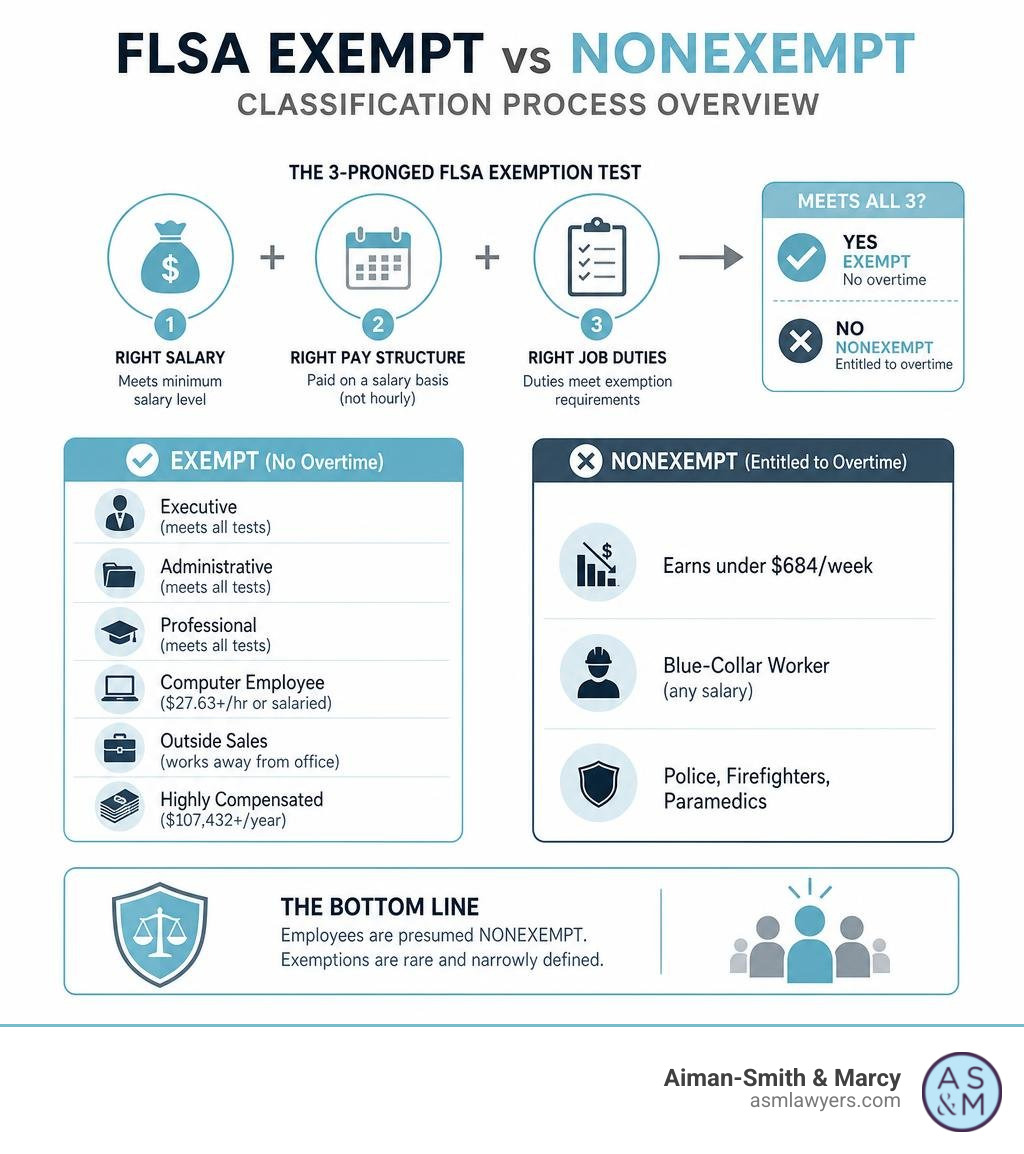
The short answer: An employee is nonexempt — and must be paid overtime — unless their employer can prove they meet all three parts of the FLSA exemption test: the right salary level, the right pay structure, and the right job duties.
Salary alone does not make someone exempt. Neither does a job title.
Misclassifying a nonexempt worker as exempt is one of the most common — and costly — wage violations employers commit. If you’ve been denied overtime pay you may have earned, this guide can help you understand why.
In this article, we’ll walk you through exactly how these classification rules work so you can spot a problem when you see one.
Understanding the Three-Pronged FLSA Exemption Test
To understand how the flsa exempt vs nonexempt chart functions, we have to look at the legal engine under the hood. Under the Fair Labor Standards Act (FLSA), all employees are legally presumed to be nonexempt by default. This means that unless an employer can actively prove an employee meets a specific legal exemption, that worker is entitled to a minimum wage and overtime pay (time-and-a-half) for all hours worked over 40 in a single workweek.
To successfully classify an employee as exempt, an employer must satisfy all three prongs of the standard FLSA exemption test. If even one prong is missed, the exemption collapses, and the employee is legally nonexempt. You can read more about how these tests apply in our comprehensive Exempt vs Non-Exempt Employees 2026: FLSA Classification Guide.
The three prongs are:
- The Salary Level Test: The employee must earn a minimum specified amount of compensation.
- The Salary Basis Test: The employee must be paid a predetermined, fixed salary that cannot be reduced based on the quality or quantity of work performed.
- The Job Duties Test: The employee’s actual day-to-day job responsibilities must match the strict criteria defined by the Department of Labor (DOL) for one of the “white-collar” exemptions.
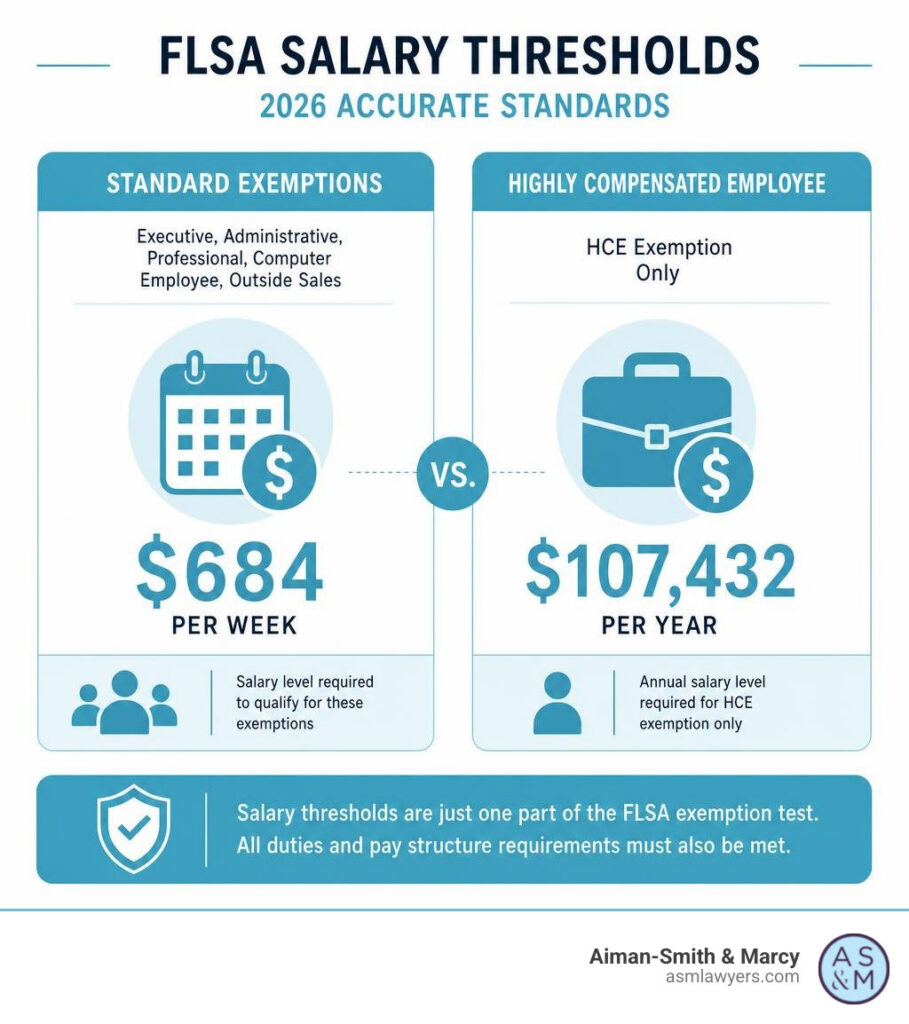
The legal landscape surrounding these tests has seen major shifts. In 2024, the DOL issued a final rule intended to raise the minimum salary thresholds significantly. However, on November 15, 2024, the U.S. District Court for the Eastern District of Texas vacated that final rule nationwide. Because of this court decision, the federal minimum salary threshold reverted to the 2019 level of $684 per week ($35,568 annually) and remains at this level in 2026.
Understanding these shifting regulations is key to ensuring misclassification and overtime pay compliance with the fair labor standards act flsa, particularly because employers often fail to adjust when federal courts intervene.
The Salary Level and Salary Basis Requirements
The first two prongs of the exemption test focus entirely on how you are paid. Under the salary basis requirement, an exempt employee must receive a predetermined salary that does not fluctuate. If your employer docks your pay because business was slow, or because you worked 35 hours instead of 40, they are treating you like an hourly worker. This can instantly destroy the exemption, making you eligible for overtime.
There are strict rules about what an employer can and cannot do to your paycheck. For example, we often represent workers who have faced illegal paycheck deductions. To learn more about your rights, check out our detailed guide on what your employer cant do if you are exempt part 1.
Under federal rules, employers may use nondiscretionary bonuses, incentives, and commissions to satisfy up to 10 percent of the standard salary level. However, this comes with a catch: these payments must be made on an annual or more frequent basis. Under the current federal standard of $684 per week, the employer must pay at least 90 percent ($615.60) as a guaranteed weekly salary, while the remaining 10 percent ($68.40) can be satisfied through these bonuses or commissions.
The Job Duties Test
Even if you are paid a high salary on a fixed basis, you are not exempt unless your day-to-day work meets the job duties test. This is where most employers make critical mistakes. They assume that because they gave you a fancy title like “Operations Manager” or “Administrative Coordinator,” you are automatically exempt.
In the eyes of the law, job titles are completely irrelevant. What matters is the actual work you perform every day. If your written job description says you manage a department, but 90% of your day is spent answering phones, filing paperwork, or greeting customers, the law looks at your actual tasks, not your title.
Many workers do not realize that their employers have mislabeled them simply to avoid paying overtime. If you suspect your title does not match your daily tasks, read our guide on supervisors mislabeling exempt check your duties to see if you might be owed back pay.
The Master FLSA Exempt vs Nonexempt Chart for 2026
To help you visualize how these different exemptions compare under federal law, we have constructed a master flsa exempt vs nonexempt chart for 2026. This chart outlines the basic criteria for the Executive, Administrative, Professional, Computer, and Outside Sales exemptions based on the federal rules currently in effect.
For a deeper dive into these historical and current federal standards, you can review the official Based on Current FLSA (Jan 1 2020) documentation.
| Exemption Category | Minimum Salary Requirement (Federal) | Primary Job Duties Criteria | Key Exclusions & Special Rules |
|---|---|---|---|
| Executive | $684 / week ($35,568 / year) | Managing the enterprise or a department; regularly directing the work of 2+ full-time employees; authority to hire/fire or make highly weighted recommendations. | Does not apply to “shift leads” who spend most of their time performing manual or routine tasks. |
| Administrative | $684 / week ($35,568 / year) | Office or non-manual work directly related to management or general business operations; must exercise “discretion and independent judgment on matters of significance.” | Clerical workers, secretarial staff, and bookkeepers are almost never exempt under this category. |
| Professional (Learned & Creative) | $684 / week ($35,568 / year) | Work requiring advanced knowledge in a field of science or learning acquired through specialized intellectual instruction (or artistic/creative endeavor). | Teachers, doctors, and lawyers are exempt from the salary level tests. LPNs are generally nonexempt. |
| Computer Employee | $684 / week OR at least $27.63 / hour | Systems analysis, software engineering, programming, or program design. | Help desk staff, hardware repair technicians, and CAD drafters are excluded and nonexempt. |
| Outside Sales | None | Primary duty is making sales or obtaining orders/contracts; must regularly work away from the employer’s place of business. | Inside sales representatives (making phone/internet sales from an office or home) are nonexempt. |
If you look at this chart and find yourself questioning whether your job actually fits into these narrow definitions, you are not alone. Ask yourself: are you exempt really? Many employees discover they have been misclassified for years.
Executive and Administrative Exemption Criteria
The Executive Exemption requires that an employee’s primary duty is management. To qualify, you must customarily and regularly direct the work of at least two or more full-time employees (or their equivalent in part-time workers, such as four half-time employees). Furthermore, you must possess real executive authority, meaning you can hire or fire employees, or your recommendations regarding hiring, firing, promotion, or advancement are given “particular weight” by upper management.
The Administrative Exemption is the most frequently abused category. To qualify, your primary duty must be office or non-manual work directly related to the management or general business operations of the employer or the employer’s customers. Crucially, your job must require you to exercise “discretion and independent judgment with respect to matters of significance.”
What does that mean? It means you have the authority to make independent decisions that bind the company financially or operationally, formulate business policies, or negotiate major contracts. If you are simply applying established guidelines, operating software, or performing routine clerical tasks, you do not meet this test.
Professional, Computer, and Outside Sales Exemption Criteria
The Professional Exemption is split into two categories: Learned Professionals and Creative Professionals. Learned Professionals must perform work requiring advanced knowledge that is predominantly intellectual in character. This knowledge must be in a field of science or learning and must be customarily acquired through a prolonged course of specialized intellectual instruction (usually a specialized bachelor’s degree or higher, such as a CPA, engineer, or architect). Creative Professionals must perform work requiring invention, imagination, originality, or talent in a recognized field of artistic or creative endeavor (such as writers, musicians, or actors).
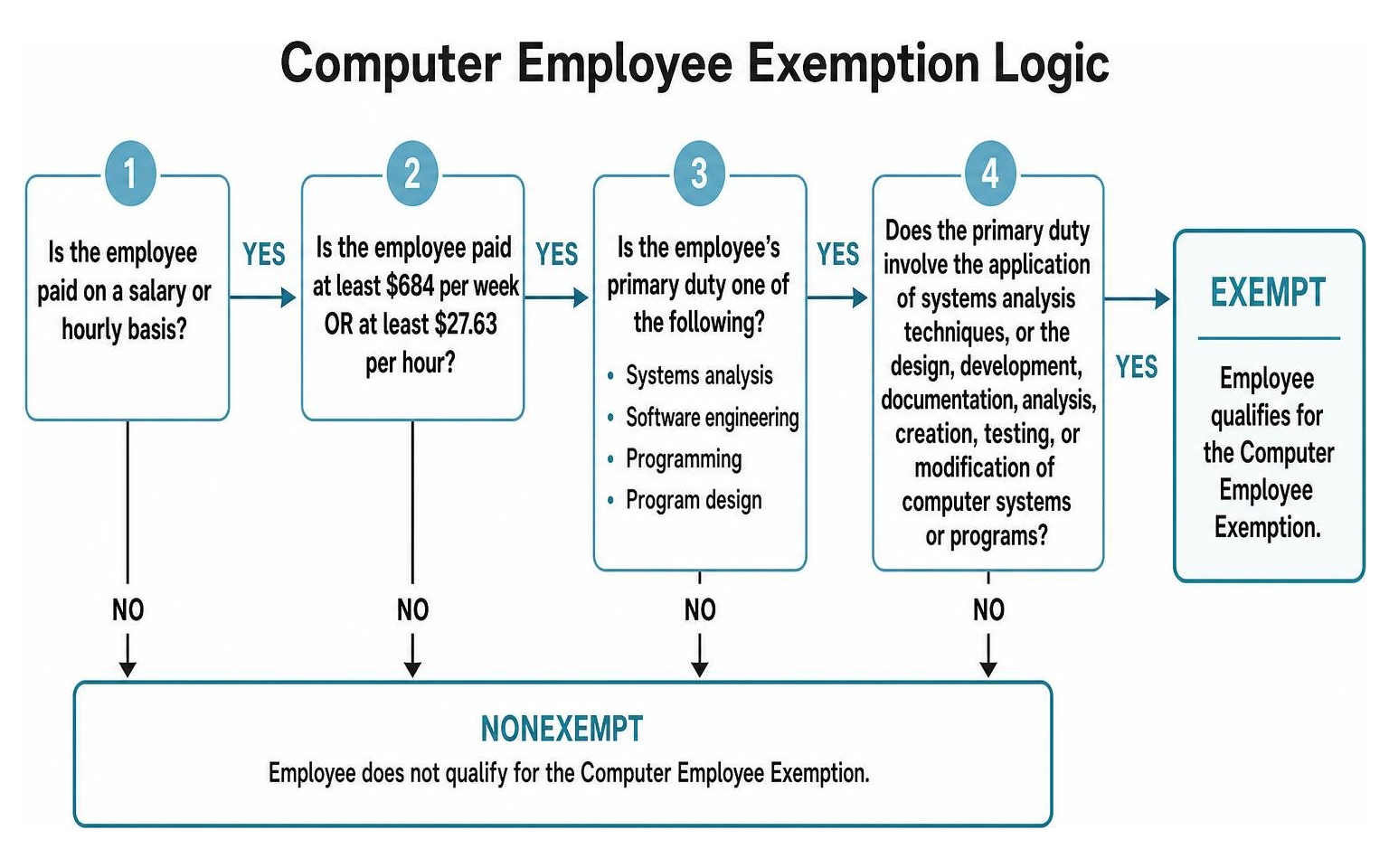
The Computer Employee Exemption has very specific technical requirements. To qualify, an employee must work as a computer systems analyst, programmer, software engineer, or a similarly skilled software professional. Their primary duty must involve the application of systems analysis techniques, or the design, development, documentation, analysis, creation, testing, or modification of computer systems or programs. Under federal law, these employees can be paid a salary of at least $684 per week or an hourly rate of not less than $27.63 per hour.
The Outside Sales Exemption is unique because it has no minimum salary requirement. To qualify, the employee’s primary duty must be making sales or obtaining orders or contracts for services or use of facilities. Additionally, the employee must “customarily and regularly” perform their work away from the employer’s place of business. If you work from home making sales over the phone, you are an inside sales representative and are generally nonexempt and eligible for overtime.
Special Rules: Highly Compensated Employees, Blue-Collar Workers, and State Overlays
The federal FLSA rules set a baseline, but there are several major exceptions and state-level rules that completely change how classifications work. First, there is the Highly Compensated Employee (HCE) exemption. Under federal rules, an employee who performs office or non-manual work and receives total annual compensation of at least $107,432 (which must include at least $684 per week paid on a salary or fee basis) is exempt if they customarily and regularly perform at least one of the exempt duties of an executive, administrative, or professional employee. This is a much simpler duties test than the standard exemptions.
However, if you work in California, the rules are entirely different. California does not recognize the federal Highly Compensated Employee exemption. Additionally, California has much stricter standards and significantly higher salary thresholds.
In California, to qualify for an executive, administrative, or professional exemption, an employee must earn a monthly salary equivalent to no less than two times the state minimum wage for full-time employment. For 2026, California’s minimum wage is $16.90 per hour, which means the minimum salary threshold for exemption is $1,352.00 per week ($70,304.00 annually).
Furthermore, while the federal FLSA uses a qualitative “primary duty” test (meaning your most important duty must be exempt, even if you spend less than 50% of your time on it), California uses a strict quantitative test. Under California law, you must spend more than 50% of your actual work time performing exempt duties to be classified as exempt.
If you are a California worker, you should read our guide on exempt vs non-exempt classification workers california to understand how these strict local rules protect your paycheck.

Why Blue-Collar Workers and First Responders Are Never Exempt
One of the absolute rules of the FLSA is that certain categories of workers can never be classified as exempt, no matter how much money they make.
Blue-collar workers who perform manual labor involving physical skill and energy are always nonexempt. This includes:
- Carpenters, electricians, mechanics, and plumbers
- Construction workers and manual laborers
- Production line workers and craftsmen
No matter how highly paid these manual laborers are, they are entitled to overtime pay under FLSA Part 541 regulations.
Similarly, police officers, detectives, deputy sheriffs, state troopers, firefighters, paramedics, emergency medical technicians (EMTs), and other first responders are never eligible for the white-collar exemptions. The law recognizes that these individuals perform work involving rescue, safety, and law enforcement, rather than administrative or executive business operations. Therefore, their right to overtime is guaranteed by law, regardless of their rank or pay level.
How State Laws and Collective Bargaining Agreements Affect Classifications
When it comes to employment law, the federal FLSA acts as a floor, not a ceiling. States are entirely free to enact laws that are more protective of workers than federal standards. When state and federal laws differ, employers must follow the standard that is most favorable to the employee.
In 2026, several states have salary thresholds that vastly exceed the federal $684 per week standard:
- California: $1,352.00 per week ($70,304.00 annually)
- Washington: $1,541.70 per week ($80,168.40 annually) for all employers, because the 2026 phase-in schedule applies the unified 2.25x state minimum wage multiplier regardless of employer size.
- New York: $1,275.00 per week ($66,300.00 annually) for executive and administrative employees in New York City, Long Island, and Westchester; $1,199.10 per week ($62,353.20 annually) for executive and administrative employees in the rest of New York State. New York’s state salary thresholds apply to executive and administrative exemptions; professional exemptions generally fall back to the federal $684.00 per week ($35,568.00 annually) standard.
Additionally, collective bargaining agreements (CBAs) negotiated by unions often provide even stronger overtime protections. However, it is important to note that a CBA can never waive or reduce an employee’s rights under the FLSA. A union contract can give you more overtime rights, but it can never legally agree to give you less than what federal or state law requires.
Common Misclassification Mistakes and Legal Consequences

Employers frequently misclassify workers due to a mix of administrative laziness, misunderstanding of the law, or a deliberate attempt to cut payroll costs. One of the most common mistakes is believing that paying an employee a salary automatically makes them exempt. This is a massive misconception. As confirmed by the DOL, a “salaried nonexempt” employee is a perfectly valid legal classification. If you are paid a salary but do not meet the duties test, you must still track your hours and receive overtime pay.
Another common mistake involves making improper deductions from an exempt employee’s salary. Under federal rules, docking an exempt employee’s pay for a partial-day absence, or for disciplinary reasons not covered by a written safety policy, destroys the salary basis of that role.
On January 5, 2026, the Department of Labor issued DOL Opinion Letter FLSA2026-1, which provided critical reclassification guidance. The letter confirmed that employers are legally permitted to voluntarily transition otherwise exempt employees to nonexempt status as a business decision. However, once an employee is reclassified as nonexempt, the employer must comply with all time-tracking and overtime requirements.
If you are wondering why companies continue to make these errors, you can explore the underlying motivations in our article on why would an employer misclassify employees.
The Consequences of Misclassifying Employees
The financial and legal consequences of misclassifying workers are severe. When an employer is found to have misclassified a nonexempt employee as exempt, they can be held liable for:
- Back Pay: Unpaid overtime wages going back two years, or three years if the violation is proven to be willful.
- Liquidated Damages: An additional amount equal to the back pay (double damages) as a penalty.
- Civil Monetary Penalties: Fines assessed by the Department of Labor.
- Attorney Fees: The employer must pay the employee’s legal fees if the employee wins the case.
For a detailed breakdown of how these cases are resolved and what you can recover, read our guide on exempt employee misclassification.
How Employers Can Conduct a Self-Audit
To avoid devastating class-action lawsuits and DOL audits, proactive employers conduct regular self-audits. This process involves performing a thorough job analysis for every salaried position, reviewing written workflows, and interviewing employees to verify that their actual daily duties match their exempt classification.
Under federal recordkeeping regulations (29 CFR 516), employers must retain complete payroll records, collective bargaining agreements, and work certificates for at least three years. If an employer discovers a misclassification during an audit and promptly pays the back wages owed, they can often utilize the DOL’s safe harbor rules to avoid willful violation findings and liquidated damages.
For HR professionals looking for a structured audit methodology, you can consult the FLSA Exempt vs Non-Exempt Classification: A Decision Guide for HR Managers in 2026 – Coggno for step-by-step guidance.
Frequently Asked Questions about FLSA Classifications
Navigating wage and hour laws can be incredibly confusing. Below, we have answered some of the most common questions workers and employers ask about FLSA classifications.
How do I use an flsa exempt vs nonexempt chart to audit my team?
An flsa exempt vs nonexempt chart is best used as a sequential decision tree. You should start by checking the employee’s weekly salary. If it is under the federal threshold of $684 (or the higher state threshold, such as California’s $1,352), the audit stops immediately — the employee is nonexempt.
Next, confirm they are paid on a true salary basis. Finally, walk through the specific duties tests for their category. If you need a visual tool to help guide you through this process, you can download a Free FLSA Exemption Flowchart — Classify Employees | HiveDesk or refer to other structural tools like the least required federal, state, or local minimum salary chart or the flowchart for salaries per week (effective July limits.
Can an employer ignore the flsa exempt vs nonexempt chart and pay everyone a salary?
Absolutely not. Paying someone a salary does not waive their right to overtime. If an employer pays a manual laborer or a clerical assistant a flat salary without tracking their hours or paying overtime, they are violating both federal and state laws.
To understand what else your employer is prohibited from doing when managing your compensation, read our analysis on what your employer cant do if you are exempt part 2.
What should I do if I suspect I have been misclassified?
If you suspect your employer has misclassified you to avoid paying you overtime, you should take action immediately. Keep detailed records of your actual daily duties and track all the hours you work, including any time spent working off-the-clock or during unpaid lunch breaks.
You can learn more about your rights and evaluate your situation by reading have i been misclassified you could have a case. To find out how to take the next steps and fight back, check out our guide on how to recover unpaid overtime wages.
Conclusion
Determining whether you are correctly classified under the FLSA is not always simple, especially in California where the laws are designed to offer workers maximum protection. If your employer has misapplied the white-collar exemptions, you could be owed thousands of dollars in unpaid overtime, interest, and penalties.
At Aiman-Smith & Marcy, we are an Oakland-based boutique law firm specializing in employment and consumer law. Our collaborative team of attorneys has worked together for over 25 years, providing comprehensive representation for workplace discrimination, unpaid wages, and class actions. We understand the tactics employers use to avoid paying overtime, and we know how to hold them accountable.
If you believe you have been misclassified or denied your hard-earned wages, contact us today for a comprehensive classification review. To learn more about how California’s specific rules protect you, read our detailed pillar page on exempt vs non-exempt classification workers california and let us help you stand up for your rights.