

What Paid Medical Leave Actually Means for Your Job and Income
Paid medical leave is a benefit that lets you take time off work for a serious health condition — and still receive a portion of your paycheck while you recover.
Here’s a quick overview of what you need to know:
| Question | Quick Answer |
|---|---|
| What is it? | Paid time off to recover from your own serious illness or injury, with partial wage replacement |
| Is it required by federal law? | No — federal law (FMLA) only guarantees unpaid leave |
| Which states offer it? | California, Massachusetts, Oregon, Washington, New York, and others |
| How much can you receive? | Typically 60–90% of wages, up to a state weekly maximum |
| Does it protect your job? | Usually yes, but only if you also qualify for FMLA or a state job-protection law |
| Who qualifies? | Most employees who meet minimum earnings or hours-worked thresholds in their state |
The United States has no national paid medical leave program. That means millions of workers must navigate a patchwork of state programs, employer-provided insurance, and federal unpaid leave rules — often during one of the most stressful moments of their lives.
As one disability advocacy organization put it, workers currently face “a cruel and unnecessary tradeoff between their health and making ends meet.” That tradeoff is real, and understanding your rights is the first step to protecting yourself.
In this guide I’ll walk you through everything you need to know — from how state programs work to what happens if your employer pushes back.
What is Paid Medical Leave and How Does It Work?
At its core, paid medical leave serves as a financial bridge when you are physically or mentally unable to work. Unlike standard sick leave, which is designed for short-term illnesses like a 24-hour stomach bug or a routine dental appointment, medical leave covers extended absences.
When you take medical leave, two separate legal concepts run parallel to each other:
- Wage Replacement: This is the actual cash benefit you receive to pay your rent, buy groceries, and keep your household running while you are out of commission.
- Job Protection: This is the legal guarantee that your employer cannot fire you, demote you, or give your job away while you are recovering.
It is incredibly common for workers to confuse these two concepts. Receiving cash benefits from a state disability fund does not automatically mean your job is protected. Conversely, having your job protected under a federal law does not mean your employer has to pay you. True peace of mind comes when you successfully coordinate both.
Defining a Serious Health Condition for Paid Medical Leave
You cannot claim paid medical leave simply because you are feeling burnt out or have a mild cold. To qualify, you must be diagnosed with a “serious health condition.” Under most state and federal frameworks, this means a physical or mental impairment that involves at least one of the following:
- Inpatient Care: Any overnight stay in a hospital, hospice, or residential medical facility.
- Continuous Treatment: A period of incapacity lasting more than three consecutive days that also requires ongoing treatment by a healthcare provider (such as multiple follow-up appointments or prescription medication regimens).
- Chronic Conditions: Illnesses like asthma, diabetes, epilepsy, or severe autoimmune disorders that cause episodic periods of incapacity and require periodic treatment.
- Pregnancy and Childbirth: Severe morning sickness, prescribed bed rest, prenatal care, and recovery from childbirth.
- Medical Certification: In almost every scenario, a licensed healthcare provider must sign a formal document certifying that your condition prevents you from performing the essential functions of your job.
Paid Medical Leave vs. Paid Family Leave
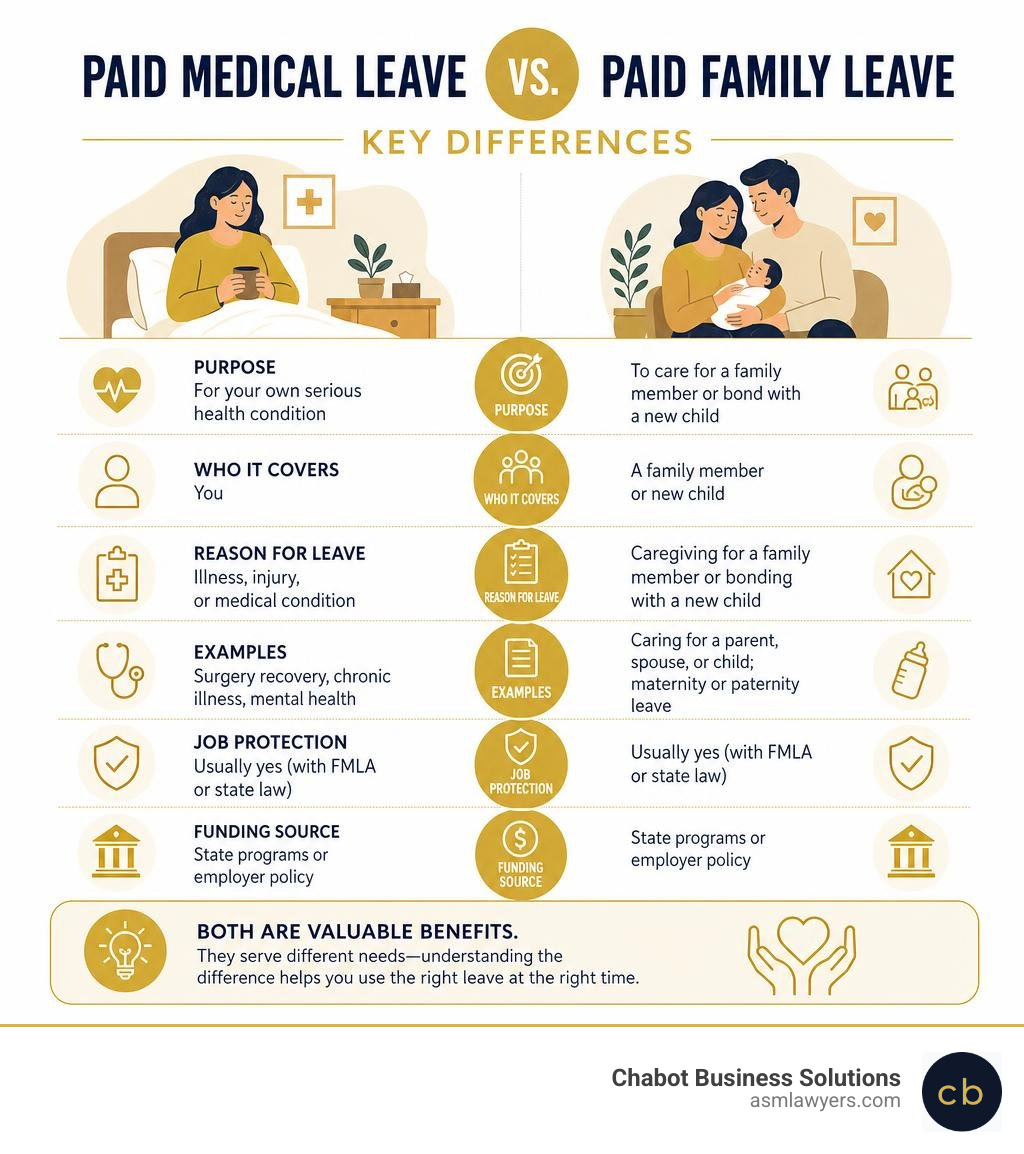
While they are often lumped together under the umbrella of “family and medical leave,” paid medical leave and paid family leave (PFL) serve different purposes:
- Paid Medical Leave is strictly for your own recovery. You are the patient.
- Paid Family Leave is for caregiving. You take this time to care for a seriously ill family member (like a spouse, child, or parent) or to bond with a newborn, newly adopted child, or foster child.
In California, these benefits are managed by the Employment Development Department (EDD). For bonding and caregiving, you utilize the program outlined in California’s Paid Family Leave Law. If you are the one recovering from childbirth or a serious medical event, you transition to State Disability Insurance (SDI).
Navigating this transition can be tricky, especially for new mothers who are dealing with both physical recovery and bonding. If you feel your employer is treating you differently because of your pregnancy or recovery timeline, you should read our guide on stopping pregnancy and maternal leave discrimination to understand your legal safeguards.
State-by-State Paid Medical Leave Programs and Benefits
Because there is no federal mandate for paid leave, progressive states have stepped up to build their own social insurance systems. These programs are typically funded through small payroll withholdings split between employers and employees (or paid entirely by employees).

To help you see how these benefits stack up across the country in 2026, we have put together a comparison table of the most active state-run programs:
| State | Maximum Medical Leave Duration | 2026 Maximum Weekly Benefit | Funding Source |
|---|---|---|---|
| California | Up to 52 weeks | $1,681 (Based on 2025/2026 rates) | 1.3% Employee Payroll Tax |
| Massachusetts | Up to 20 weeks | $1,230.39 | Split Employer/Employee Tax |
| Oregon | Up to 12 weeks (14 for pregnancy) | Varies by average wage | Split Employer (40%) / Employee (60%) |
| Washington | Up to 12 weeks (18 for pregnancy) | Varies by average wage | Split Employer (28.57%) / Employee (71.43%) |
| New York | Up to 26 weeks | $170 (Statutory cap) | Employer-Purchased Private Insurance |
California State Disability Insurance (SDI)
For our clients here in California, the local system is incredibly robust but highly specific. California’s State Disability Insurance (SDI) program provides up to 52 weeks of paid personal medical leave. This is funded entirely by a 1.3% premium rate withheld from employee wages.
While you are receiving SDI, you are getting partial wage replacement. However, to ensure your job is still waiting for you when you return, you must coordinate these payments with job-protection laws. The California Family Rights Act (CFRA) provides up to 12 weeks of unpaid, job-protected leave for eligible employees.
To learn more about how these state-level job protections interact with your paycheck, check out our resources on being entitled paid sick leave in California and review the California Family Rights Act FAQs.
Massachusetts Paid Family and Medical Leave (PFML)
On the East Coast, Massachusetts operates a highly structured PFML program. Eligible workers can take up to 20 weeks of paid medical leave per benefit year to manage their own serious health condition.
The state has scheduled regular benefit increases: in 2025, the maximum weekly benefit was $1,170.64, and as of 2026, it has increased to $1,230.39. Massachusetts enforces a standard 7-day waiting period before payments begin, and applicants must locate their employer’s Federal Employer Identification Number (FEIN) on their W-2 to initiate the claim.
Paid Leave Oregon and Washington State PFML
In the Pacific Northwest, both Oregon and Washington have modern, user-friendly paid leave systems.
Under Paid Leave Oregon Home, workers can access up to 12 weeks of paid leave, which can be extended to 14 weeks for pregnancy-related complications. Oregon enforces a strict 90-day job protection rule, meaning you must have worked for your employer for at least 90 consecutive days to guarantee your right to reinstatement.
Washington State offers a similar 12-week program (extendable to 18 weeks for pregnancy-related incapacitation). Washington’s program began payroll withholdings in 2019 and started paying out benefits in 2020, establishing a solid model for split-premium funding.
Eligibility, Weekly Benefits, and the Application Process
To qualify for state-run paid medical leave, you must meet specific financial and employment thresholds. States do not look at how much you need the money; instead, they look at your historical contributions to the system.

Most programs evaluate your eligibility using a “base year” or “alternative base year” calculation. This looks at your earnings over a 12-month period prior to your leave. For example, in Oregon, you must have earned at least $1,000 during your base year to qualify. In California, your weekly benefit is determined by your highest-earning quarter within a specific 12-to-15-month window.
Understanding these requirements is a core part of knowing what are your rights when you are an employee.
Step-by-Step Application Process
While every state has its own online portal (such as California’s SDI Online or Oregon’s Frances Online), the general application process follows a standard sequence:
- Notify Your Employer: You must give your employer at least 30 days’ advance notice for foreseeable leave (like a scheduled surgery). If your medical emergency is unexpected, you must notify them as soon as practicable—usually within 24 to 48 hours.
- Secure Medical Certification: Have your treating physician fill out the medical portion of the application. This form must explicitly state your diagnosis, the start date of your condition, and an estimated date of return. If you are applying for benefits, ensure your doctor signs this form within the required timeframe (for instance, within 60 days of your leave start date under Oregon’s guidelines).
- Submit Your Application: File your claim online. If you are looking for a practical breakdown of how this works elsewhere, you can read about applying for medical leave in Oregon as a reference point for how modern state portals operate.
- Wait for Approval: State agencies typically take 1 to 2 weeks to review your documentation and issue a determination.
Interaction with Short-Term Disability and Employer Benefits
State-run programs do not exist in a vacuum. Many employers offer private short-term disability insurance (STDI) plans as part of their benefits package. In March 2024, approximately 45% of private-sector employees in the United States had access to these employer-supported plans.
Among those with access to STDI, the median number of available benefit weeks was 26, with a median maximum weekly benefit of $1,000.
If you live in a state with a mandatory program (like California) and also have private STDI, your benefits must be coordinated. Usually, your private insurance acts as a “supplemental” policy. This means the private plan will pay the difference between your state benefit and your regular salary so that you can reach up to 100% of your normal take-home pay.
To make sure your employer is coordinating these benefits correctly without shortchanging you, it is vital to know employee rights in California.
The Broader Picture: US Policy, OECD Comparisons, and Economic Impact
When we look at paid medical leave from a global perspective, the United States is a stark outlier.
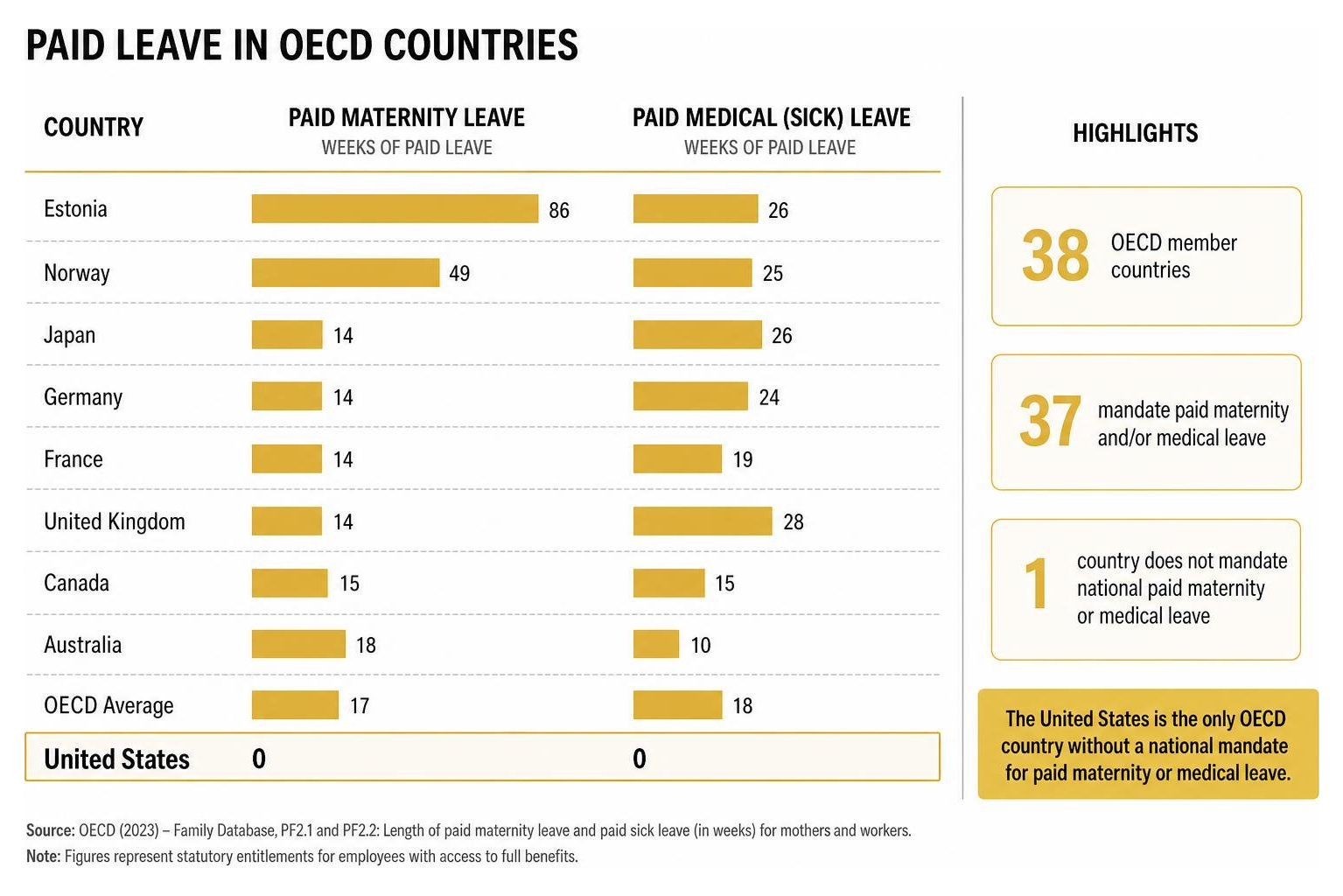
Among the 38 member countries of the Organisation for Economic Co-operation and Development (OECD), the United States is the only nation that does not mandate national paid maternity or medical leave. In Europe and parts of Asia, workers routinely receive months of fully or partially paid sick leave funded through national social security systems.
In the U.S., the lack of a federal safety net has forced states to run their own experiments. The real-world results of these programs are highly encouraging. According to the California PFL DOL Report, which analyzed the first decade of California’s program, access to paid leave significantly strengthens labor force attachment (especially for low-wage workers), improves public health outcomes, and reduces overall employer turnover costs by allowing valued employees to return to their jobs instead of quitting.
Federal Legislative Proposals
There have been several attempts to fix this national gap. The most prominent federal proposal is the Family and Medical Insurance Leave (FAMILY) Act, which aims to build a national paid family and medical leave program funded by small payroll contributions from both employers and employees.
Additionally, current tax codes have tried to incentivize employers voluntarily. The federal Employer Credit for Paid Family and Medical Leave offers a tax credit of up to 25% of paid leave wages to companies that voluntarily provide paid leave to lower-income workers. However, because these voluntary programs are not mandatory, access remains highly unequal across different wage groups and industries.
Frequently Asked Questions about Paid Medical Leave
Does receiving state paid medical leave guarantee my job is protected?
No. This is perhaps the most dangerous misconception in employment law. State paid leave programs (like California’s SDI) are insurance funds designed to replace your lost wages; they do not grant job protection.
To keep your job safe, you must qualify for a job-protection statute such as the federal Family and Medical Leave Act (FMLA) or the California Family Rights Act (CFRA). These laws require employers to maintain your health insurance and reinstate you to your original position (or an equivalent one) when your leave ends. To learn more about your right to return to work, read our detailed breakdown of what do you really have a right to as an employee.
Can independent contractors access paid medical leave?
Yes, but it is not automatic. Standard state disability and medical leave programs are funded via payroll taxes withheld from traditional W-2 employees. Because independent contractors do not have these taxes withheld, they are not covered by default.
However, states like California allow self-employed individuals and independent contractors to opt into elective coverage. By paying a quarterly premium based on their net earnings, contractors can access the exact same SDI and PFL benefits as traditional employees. If you are unsure of your employment status, you can explore the employee independent contractor distinction to see where you stand.
What should I do if my employer retaliates against me for taking leave?
If your employer demotes you, reduces your hours, threatens you, or terminates your employment because you requested or took legally protected medical leave, they have broken the law.
You should immediately document every interaction, save all written correspondence, and consult an experienced employment attorney. If you suspect your workplace rights have been compromised, you can learn about the process of holding your employer accountable by reading our guide on what to do if you believe your employer is violating California wage and hour laws.
Conclusion
Taking time off to heal should not cost you your career or your financial stability. While the legal landscape surrounding paid medical leave can feel overwhelming, you do not have to navigate it alone.
At Aiman-Smith & Marcy, we are an Oakland-based boutique law firm specializing in employment law. Our collaborative team of attorneys has spent over 25 years working together to stand up for workers’ rights, tackle workplace discrimination, and fight for unpaid wages. We understand the complex interplay between California’s SDI, the CFRA, and federal protections, and we are here to ensure your employer respects the law.
If you have questions about your eligibility or believe your employer has wrongfully denied your request for time off, we encourage you to read our focused guide: Am I entitled to paid sick leave in California? or reach out to us directly to discuss your situation.