
Understanding Employee Rights: Exempt vs Nonexempt Status Under the Fair Labor Standards Act
When it comes to workplace rights, understanding where you stand under the Fair Labor Standards Act (FLSA) is critical. The core distinction between exempt and nonexempt employees dictates whether you are legally entitled to overtime pay and strict timekeeping protections.
Nonexempt workers are protected by federal and state wage-and-hour laws. If you are nonexempt, your employer must pay you at least the applicable minimum wage for all hours worked, plus overtime compensation—typically time-and-a-half—whenever you log more than 40 hours in a single workweek. Additionally, nonexempt employees are covered by strict timekeeping requirements, meaning your employer must maintain complete, accurate records of all compensable hours worked.
In contrast, exempt employees are excluded from federal overtime protections. Because exempt status strips away your right to overtime, the law presumes that every worker is nonexempt unless the employer can affirmatively prove that the employee meets narrow statutory criteria.
| Employee Protection | Nonexempt Workers | Exempt Workers |
|---|---|---|
| Minimum Wage Rights | Guaranteed under federal, state, and local laws | Covered, but salary thresholds usually far exceed minimum wage |
| Overtime Pay Eligibility | Mandatory (1.5x regular rate after 40 hours/week) | Generally excluded from FLSA overtime protections |
| Timekeeping Requirements | Employers must track precise daily and weekly hours | Strict clock-in tracking is generally not federally required |
| Pay Deductions | Paid for actual hours worked; pay varies by hours | Fixed salary; improper partial-day deductions are restricted |
To dive deeper into the basics of worker classification, explore our overview on The Great Classification Debate: FLSA Exempt vs Non-Exempt Explained.
Step-by-Step FLSA Checklist Exempt vs Nonexempt: The Three Core Tests
To legally declare you exempt from overtime, your employer cannot simply make an arbitrary decision or slap a fancy title on your business card. Under federal regulations, an employer must prove that your position satisfies a strict three-pronged checklist:
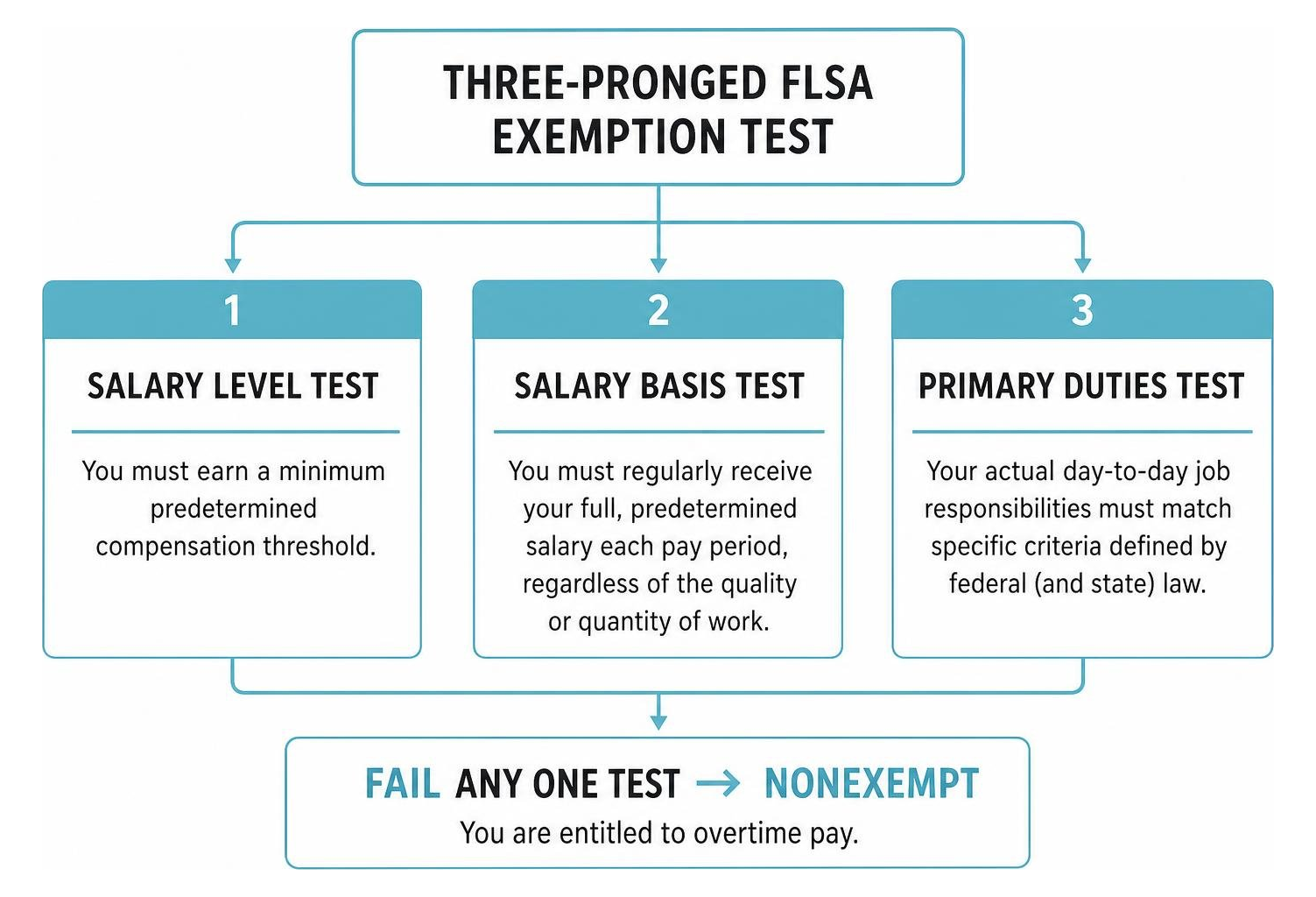
- The Salary Level Test: You must earn a minimum predetermined compensation threshold.
- The Salary Basis Test: You must regularly receive your full, predetermined salary each pay period, regardless of the quality or quantity of work performed.
- The Primary Duties Test: Your actual day-to-day job responsibilities must match specific criteria defined by federal (and state) law.
If your job fails even one of these three tests, you are nonexempt and entitled to overtime pay. You can review standard administrative templates like the university FLSA Compliance Checklist to see how employers document these categories, or read our guide on How to Determine Exempt vs Non-Exempt Status Without Losing Your Mind.
Federal and State Salary Threshold Requirements
Under federal FLSA rules, the baseline salary threshold for standard white-collar exemptions is $684 per week, which equals $35,568 per year. Up to 10 percent of this federal threshold can be satisfied using nondiscretionary bonuses, incentive payments, or commissions paid at least annually.
However, state laws frequently establish much higher hurdles to protect workers. In California, for instance, state wage-and-hour rules in 2026 set the minimum wage at $16.90 per hour. To qualify for most executive, administrative, or professional exemptions under California law, an employee must earn a fixed salary equal to at least two times the state minimum wage for full-time employment. That requires a salary threshold of $1,352 per week, or $70,304 annually.
When federal and state laws overlap, your employer is legally bound to follow the standard that provides you with the greatest protection and higher pay. For more details on what your employer can and cannot do regarding pay rates, check out What Your Employer Can’t Do If You Are Exempt Part 1.
The Salary Basis Test and Illegal Pay Deductions
The salary basis test requires that an exempt worker receive a guaranteed, predetermined sum of money each pay period. This fixed salary cannot be reduced based on variations in the quality or quantity of the work you complete during any given week. If you perform any work during a workweek, your employer generally must pay your full salary.
Improper deductions are a major red flag that can destroy an employee’s exempt status. For example, if your employer docks your salary for a four-hour absence because you ran out of personal time off (PTO), or reduces your pay during business slowdowns, they are treating you like an hourly employee. Unlawful partial-day deductions violate the salary basis test and can invalidate your exempt status, opening the door for back overtime pay claims. Learn more about prohibited pay practices in What Your Employer Can’t Do If You Are Exempt Part 2.
Evaluating Primary Duties: Actual Responsibilities vs. Inflated Job Titles
The most common tactic employers use to avoid paying overtime is relying on inflated job titles. Department of Labor regulations state unequivocally that job titles alone mean nothing when determining exemption status. Whether you are called a “Senior Shift Manager,” “Operations Specialist,” or “Assistant Director,” your classification depends entirely on your actual daily tasks.

Under the FLSA, your “primary duty” is the main, most important responsibility you perform. In California, primary duty evaluations are even stricter: an employee must spend more than 50 percent of their actual working hours performing exempt managerial, administrative, or professional tasks. If you spend 70 percent of your shift stocking shelves, entering routine data, or making coffee, you are nonexempt—regardless of your job title or salary. Read our detailed analysis on Supervisors Mislabeling Exempt? Check Your Duties.
Breakdown of the 6 Main FLSA Exemption Categories
The federal government outlines six major exemption categories under Section 13(a)(1) of the FLSA. Official legal criteria can be cross-referenced via federal guidance like Fact Sheet #17A: Exemption for Executive, Administrative, … . Below is how these categories break down for workers evaluating their rights.
Executive, Administrative, and Professional Duties Tests
The primary “white-collar” exemptions require specific, elevated levels of workplace authority and specialized skill:
- Executive Exemption: To qualify, your primary duty must be managing the enterprise or a recognized department. You must regularly direct the work of two or more full-time employees (or the equivalent in part-time workers), and hold genuine authority to hire or fire employees—or have your recommendations given significant weight.
- Administrative Exemption: This category is heavily abused by employers. To be genuinely exempt, your primary duty must be office or non-manual work directly related to general business management or operations. Crucially, your daily tasks must involve the regular exercise of discretion and independent judgment on matters of significance. Routine clerical tasks or following pre-set procedures do not qualify.
- Learned & Creative Professional Exemptions: Learned professionals must perform work requiring advanced knowledge in a specialized field of science or learning, typically acquired through a prolonged course of specialized intellectual instruction (e.g., licensed lawyers, doctors, or certified CPA accountants). Creative professionals must perform primary duties requiring invention, imagination, originality, or talent in a recognized artistic field.
If you suspect your daily responsibilities fall short of these tests, consult our guide on Are You Exempt Really?.
Computer Employee Exemption and Outside Sales Rules Under the FLSA Checklist Exempt vs Nonexempt
Using the flsa checklist exempt vs nonexempt criteria reveals specialized rules for technology and sales roles:
- Computer Employee Exemption: To qualify, an employee must work as a computer systems analyst, computer programmer, software engineer, or similar skilled role focused on system design, analysis, programming, or testing. Under federal rules, computer employees can be paid on a salary basis or an hourly rate of at least $27.63 per hour. However, note that the $27.63 hourly figure is only the federal baseline; state laws often require significantly higher hourly rates to keep overtime rights intact. Moreover, entry-level IT support, CAD drafters, and helpdesk technicians who perform routine hardware repairs are nonexempt.
- Outside Sales Exemption: This exemption requires that the worker’s primary duty be making sales or obtaining orders for products or services. Crucially, the employee must be customarily and regularly engaged away from the employer’s physical place of business. Inside sales reps working from a call center or corporate office do not qualify and remain overtime-eligible. There is no federal minimum salary threshold for outside sales employees.
For an in-depth look at time-tracking and pay mechanics in these roles, read To Clock or Not to Clock: Weighing the Benefits of Exempt vs Non-Exempt Status.
Exclusions for Blue-Collar Workers, First Responders, and High Earners
Federal and state laws establish explicit rules for physical workers, public safety personnel, and high-wage earners:
- Blue-Collar Workers: Manual laborers and trade workers who perform work involving physical skill and routine operations—such as mechanics, electricians, plumbers, construction workers, and assembly-line operators—are always nonexempt. No matter how high their earnings are, blue-collar workers can never be classified under white-collar exemptions.
- First Responders: Police officers, detectives, deputy sheriffs, firefighters, paramedics, EMTs, and emergency rescue personnel are nonexempt overtime-protected employees under FLSA regulations, regardless of their rank or pay level.
- Highly Compensated Employees (HCE): Under federal rules, employees performing office or non-manual work who earn at least $107,432 in total annual compensation (including at least $684 per week paid on salary) may be exempt under a streamlined duties test. However, state wage laws (including California) often do not recognize the HCE rule, requiring employers to satisfy full, rigorous primary duty tests regardless of total pay.
Review our resource on Exempt Employee Misclassification for more worker-focused insights.
Common Employer Misclassification Tactics Used to Avoid Overtime

Wage theft through misclassification is widespread across many industries. Employers use a variety of deceptive strategies to suppress wages and avoid paying overtime premiums:
- The “Manager” Label: Giving frontline staff supervisory titles while requiring them to spend 80 percent of their day performing production or customer-service tasks.
- Daily Rate Structures: Paying workers a fixed daily rate (even over $200/day) without a guaranteed weekly salary structure, which federal courts have held violates the salary basis test (see Helix Energy Solutions Group v. Hewitt).
- Fake Independent Contractor Labels: Labeling employees as “1099 independent contractors” to avoid minimum wage, overtime, and meal break laws entirely.
- Forced Salaried Conversion: Converting hourly staff to salary pay without changing their routine job duties or ensuring they meet legal exemption standards.
To learn why companies engage in these illegal practices, read Why Would an Employer Misclassify Employees?.
Temporary Assignments and the FLSA Checklist Exempt vs Nonexempt
Applying an flsa checklist exempt vs nonexempt audit is especially important when an employee’s job duties shift due to temporary operational needs. If an exempt employee is temporarily reassigned to perform nonexempt work—such as covering open hourly shifts during staff shortages—their exemption status may break down.
It is worth noting that when discussing temporary-worker assignment length, neither federal nor California law imposes a blanket statutory cap on how long a private employer can keep an individual classified as temporary. However, if temporary or reassigned manual duties become a substantial, regular part of your workload, your employer must reassess your classification and pay you overtime for long hours worked. Learn more about worker protections at Worker Misclassification.
Remedies and Legal Penalties for FLSA Worker Misclassification

When an employer misclassifies you as exempt, they are depriving you of legally earned compensation. Fortunately, plaintiff-side employment laws provide powerful tools to recover your unpaid wages and hold employers accountable:
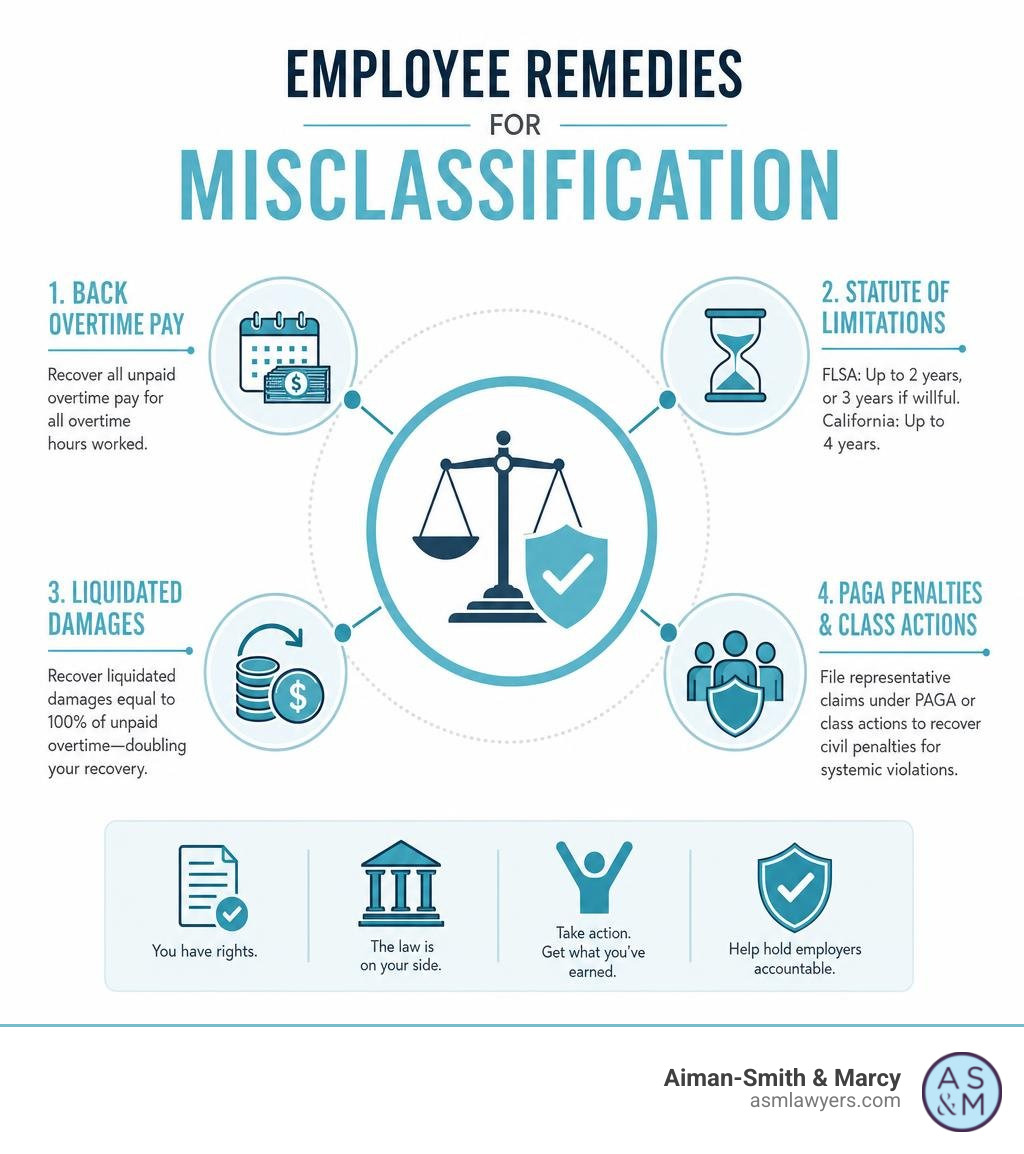
- Back Overtime Pay: You can recover all unpaid overtime pay calculated at time-and-a-half (or double-time under state rules) for all overtime hours worked.
- Statute of Limitations: Under the FLSA, workers can recover back pay for up to 2 years, or 3 years if the employer’s violation was willful. Under California law, claims can often reach back 4 years under unfair competition statutes.
- Liquidated Damages: Federal law allows misclassified employees to recover liquidated damages equal to 100 percent of their unpaid overtime—effectively doubling the award.
- PAGA Penalties & Class Actions: In California, individual workers can file representative claims under the Private Attorneys General Act (PAGA) or initiate class action lawsuits to recover civil penalties for systemic payroll violations on behalf of all affected coworkers.
For a full breakdown of legal remedies, read Misclassification and Overtime Pay Compliance with the Fair Labor Standards Act (FLSA) and evaluate your situation with Have I Been Misclassified? You Could Have a Case.
Frequently Asked Questions about FLSA Exemption Status
Can my employer classify me as exempt based on my job title alone?
No. Job titles have zero legal weight under the FLSA or state labor laws. Exemption status is determined strictly by the three legal tests: salary level, salary basis, and your actual daily responsibilities. If your daily tasks consist of nonexempt work, an executive job title will not prevent you from recovering unpaid overtime.
What happens to my exempt status if my pay is docked for working a partial day?
If your employer docks your predetermined salary for working a partial day (for instance, taking four hours off for a personal errand when you have run out of vacation time), they violate the salary basis test. Unlawful partial-day pay deductions undermine your exempt status, treating you as an hourly employee and creating legal liability for unpaid overtime compensation.
Are hourly computer professionals automatically exempt from overtime pay?
No. While federal rules allow computer professionals earning at least $27.63 per hour to be exempt, state rules (like California’s) mandate much higher hourly wage thresholds. Furthermore, hourly computer workers must perform high-level system architecture, programming, or software design. Helpdesk workers and hardware technicians remain fully nonexempt and overtime-eligible.
Conclusion: Fight Back Against Worker Misclassification and Wage Theft
Misclassification is wage theft, plain and simple. If your employer has labeled you exempt to avoid paying overtime while giving you routine work or docking your pay, you have the right to take legal action. To explore state-specific rights, read our guide on Exempt vs Non-Exempt Classification Workers California.
At Aiman-Smith & Marcy, we are a plaintiff-side employment and consumer fraud law firm representing individuals in individual, PAGA, and class actions. We do not represent corporate employers—we fight exclusively for workers seeking the fair pay and legal protections they deserve.
Talk to ASM Lawyers
Have questions about how California law applies to your situation? The team at ASM Lawyers offers consultations to help you understand your rights and options. Visit https://asmlawyers.com/contact/ to speak with an attorney about your case.
Laws change over time and every situation is different. For advice about your specific circumstances, consult a licensed California attorney.
Attorney Advertising
Legal Disclaimer This article is for general informational purposes only and does not constitute legal advice. Reading this article or contacting ASM Lawyers does not create an attorney-client relationship.


