

Understanding the Exempt vs Non Exempt Salary Threshold and the FLSA Framework
The Fair Labor Standards Act (FLSA) sets the foundation for federal wage and hour rights across the United States. Under the FLSA, all covered employees are presumed to be non-exempt—meaning they are entitled to federal minimum wage and overtime pay—unless their employer proves that they qualify for a specific legal exemption.
A common misconception in many workplaces is that simply receiving an annual salary makes a worker exempt from overtime. In reality, meeting the exempt vs non exempt salary threshold is only one component of a strict legal framework. An employee’s exemption status depends on three distinct legal requirements: how they are paid (salary basis), how much they are paid (salary level), and what tasks they actually perform (job duties).
| Characteristic | Exempt Employees | Non-Exempt Employees |
|---|---|---|
| Overtime Eligibility | Excluded from FLSA overtime protections | Entitled to 1.5x regular rate after 40 hours/week |
| Pay Structure | Fixed predetermined salary (or qualifying fee basis) | Hourly rate, piece rate, commission, or salary |
| Federal Salary Floor | Minimum $684 per week ($35,568 per year) | Must meet federal minimum wage for all hours worked |
| California Salary Floor (2026) | Minimum $1,352 per week ($70,304 per year) | Must earn at least $16.90 per hour + daily overtime |
| Pay Deductions | Strict limits on partial-day or disciplinary deductions | Paid strictly for actual hours and minutes worked |
| Duties Requirement | Must satisfy specific executive, administrative, or professional criteria | Performs routine, operational, or manual support tasks |
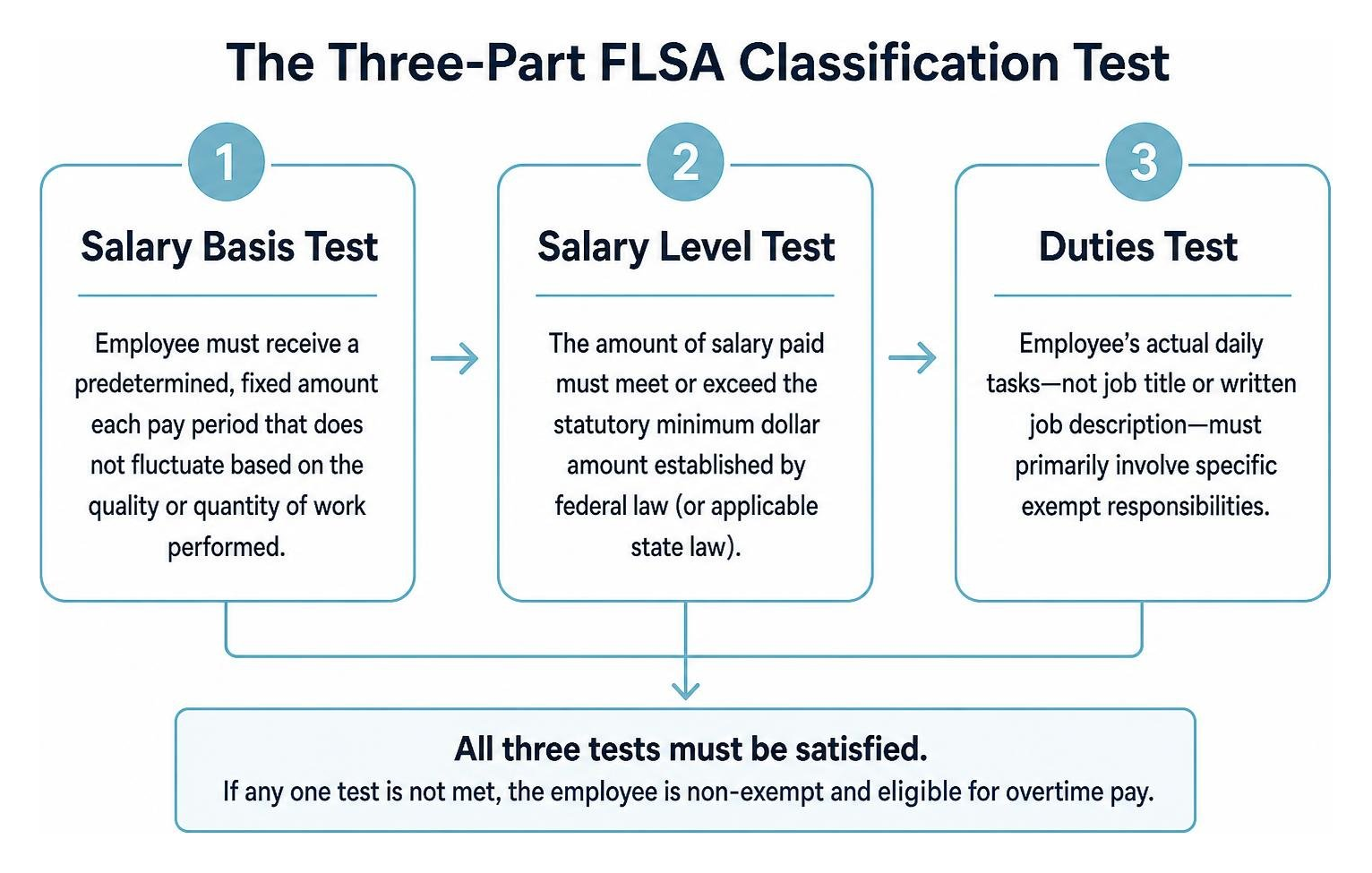
The Three-Part FLSA Classification Test
To properly establish that a worker is exempt from federal overtime pay under the standard “white-collar” regulations, an employer must satisfy all three prongs of the FLSA classification test:
- Salary Basis Test: The employee must be paid a predetermined, fixed amount of compensation for each pay period that does not fluctuate based on the quality or quantity of work performed.
- Salary Level Test: The amount of salary paid must meet or exceed the statutory minimum dollar amount established by federal law (or applicable state law).
- Duties Test: The employee’s actual daily tasks—not their formal job title or written job description—must primarily involve specific exempt responsibilities.
Under the salary basis prong, an exempt employee must generally receive their full predetermined salary for any workweek in which they perform any work, regardless of how many or how few hours they log.
Employers are strictly prohibited from docking an exempt worker’s pay for partial-day absences, operational slowdowns, or poor performance. When an employer makes improper deductions from a worker’s predetermined pay, they violate the salary basis test and risk forfeiting the exemption entirely. Workers looking to evaluate their basic wage structure can review a cheat sheet to determine FLSA exempt vs nonexempt status or read the official guidance in Fact Sheet #17G: Salary Basis Requirement.
Federal Standards for the Exempt vs Non Exempt Salary Threshold
As of September 2026, the standard federal salary threshold for executive, administrative, and professional exemptions is $684 per week, which equals $35,568 per year.
This figure has a complex recent history. In April 2024, the U.S. Department of Labor (DOL) issued a final rule designed to significantly raise standard salary thresholds in phases—first to $844 per week in July 2024, and then to $1,128 per week ($58,656 annually) in January 2025. However, in November 2024, a federal district court struck down and vacated the DOL’s 2024 final rule.
Because of that court ruling, the federal floor snapped back to the 2019 standard of $684 per week. The legal status of federal salary floors remains subject to ongoing administrative actions and litigation. Detailed historical updates can be found through the Department of Labor’s Earnings thresholds for Executive, Administrative, and Professional exemptions under the FLSA and in our analysis of the great classification debate between exempt and non-exempt status.
Special Industry and Territorial Salary Rates
Federal law recognizes specific exceptions and tailored rates for certain geographic regions and industries:
- Puerto Rico, Guam, the U.S. Virgin Islands, and the CNMI: The federal salary threshold for executive, administrative, and professional employees in these territories is set at $455 per week ($23,660 annually).
- American Samoa: The threshold is established at $380 per week ($19,760 annually).
- Motion Picture Producing Industry: Employees in the motion picture industry who are paid on a base rate rather than a standard salary may qualify for exemption if they earn at least $1,043 per week (or a proportionate amount for partial-week engagements).
Job Duties Tests and White-Collar Exemption Categories
Earning above the statutory salary threshold does not make an employee exempt on its own. The core of any exemption analysis lies in the employee’s “primary duty”—the main, most significant responsibility the worker performs on the job.
Standard Duties Tests for Executive, Administrative, and Professional Roles
Each standard white-collar category has distinct legal criteria:
- Executive Exemption: The employee’s primary duty must be the management of the enterprise, or a recognized department/subdivision. The employee must regularly direct the work of two or more full-time employees (or the equivalent in part-time workers) and have the authority to hire or fire, or their suggestions regarding hiring, firing, advancement, or promotion must carry significant weight.
- Administrative Exemption: The primary duty must consist of performing office or non-manual work directly related to the management or general business operations of the employer or the employer’s customers. Crucially, the role must require the customary exercise of discretion and independent judgment on matters of significance. Routine administrative support, data entry, and clerical work do not qualify.
- Professional Exemption: This category divides into learned professionals and creative professionals. Learned professionals must perform work requiring advanced knowledge in a specialized field of science or learning, customarily acquired through prolonged intellectual instruction (such as lawyers, doctors, certified accountants, and engineers). Creative professionals must perform work requiring invention, imagination, originality, or talent in a recognized artistic field.
To explore how these roles differ in practice, review our guide to exempt vs non-exempt salary in-depth differences.
Computer Employee and Outside Sales Exceptions
The FLSA also provides specific exemptions for certain technical and sales personnel:
- Computer Employees: Skilled computer systems analysts, programmers, software engineers, and software architects can be exempt if paid on a salary basis meeting the standard threshold, or on an hourly basis. Under federal law, the minimum hourly rate is $27.63 per hour. However, it is vital to note that this $27.63 figure is only the federal baseline. State laws (such as California’s) often require substantially higher hourly rates to maintain an exemption and keep overtime rights intact.
- Outside Sales Employees: Workers whose primary duty is making sales or obtaining orders away from the employer’s place of business do not have a salary requirement under federal law. Inside sales personnel, customer support agents, and retail workers do not qualify for this exemption.
For a deeper look into hourly pay standards, see our comprehensive guide to hourly employee classification.
Highly Compensated Employees and the Relaxed Duties Test
Under federal regulations, workers who earn significant annual compensation are evaluated under a “relaxed” duties test. A worker who receives total annual compensation of at least $107,432—which must include at least $684 per week paid on a salary or fee basis—can be classified as exempt if they customarily and regularly perform at least one exempt duty of an executive, administrative, or professional employee.
While this test makes exemption easier to establish under federal rules, state laws often reject the relaxed test entirely, holding high earners to full duties standards. For more context on these classifications, see our overview demystifying exempt vs non-exempt legal terms.
State Overtime Laws and Geographic Salary Variations

The FLSA establishes a legal floor, not a ceiling. When state laws provide greater wage protections or mandate higher salary thresholds than federal law, employers must follow the stricter state standard.
State Variations in the Exempt vs Non Exempt Salary Threshold
Several states maintain salary thresholds that significantly exceed the federal $684 weekly floor:
- California: Under California Labor Code provisions, exempt employees in administrative, executive, or professional roles must earn a monthly salary equivalent to at least twice the state minimum wage for full-time employment (40 hours per week). With the 2026 California minimum wage set at $16.90 per hour, the minimum exempt salary threshold is $1,352 per week, which equals $70,304 annually. Official updates are detailed in the California Department of Industrial Relations wage announcements. California also requires exempt workers to spend more than 50% of their working time performing exempt tasks (a quantitative test stricter than the federal primary duty test).
- Washington: Sets exemption thresholds pegged to multipliers of its state minimum wage, reaching 2.25 times the minimum wage ($1,541.70 weekly) for larger employers in 2026.
- Colorado: Enforces an annually indexed salary threshold of $1,111.23 per week for 2026.
- New York: Sets thresholds for executive and administrative exemptions using a 75-times minimum wage multiplier ($1,199.10 per week in designated regions).
- Maine: Enforces a state-specific weekly salary threshold of $871.16.
Bonus Credits and Part-Time Salary Rules
Federal rules permit employers to use nondiscretionary bonuses and incentive payments (such as tied commissions or productivity bonuses) to satisfy up to 10 percent of the standard federal salary level, provided these payments are distributed at least annually. If an employee does not earn enough in bonuses by the end of the 52-week period, the employer must make a catch-up payment within one pay period to maintain the exemption.
Importantly, the salary threshold cannot be prorated for part-time workers. A professional working 20 hours per week must still receive the full weekly statutory threshold ($684 federally, or $1,352 in California) to be classified as exempt. If an employer prorates the salary to match reduced hours, the employee automatically fails the salary level test and must be classified as non-exempt, entitling them to hourly timekeeping and overtime pay.
Legal Consequences of Employee Misclassification
When an employer improperly classifies an employee as exempt, the financial and legal consequences can be extensive. Misclassification deprives workers of mandatory overtime premiums, accurate itemized wage statements, and legally mandated rest and meal breaks.
Unpaid Overtime, Liquidated Damages, and Wage Penalties
Workers who have been misclassified can pursue legal claims to recover their unpaid wages and statutory remedies:
- Back Overtime Pay: Misclassified employees are entitled to retroactive overtime compensation calculated at 1.5 times their regular hourly rate for all hours worked over 40 in a workweek (plus daily overtime under California law).
- Liquidated Damages: Under the FLSA, employees can recover an additional amount equal to 100% of their unpaid overtime as liquidated damages, effectively doubling the recovery unless the employer proves it acted in good faith.
- Statute of Limitations: Federal claims allow workers to recover back pay for two years, or three years if the employer committed a willful violation.
- State Penalties and PAGA: In states like California, employers face substantial additional civil penalties under the Private Attorneys General Act (PAGA), waiting-time penalties, and statutory interest.
Learn more about employer liabilities in our guide to exempt employee misclassification liabilities.
How to Audit and Protect Worker Rights
Workers who suspect they have been misclassified should evaluate their day-to-day working reality rather than accepting a job title at face value:
- Log Actual Daily Tasks: Record the specific duties performed each day and the approximate percentage of time spent on routine operational work versus genuine managerial or specialized tasks.
- Track Actual Working Hours: Maintain personal records of start times, end times, meal breaks, and total hours worked each week.
- Review Pay Stubs: Check whether compensation meets the required federal or state salary floor without unlawful deductions.
For practical steps on identifying improper status, review our walkthrough on how to determine exempt status without confusion.
Frequently Asked Questions About Exemption Thresholds
Can part-time workers qualify for exempt status under the salary threshold?
Yes, but only if they are paid the full statutory salary threshold. The FLSA and state wage laws do not allow employers to prorate the salary floor based on part-time hours. If a part-time worker is paid less than $684 per week (or less than $1,352 per week in California), they fail the salary level test and must be classified as non-exempt, receiving hourly pay and overtime protections.
How do nondiscretionary bonuses affect the weekly salary threshold calculation?
Under federal FLSA rules, employers may credit nondiscretionary bonuses, incentive payments, and commissions toward up to 10 percent of the standard salary threshold, provided those payments are paid out at least annually. If the employee’s combined salary and bonus fall short of the required threshold at the end of the year, the employer must make a single catch-up payment within one pay period to preserve the exemption.
What happens if an employee meets the salary threshold but fails the duties test?
The employee is legally non-exempt. The salary basis, salary level, and duties tests are concurrent requirements. Paying an employee a high salary does not eliminate their right to overtime pay if their actual daily duties do not meet the legal criteria for executive, administrative, or professional exemptions.
Conclusion
Understanding wage rights under the Fair Labor Standards Act and state labor codes ensures that workers receive the compensation they have earned. The exempt vs non exempt salary threshold serves as an essential baseline, but it must always be evaluated alongside actual job duties and state-specific salary floors. If you work in California, review our detailed guide on the exempt vs non-exempt classification of workers in California.
Talk to ASM Lawyers Have questions about how California law applies to your situation? The team at ASM Lawyers offers consultations to help you understand your rights and options. Visit our Contact page to speak with an attorney about your case.
Aiman-Smith & Marcy is a plaintiff-side employment and consumer fraud law firm representing workers in individual, PAGA, and class action wage claims across California.
Laws change over time and every situation is different. For advice about your specific circumstances, consult a licensed California attorney.
Attorney Advertising.
Legal Disclaimer This article is for general informational purposes only and does not constitute legal advice. Reading this article or contacting ASM Lawyers does not create an attorney-client relationship.