
PTO and Sick Time Are Not the Same in California
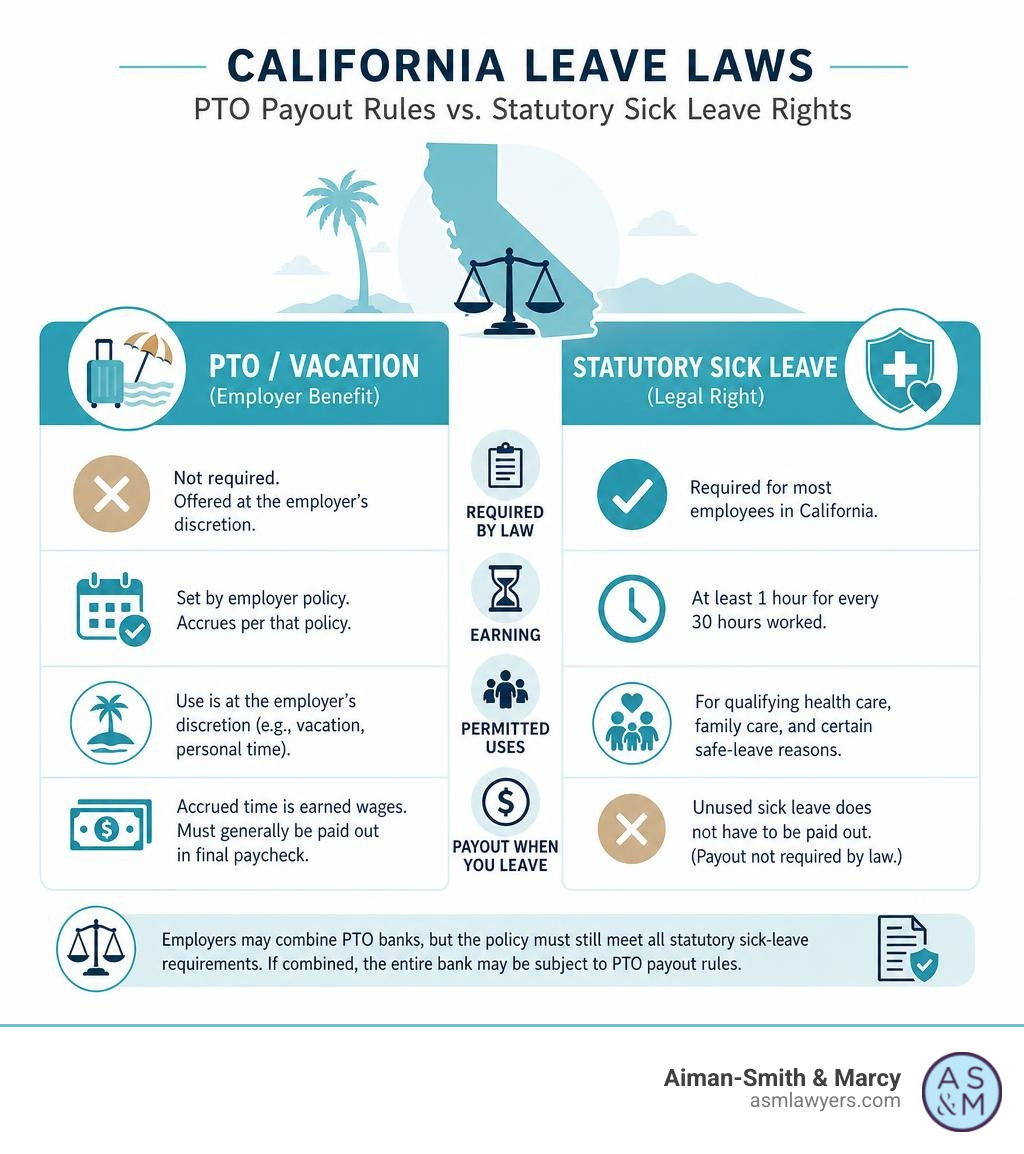
Under California PTO and sick time laws, paid sick leave is a legal right for most workers, while vacation and general PTO are benefits an employer may choose to offer. The difference matters when you need time off and when you leave a job.
- Paid sick leave: Most employees earn at least 1 hour for every 30 hours worked and can use it for qualifying health care, family care, and certain safe-leave reasons. Employers generally must provide at least 40 hours or 5 days, whichever is greater, each year.
- Vacation or combined PTO: If an employer offers it, accrued time is generally treated as earned wages. It cannot be taken away through a “use it or lose it” rule and must generally be paid out in a final paycheck.
A company can use one PTO bank instead of separate vacation and sick-leave banks, but the policy must still meet California sick-leave rules. Combining leave can also make the whole bank subject to vacation payout rules.
These details can affect your paycheck, your leave balance, and whether an attendance policy is lawful. California law also protects workers from retaliation for using accrued paid sick leave.
Understanding California PTO and Sick Time Laws: Key Legal Distinctions
In California, workers often hear the terms “PTO” (Paid Time Off), “vacation time,” and “sick leave” used interchangeably. Legally, they occupy very different spaces under the California Labor Code. Knowing your rights starts with understanding how the state treats each type of leave.
Statutory paid sick leave is an absolute legal mandate. By contrast, California employers are not required by law to provide paid vacation days or general paid holidays. However, once an employer chooses to offer vacation or a universal PTO policy, state law establishes strict protections to ensure workers actually receive the wages they have earned. Reviewing key California requirements impacting time off helps clarify where discretionary workplace perks end and mandatory employee protections begin.
What Qualifies as Sick Leave Under California Labor Code Section 246
Under California Code, LAB 246. , paid sick leave is dedicated time off designed specifically for health, wellness, and safety needs. Qualifying employees earn statutory sick pay to address medical conditions without losing their regular income.
Statutory sick leave in California can be taken for:
- Diagnosis, care, or treatment of an existing health condition for the employee.
- Preventive medical, dental, or vision care.
- Caring for an eligible family member (child, parent, spouse, registered domestic partner, grandparent, grandchild, or sibling).
- Caring for a “designated person” chosen by the employee when requesting leave (employers can limit workers to one designated person per 12-month period).
- Seeking medical attention, psychological counseling, or legal relief if the worker or their family member is a victim of domestic violence, sexual assault, stalking, or other qualifying violent acts.
Vacation and Combined PTO as Vested Wages Under California Law
Under California Labor Code Section 227.3, vacation time and unified PTO banks are legally classified as deferred wages. This means that as you perform work, your vacation or PTO time vests proportionally alongside your earnings.
Because these hours are treated as earned compensation:
- “Use-it-or-lose-it” policies are illegal: An employer cannot set an arbitrary deadline where unused PTO disappears at the end of a calendar year. While an employer may implement a reasonable accrual cap to pause further accrual until hours are taken, they cannot confiscate time you have already earned.
- Mandatory final paycheck cash-out: Learn more about what happens to your vacation pay when you quit are fired. When your employment ends for any reason, every minute of accrued, unused vacation or PTO must be cashed out at your final rate of pay.
California Paid Sick Leave Requirements: SB 616, Accrual, and Usage Rules

The baseline for paid health leave in California was established under the Healthy Workplace Healthy Family Act of 2014 (AB 1522) . Under Senate Bill 616 (SB 616), California significantly expanded these protections.
Employers must provide at least 40 hours or 5 days of paid sick leave per year, whichever is greater based on the employee’s work schedule. For example, if you regularly work 10-hour daily shifts, 5 days of leave equals 50 hours of protected paid sick leave.
To qualify for paid sick leave, an employee must:
- Work in California for the same employer for at least 30 calendar days within a year from the start of employment.
- Satisfy a 90-calendar-day waiting period before being entitled to use accrued sick leave, though employers may permit earlier use.
Accrual, Frontloading, and Carryover Caps Under California PTO and Sick Time Laws
Employers generally satisfy their sick leave obligations through one of two methods:
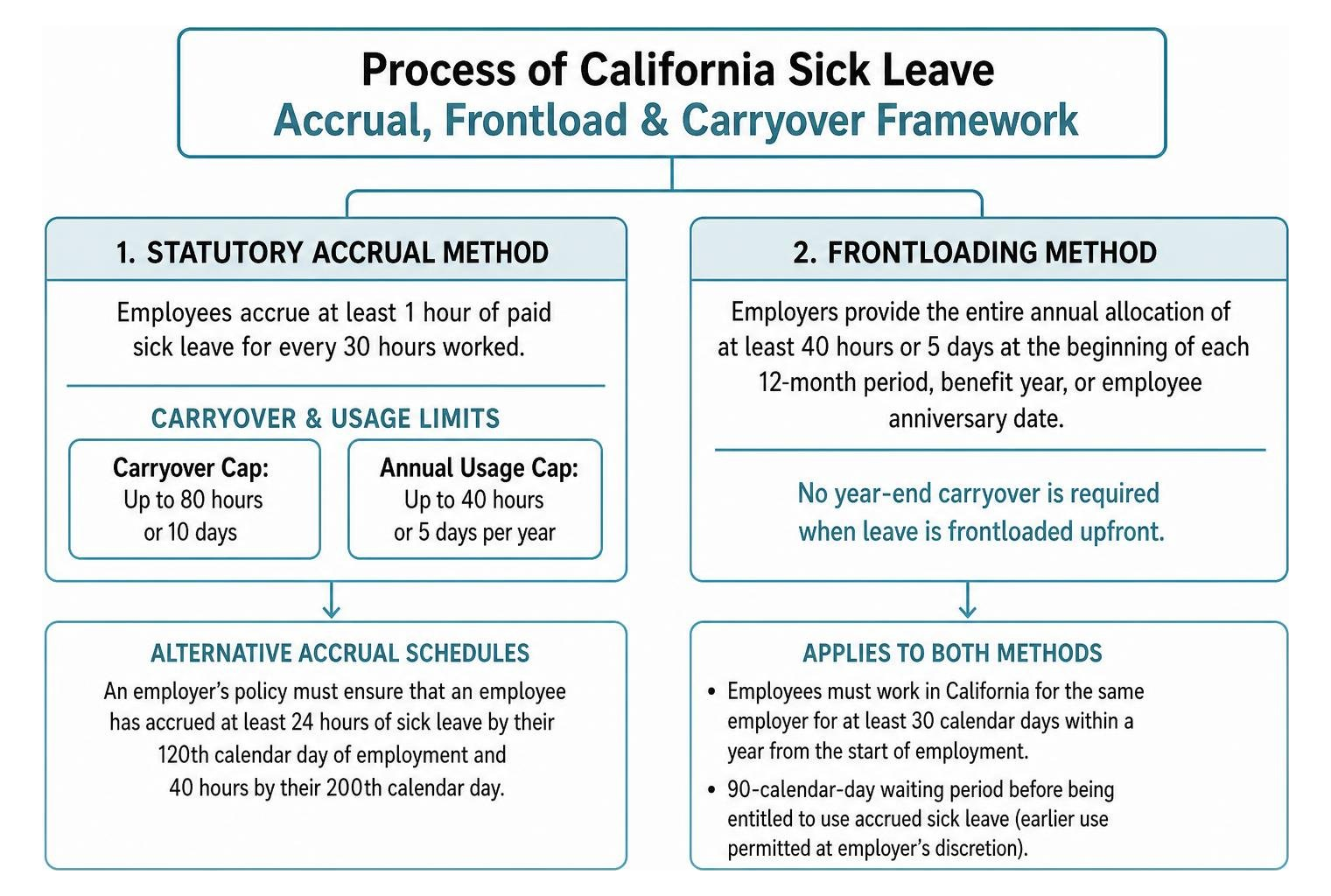
- The Statutory Accrual Method: Employees accrue at least 1 hour of paid sick leave for every 30 hours worked. Under this system, unused sick leave carries over from year to year, but employers can cap total accrual at 80 hours or 10 days. Employers may also cap an employee’s annual usage at 40 hours or 5 days per year.
- The Frontloading Method: Employers provide the entire annual allocation of at least 40 hours or 5 days at the beginning of each 12-month period, benefit year, or employee anniversary date. When leave is frontloaded upfront, no year-end carryover is required.
Under alternative accrual schedules, an employer’s policy must ensure that an employee has accrued at least 24 hours of sick leave by their 120th calendar day of employment and 40 hours by their 200th calendar day.
Permitted Uses, Safe Leave Under AB 2499, and Kin Care
California law gives workers broad rights to use their statutory sick leave:
- Kin Care (Labor Code § 233): Workers are legally entitled to use up to half of their annual sick leave entitlement to care for family members.
- Expanded Safe Leave (AB 2499): Effective in 2025 and moving forward, safe leave covers situations where an employee or their qualifying family member is a victim of domestic violence, sexual assault, stalking, or crimes involving serious bodily injury or dangerous weapons.
- Emergency Conditions: Agricultural and outdoor workers are protected when using paid sick days to avoid hazardous smoke, extreme heat, or flood conditions during declared state or local emergencies.
- Court and Witness Appearances: Paid sick leave can also be utilized for subpoenaed witness duties or jury duty under statutory safe leave provisions.
PTO vs. Separate Leave Policies: Compliance Risks and Separation Payouts
Employers often debate whether to offer a single combined PTO bank or maintain separate vacation and sick leave policies. The comparison below outlines how these two systems function under California law:
| Policy Feature | Separate Sick Leave Bank | Combined Universal PTO Bank |
|---|---|---|
| Legal Mandate | Required by California Labor Code § 246 | Optional (discretionary employer benefit) |
| Minimum Annual Amount | At least 40 hours or 5 days | At least 40 hours or 5 days (to meet sick law) |
| Payout Upon Termination | No payout required (Labor Code § 246(g)(1)) | 100% payout required as vested wages (Labor Code § 227.3) |
| “Use-It-or-Lose-It” Rules | Carryover required unless frontloaded | Strictly illegal; caps can only pause accrual |
| Usage Reason Restrictions | Limited to medical, caregiving, safe leave | Any purpose (vacation, personal, illness) |
| Notice & Absence Rules | Cannot penalize or demand shift coverage | Sick-related uses retain statutory protections |
Payout at Termination: Why Bundled PTO Creates Additional Liability
When an employer bundles all time off into a single PTO bank, every single hour in that bank is treated as earned wages under Labor Code Section 227.3. If you quit or are terminated, your employer cannot withhold any portion of that balance by claiming “part of this was meant for sick days.”
If you believe your balance was improperly docked or withheld, read about what to do when i think my employer is messing with my pto is that legal. Employers cannot retroactively reclassify accrued PTO into non-payable sick leave.
Furthermore, under AB 2123, California employers are prohibited from forcing employees to exhaust their accrued vacation or PTO balances before receiving State Disability Insurance (SDI) or Paid Family Leave (PFL) benefits.
Managing Local City Ordinances Under California PTO and Sick Time Laws
Several California cities enforce local municipal ordinances providing sick leave benefits that exceed state minimums. Examples include the San Francisco Paid Sick Leave Ordinance and the rules detailed in the Oakland Minimum Wage, Sick Leave, and Other Labor Laws. Other municipalities, such as Los Angeles, Berkeley, and Emeryville, also enforce local paid leave standards.
When local city laws provide greater accrual caps or faster accrual rates, employers must comply with the standard that is most generous to the worker. However, state law under Section 246(r) maintains uniform statewide rules for paystub statement formatting, rehire reinstatement, regular rate calculations, and final wage payout rules.
Employee Rights, Anti-Retaliation Protections, and Documentation Limits
The California Labor Commissioner strictly enforces paid leave protections. Official regulatory interpretations published in the California Paid Sick Leave: Frequently Asked Questions reinforce that statutory sick time is a protected right.
Under California Labor Code Section 246.5, it is unlawful for an employer to deny an employee the right to use accrued sick days, or to discharge, threaten to discharge, demote, suspend, or discriminate against an employee for exercising their rights. If an employer takes adverse action against a worker within 30 days of the employee filing a complaint or using sick leave, state law creates a rebuttable presumption of unlawful retaliation. Workers facing wage theft or retaliation can pursue wage and hour claims to recover owed pay and statutory penalties.
Doctor’s Notes, Attendance Policies, and No-Replacement Rules
California law sets strict boundaries on how employers manage sick time:
- No Doctor’s Note Requirement: Employers cannot deny statutory paid sick leave simply because an employee did not present a medical note for a brief absence.
- Attendance Policy Protections: Employers cannot assign disciplinary “points,” “occurrences,” or negative reviews under an attendance policy when a worker takes accrued statutory sick days.
- No Replacement Worker Mandate: An employer cannot require you to search for or find a replacement worker as a condition of taking paid sick leave.
- Usage Increments: Employers can set a reasonable minimum increment of use, but California law mandates that the minimum cannot exceed 2 hours.
Rehire Reinstatement and Wage Statement Tracking
To ensure transparency, California requires employers to display your available paid sick leave balance (or universal PTO balance) directly on your itemized wage statement (paystub) or on a separate written notice provided on payday. Employers must retain sick leave accrual and usage records for a minimum of three years. If an employer fails to keep proper records, the law presumes the employee is entitled to the maximum allowable accrual unless the employer proves otherwise by clear and convincing evidence.
Additionally, under California Labor Code Section 246(g)(2), if you leave a job and are rehired by the same employer within 12 months, your previously accrued, unused statutory sick leave balance must be immediately reinstated (unless it was already cashed out at termination as part of a PTO bank). Reviewing resources to know employee rights california can help you protect your earned compensation.
Frequently Asked Questions About California PTO and Sick Leave
Does an employer have to pay out unused sick time when I leave my job?
No. If an employer maintains a separate, standalone paid sick leave policy, California law does not require them to cash out unused sick hours upon resignation, layoff, or termination. However, if your employer combines sick time and vacation into a single universal PTO plan, every accrued hour is considered earned wages and must be paid out in full on your final paycheck.
Can my employer require a doctor’s note every time I take a sick day?
Generally, no. For routine, short-term use of statutory paid sick days, employers cannot condition your right to take leave on providing medical certification. Requiring a doctor’s note for taking a single statutory sick day interferes with your protected right under Labor Code Section 246.5.
Can an employer force me to use PTO before accessing California Paid Family Leave?
No. Under AB 2123, California employers are prohibited from requiring employees to use their accrued PTO or vacation time before receiving benefits through the state Paid Family Leave (PFL) or State Disability Insurance (SDI) programs.
Conclusion
Understanding California leave laws is essential for protecting your health, family, and hard-earned compensation. Whether dealing with statutory sick leave minimums, vested PTO payouts, or local city ordinances, you have the right to take protected leave without fear of retaliation or docked pay. If you want to evaluate your workplace benefits, review am i entitled to paid sick leave in california to understand how the law applies to your specific schedule.
Aiman-Smith & Marcy is an Oakland-based boutique law firm specializing in employment and consumer law. Our collaborative team of attorneys brings over 25 years of experience working together to represent individuals in individual, PAGA, and class action lawsuits. We stand with California workers to enforce wage protections and hold employers accountable for labor violations.
Talk to ASM Lawyers Have questions about how California law applies to your situation? The team at ASM Lawyers offers consultations to help you understand your rights and options. Visit https://asmlawyers.com/contact/ to speak with an attorney about your case.
Laws change over time and every situation is different. For advice about your specific circumstances, consult a licensed California attorney.
Legal Disclaimer This article is for general informational purposes only and does not constitute legal advice. Reading this article or contacting ASM Lawyers does not create an attorney-client relationship.
Attorney Advertising.


