
Why the benefits of exempt vs non exempt Status Matter More Than You Think
Understanding the benefits of exempt vs non exempt classification can mean the difference between thousands of dollars in unpaid overtime — and never knowing you were owed it.
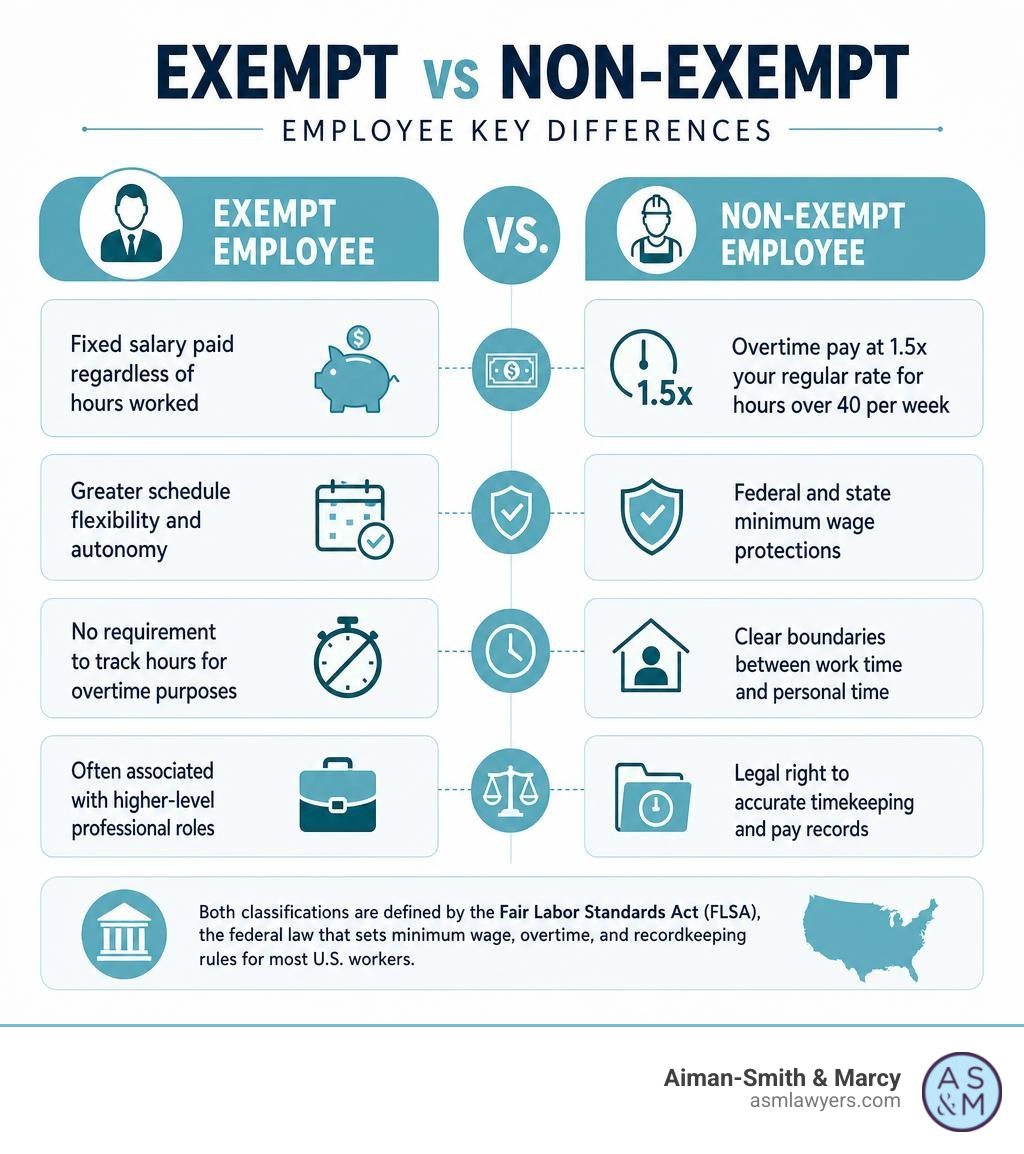
Here is a quick breakdown of the key benefits for each status:
Exempt Employee Benefits
- Fixed salary paid regardless of hours worked
- Greater schedule flexibility and autonomy
- No requirement to track hours for overtime purposes
- Often associated with higher-level professional roles
Non-Exempt Employee Benefits
- Overtime pay at 1.5x your regular rate for hours over 40 per week
- Federal and state minimum wage protections
- Clear boundaries between work time and personal time
- Legal right to accurate timekeeping and pay records
These two classifications are defined by the Fair Labor Standards Act (FLSA), the federal law that sets minimum wage, overtime, and recordkeeping rules for most U.S. workers. Your classification is not based on your job title. It is based on your actual duties and how you are paid.
Many workers are misclassified — often without realizing it — and that can cost them real money.
In this guide I’ll walk you through everything you need to know to understand which classification applies to you and what rights come with it.
Understanding the Core Differences and Benefits of Exempt vs Non Exempt
At our Oakland-based employment law firm, Aiman-Smith & Marcy, we regularly consult with workers who are confused about how their jobs are classified. Many believe that if they receive a salary, they are automatically “exempt” from overtime. This is one of the most common and costly myths in the modern workplace.
To determine whether an employee is exempt or non-exempt, the law looks past fancy job titles and focuses on three strict legal tests.
- The Salary-Level Test: The employee must earn a minimum salary threshold. Following the federal court vacatur of the 2024 Department of Labor rules, the federal minimum salary threshold for 2026 remains at $684 per week ($35,568 annually). However, as we will discuss below, states like California enforce significantly higher thresholds.
- The Salary-Basis Test: The employee must receive a predetermined, fixed salary that cannot be reduced because of the quality or quantity of the work performed. If an employer docks an employee’s pay for a partial-day absence or because business was slow, they violate this test, which can destroy the exempt status.
- The Duties Test: This is where most legal disputes arise. The employee’s actual day-to-day job duties must primarily involve executive, administrative, professional, computer, or outside sales responsibilities.
To help visualize how these two structures compare, our team has put together a quick breakdown of the core compensation structures:
| Feature | Exempt Employees | Non-Exempt Employees |
|---|---|---|
| Primary Pay Structure | Salaried (Fixed periodic pay) | Hourly (or hourly-equivalent salary) |
| Overtime Eligibility | No (with narrow exceptions) | Yes (1.5x regular rate after 40 hours/week) |
| Time Tracking | Generally not required by law | Strictly required |
| Minimum Wage Protection | Covered by salary thresholds | Covered by federal/state hourly minimums |
| Schedule Structure | Flexible, task-oriented | Fixed shifts or scheduled hours |
If you want to dive deeper into the basic federal criteria, you can learn more about FLSA classifications. However, because these tests are highly technical, employers frequently misapply them. If you suspect your job duties do not match your salaried status, you should ask yourself: Are you really exempt?
The Financial and Lifestyle Benefits of Exempt vs Non Exempt Status
When comparing the benefits of exempt vs non exempt status, there is no single “better” option. Instead, each classification offers a distinct trade-off between financial upside, schedule flexibility, and work-life balance.
For some professionals, the predictability of a steady salary and the freedom to manage their own hours is the ultimate workplace benefit. For others, the guarantee of earning overtime pay for every single minute worked past their standard schedule provides essential financial security and prevents burnout.
Let’s look at how these dynamics play out in real-world professional and hourly positions.
Exploring the Professional Benefits of Exempt vs Non Exempt Roles

For those classified as exempt, the primary advantages center on professional autonomy, salary stability, and lifestyle flexibility.
- Salary Stability: As an exempt employee, your paycheck is predictable. Whether you work 35 hours or 55 hours in a given week, your salary remains exactly the same. This protects you from financial dips during slow business cycles or seasonal downturns.
- Schedule Flexibility: Because exempt employees are paid for the outcomes they deliver rather than the hours they sit at a desk, they often enjoy the freedom to adjust their daily schedules. Need to leave early for a doctor’s appointment or attend a parent-teacher conference? An exempt employee can typically do so without worrying about docking their pay or using paid time off (PTO).
- Professional Prestige: Historically, exempt roles have been associated with leadership, management, and specialized professional tracks. These positions often come with greater upward mobility, discretionary bonuses, and higher long-term earning potential.
However, this flexibility is not a license for employers to take advantage of you. There are strict legal limits on how your employer can treat your pay and schedule. To understand your protections, read our detailed guide on what your employer cannot do if you are exempt.
Evaluating the Hourly Benefits of Exempt vs Non Exempt Positions

While exempt roles offer flexibility, non-exempt roles provide powerful financial and physical boundaries that protect workers from exploitation.
- Guaranteed Overtime Pay: The single greatest benefit of being a non-exempt employee is the right to earn overtime. Under federal law, any hours worked over 40 in a single workweek must be compensated at no less than time-and-a-half (1.5x) your regular hourly rate. In progressive states like California, this protection is even stronger, offering daily overtime and double-time.
- Clear Work-Life Boundaries: Because every minute of work costs the employer money, companies are highly motivated to keep non-exempt employees on structured schedules. When you clock out, your workday is officially over. You are not expected to answer late-night emails or handle weekend emergencies for free.
- Protection Against Wage Theft: Non-exempt employees must be paid for all compensable hours, including mandatory training sessions, short rest breaks (under 20 minutes), and prep work.
Unfortunately, many employers try to squeeze extra “off-the-clock” work out of hourly staff. If you have been forced to work unpaid hours, you have the legal right to fight back. Learn more about the process of recovering unpaid overtime wages to get the compensation you earned.
Health Insurance, Benefits, and Tax Implications
Beyond daily pay and schedules, your classification can also influence your employer-sponsored benefits and tax treatment.
Under federal laws like the Affordable Care Act (ACA) and the Employee Retirement Income Security Act (ERISA), employers are allowed to offer different benefits packages to different groups of employees, provided they do not discriminate based on protected characteristics (such as age, gender, or race).
For example, an employer can legally offer a more comprehensive health insurance plan or higher retirement matching to salaried (exempt) staff than to hourly (non-exempt) staff, as long as the distinction is based on objective business classifications.
Additionally, many modern businesses in 2026 utilize Individual Coverage Health Reimbursement Arrangements (ICHRAs). Under ICHRA rules, employers can divide their workforce into 11 distinct classes (such as salaried vs. hourly, or full-time vs. part-time) to offer varying levels of tax-free health insurance contributions.
From a tax perspective, both exempt and non-exempt employees receive W-2 tax forms, but their withholding patterns may differ:
- Exempt employees typically have highly consistent tax withholdings because their base pay rarely changes.
- Non-exempt employees may see their tax brackets and withholding amounts fluctuate from pay period to pay period depending on the amount of overtime, shift differentials, or hourly bonuses they earn.
To see how these benefits and tax structures integrate into modern payroll systems, you can read about benefits and classification differences.
How State Laws and Higher Salary Thresholds Impact Employee Benefits
While federal laws provide a baseline of worker protections, states have the legal authority to enact stricter standards. When federal and state laws conflict, the law that is most favorable to the employee always applies.
For workers in California, this interaction is incredibly important. California has some of the most robust worker protection laws in the country, rendering federal standards obsolete for local employers.
Here is how California’s 2026 standards compare to federal rules and other high-threshold states:
- California Minimum Salary Threshold (2026): To be classified as exempt in California, an employee must earn a fixed salary of at least twice the state’s minimum wage for full-time work. As of 2026, this translates to $1,352.00 per week ($70,304.00 annually). Any salaried worker earning less than this amount is automatically non-exempt and entitled to overtime, regardless of their job duties.
- California Daily Overtime: Unlike federal law, which only requires overtime after 40 hours in a workweek, California requires employers to pay 1.5x the regular rate for any hours worked over 8 in a single workday, and double-time (2x) for any hours worked over 12 in a single workday.
- Specialized Computer Software Exemption: California enforces an incredibly high salary threshold for exempt computer professionals. In 2026, software engineers and programmers must earn at least $58.85 per hour (or $122,573.13 annually) to be exempt from overtime.
- Other High-Threshold States: For comparison, Washington state’s 2026 minimum exempt threshold is $1,541.70 per week ($80,168.40 annually), while New York City and its surrounding counties require $1,275 per week ($66,300 annually) for executive and administrative exemptions.
If you work in the Golden State, understanding these local nuances is vital to protecting your paycheck. For a complete breakdown of your local rights, read our comprehensive guide on California exempt vs non-exempt classification.
The Risks of Misclassification and Employer Rights
Employee misclassification is not just an administrative oversight; it is a serious violation of state and federal labor laws. When an employer misclassifies a non-exempt worker as exempt, they are essentially depriving that worker of their legally protected right to overtime pay, meal periods, and rest breaks.
The Consequences of Misclassification
If an employee is found to have been misclassified, the financial penalties for the employer can be devastating. Courts can order the business to pay:
- Back Wages: Unpaid overtime compensation going back up to three years for willful violations.
- Liquidated Damages: An additional amount equal to the back wages (effectively doubling the owed amount).
- Interest and Penalties: State-specific civil penalties, such as California’s Private Attorneys General Act (PAGA) fines.
- Attorney Fees: The employer must pay the employee’s reasonable legal fees and litigation costs.
Can Employers Voluntarily Choose to Reclassify?
Yes. In fact, the Department of Labor issued DOL Opinion Letter FLSA2026-1, which explicitly confirmed that employers have the right to classify otherwise exempt-qualifying employees as non-exempt as a business decision.
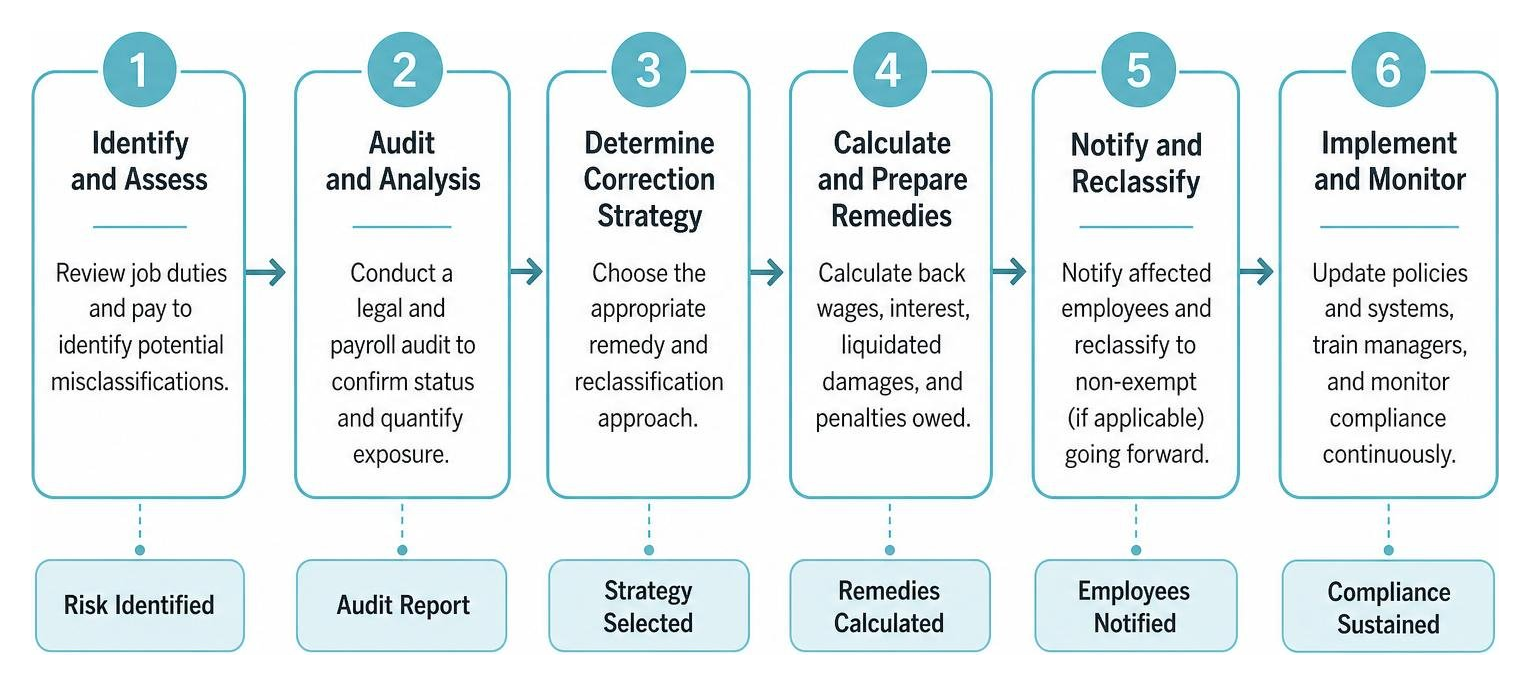
However, executing a reclassification must be handled carefully. If an employer realizes they have misclassified a group of workers, they cannot simply change their status going forward and sweep the historical unpaid overtime under the rug.
To help visualize how a proper legal correction should take place, review this compliance sequence:
If you believe your employer has misclassified you to avoid paying overtime, you can find more information in our HR-focused FLSA classification guide for HR or explore our legal overview of exempt employee misclassification risks.
Frequently Asked Questions About Employee Classification
Can an employer choose to classify an otherwise exempt employee as non-exempt?
Yes. Under federal and state labor guidelines, “non-exempt” is the default legal classification for all workers. Employers are always legally permitted to provide more protections to an employee than the law requires. If an employer wants to pay a highly skilled manager or software engineer on an hourly basis with overtime benefits, they are fully entitled to do so.
Does having a “manager” job title automatically make an employee exempt?
Absolutely not. Job titles are legally irrelevant under both the FLSA and California Labor Code. To qualify for the executive exemption, an employee’s primary duties must actually involve managing the enterprise or a recognized department, customarily directing the work of two or more full-time employees, and holding genuine authority to hire, fire, or promote staff. If a “manager” spends 80% of their shift working a cash register or performing manual labor, they are legally non-exempt.
How does the salary-basis test determine which protections an employee receives?
The salary-basis test requires that an exempt employee receive a guaranteed, fixed salary every single week, regardless of how many hours they work or the quality of their output. If an employer reduces an employee’s salary because of a business slowdown, a partial-day absence, or disciplinary reasons, the salary-basis test is violated. Once this test is failed, the employee loses their exempt status and becomes eligible for overtime protections.
Conclusion
Determining the right classification for your unique career path requires carefully weighing the benefits of exempt vs non exempt status. Whether you prefer the flexibility and predictable income of an exempt salary or the financial protections and strict boundaries of a non-exempt hourly wage, your employer must play by the rules.
Unfortunately, wage theft and worker misclassification remain rampant across California. At Aiman-Smith & Marcy, we are a collaborative, boutique employment law firm based in Oakland, California. Our tightly knit team of attorneys has spent more than 25 years working together to stand up for workers’ rights. We specialize in representing employees in cases involving workplace discrimination, unpaid wages, and complex class-action lawsuits.
If you believe your employer has misclassified your role, denied you overtime pay, or violated your rights under California’s strict labor laws, we are here to help.
Protect your rights with California wage and hour attorneys by contacting Aiman-Smith & Marcy today for a professional consultation.
Legal Disclaimer
This article is for general informational purposes only and does not constitute legal advice. Reading this article or contacting ASM Lawyers does not create an attorney-client relationship. Laws change over time and every situation is different. For advice about your specific circumstances, consult a licensed California attorney.
Talk to ASM Lawyers
Have questions about how California law applies to your situation? The team at ASM Lawyers offers consultations to help you understand your rights and options. Visit https://asmlawyers.com/contact/ to speak with an attorney about your case.
Attorney Advertising.


