
What Exempt and Non-Exempt Mean for Your Pay
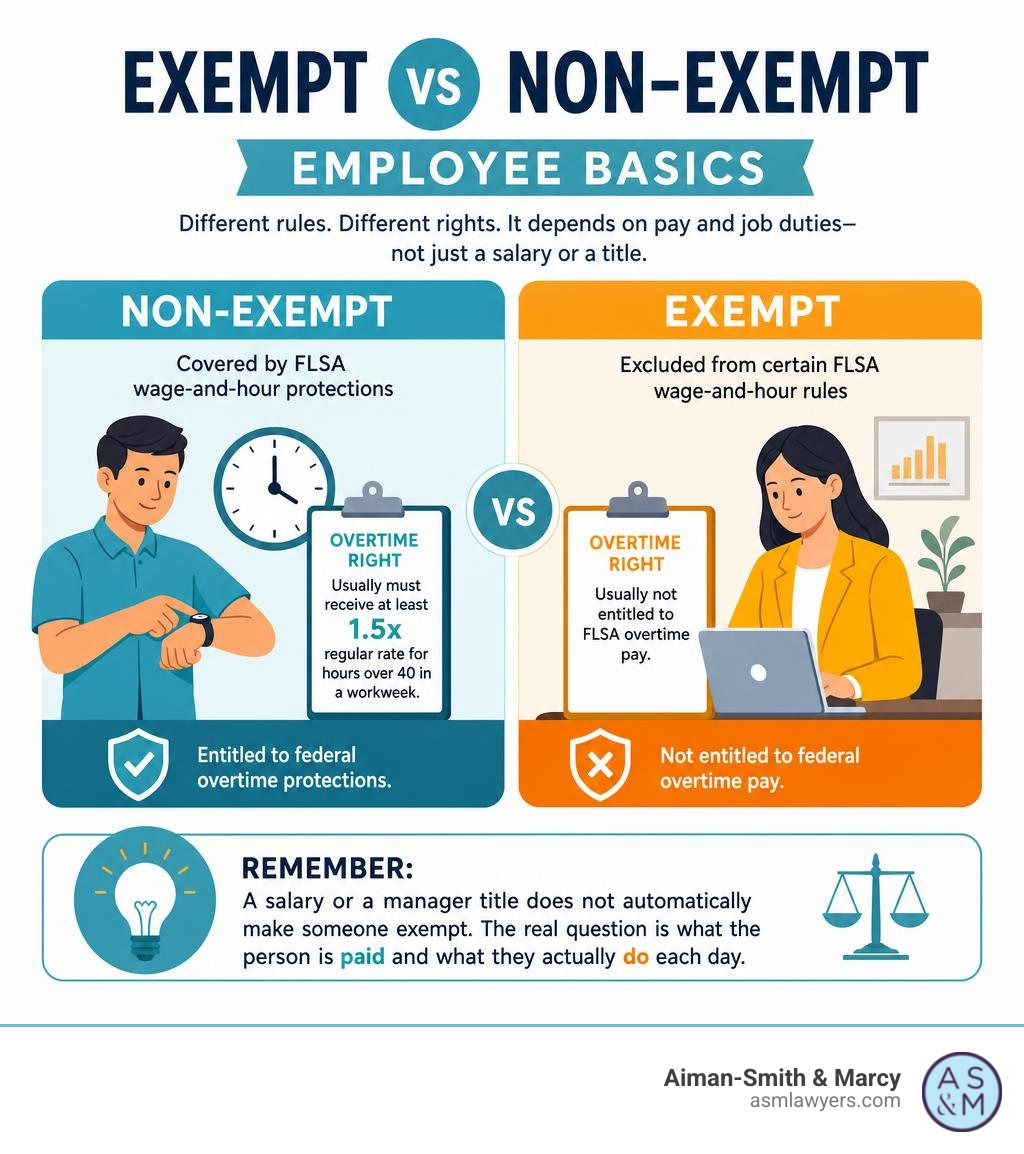
The definition of exempt and non exempt status is simple: non-exempt employees generally have federal minimum-wage and overtime protections, while exempt employees do not qualify for overtime under the Fair Labor Standards Act (FLSA) if they meet strict pay and job-duty rules.
| Status | Basic meaning | Overtime right under federal law |
|---|---|---|
| Non-exempt | Covered by FLSA wage-and-hour protections | Usually must receive at least 1.5 times their regular rate for hours over 40 in a workweek |
| Exempt | Excluded from certain FLSA wage-and-hour rules because the job meets a legal exemption | Usually not entitled to FLSA overtime pay |
A salary does not automatically make someone exempt. Neither does a manager title. The real question is what the person is paid and what they actually do each day.
For Oakland and California workers, the answer can be even more important. State wage laws often provide stronger protections than federal law, including higher salary requirements and daily overtime rules. Aiman-Smith & Marcy represents individuals in employment matters, including individual, PAGA, and class actions involving wage-and-hour violations and worker misclassification.
Must-know definition of exempt and non exempt terms:
Legal Definition of Exempt and Non Exempt Status Under the FLSA
The primary legal baseline governing employee compensation across the United States is the Fair Labor Standards Act (FLSA), originally enacted in 1938. Under federal law, the default legal rule is that every employee is non-exempt. This means an employer must treat every worker as covered by federal minimum wage and overtime requirements unless the employer can affirmatively establish that a specific legal exemption applies.
Federal statutory provisions set forth in 29 USC 213: Exemptions exclude specific categories of workers from FLSA minimum wage or overtime guarantees. However, these exclusions are narrow exceptions to the general rule of worker protection. When an employer claims a worker is exempt, the legal burden rests entirely on the employer to prove that the worker’s compensation and daily job tasks satisfy every element of the statutory test.
To better understand this broader statutory framework, employees can explore our breakdown on Understanding classification debate. As we see every day in our plaintiff-side wage recovery practice, many employers mistakenly operate as if paying a fixed salary or assigning a professional-sounding job title automatically strips an employee of overtime eligibility. In reality, the legal definition of exempt and non exempt status depends strictly on regulatory criteria, not executive preference or internal job labels.
Statutory Definition of Exempt and Non Exempt Workers
The statutory framework divides employees into two primary legal categories:
- Non-Exempt Employees: Workers entitled to federal minimum wage rates and mandatory overtime compensation (time and one-half the regular rate of pay) for any hours worked beyond 40 in a single workweek. Hourly workers, manual laborers, customer service representatives, administrative support staff, and many service personnel are non-exempt by default.
- Exempt Employees: Workers excluded from FLSA minimum wage and overtime protections because their position fulfills specific statutory exemptions. These exemptions primarily apply to bona fide executive, administrative, professional, creative, computer, and outside sales positions—frequently referred to as “white-collar exemptions.”
Specific Exemption Categories and Exclusions
To streamline federal wage standards, the U.S. Department of Labor (DOL) publishes administrative guidance, such as Fact Sheet #17A guidelines, defining white-collar exemption criteria. Under these rules, exemptions apply strictly to administrative, executive, professional, computer, and outside sales staff who satisfy specific compensation levels and duty tests.
Conversely, federal regulations explicitly bar certain types of workers from being classified as exempt white-collar employees, regardless of how much money they earn or how highly skilled they are:
- Blue-Collar Workers and Manual Laborers: Skilled tradespeople and manual workers—including carpenters, electricians, mechanics, plumbers, construction workers, ironworkers, line workers, and assembly plant operators—are legally non-exempt. The law recognizes that work involving repetitive operations with hands, physical skill, and physical energy cannot be classified as white-collar management or professional work.
- First Responders: Police officers, detectives, deputy sheriffs, state troopers, firefighters, paramedics, emergency medical technicians (EMTs), rescue workers, ambulance personnel, and correctional officers are legally non-exempt from overtime protections under Part 541 white-collar regulations, regardless of their rank or salary level.
The Three-Part Test for FLSA Employee Classification

To legally classify a worker as an exempt white-collar employee under federal rules, an employer must satisfy all three prongs of the standard FLSA exemption test. If an employee fails even one prong, the worker remains non-exempt and is entitled to full minimum wage and overtime pay.
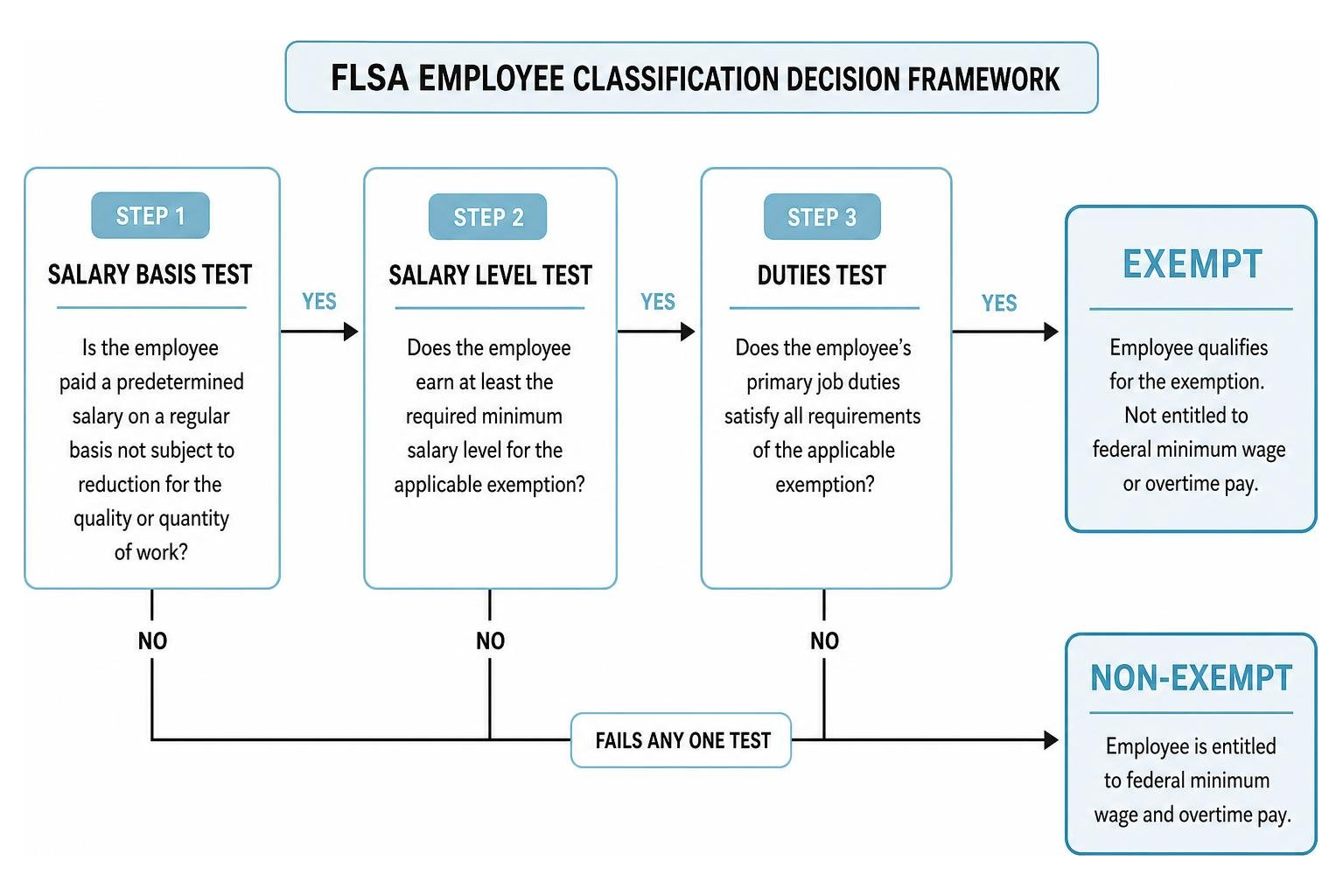
Determining where a position falls requires checking salary structure, salary total, and daily duties. For a helpful overview on evaluating these elements, see our guide on How to determine status.
Salary Basis and Salary Level Tests
The first two prongs of the FLSA classification test focus strictly on how and how much an employee is paid:
- Salary Basis Test: The employee must receive a predetermined, fixed salary that does not fluctuate based on the quality or quantity of work performed in any given workweek. An exempt employee must generally receive their full salary for any week in which they perform work, regardless of how many or how few hours they log.
- Salary Level Test: The guaranteed regular salary must meet or exceed federal statutory minimum threshold levels. Under active federal standards, the standard federal salary threshold is $684 per week, which equals $35,568 annually. Employers may use nondiscretionary bonuses, incentive payments, and commissions paid on an annual or more frequent basis to satisfy up to 10 percent of this standard federal salary threshold.
A critical aspect of the salary basis test is that employers cannot make improper deductions from an exempt employee’s salary for partial-day absences, quality errors, or fluctuations in operational workload. To learn more about what managers can and cannot deduct from paychecks, read our detailed article on What employers cannot do.
Primary Duties Test and Specific Role Nuances
The third prong—the primary duties test—is where wage-and-hour disputes most frequently arise. Having a managerial job title or receiving a fixed salary is legally meaningless if the worker’s primary job tasks involve non-exempt labor. Under federal rules, “primary duty” means the main, most important responsibility the employee performs.
The standard white-collar duty tests include:
- Executive Exemption: The employee’s primary duty must be managing the enterprise or a recognized department/subdivision; they must customarily and regularly direct the work of two or more full-time employees (or the equivalent in part-time staff); and they must possess the authority to hire or fire employees, or their suggestions regarding hiring, firing, advancement, or promotion must carry significant weight.
- Administrative Exemption: The employee’s primary duty must be performing office or non-manual work directly related to the management or general business operations of the employer or the employer’s customers; and their primary duty must include the exercise of discretion and independent judgment with respect to matters of significance.
- Learned Professional Exemption: The employee’s primary duty must be performing work requiring advanced knowledge in a field of science or learning, customarily acquired by a prolonged course of specialized intellectual instruction (such as licensed attorneys, certified public accountants, registered nurses, and engineers).
- Computer Employee Exemption: The employee must be employed as a computer systems analyst, computer programmer, software engineer, or other similarly skilled computer professional. Under federal law, these workers can be paid on a salary basis meeting standard thresholds or an hourly rate of not less than $27.63 per hour. However, it is essential to note that the federal $27.63 hourly figure is only the baseline. State wage laws—most notably in California—enforce significantly higher hourly pay thresholds to keep an IT professional exempt from overtime rights.
When evaluating technical or staffing roles, workers often ask about temporary assignments. It is an important wage-and-hour rule that neither federal law nor California state law imposes a blanket statutory cap on how long a private employer can keep an individual classified as a temporary worker. However, temporary status does not strip an employee of non-exempt overtime rights if their daily duties or pay structure fail exemption requirements.
Practical Application and Definition of Exempt and Non Exempt Roles
In real-world workplaces, the true definition of exempt and non exempt positions turns entirely on what happens during a shift rather than what is written in a formal job description.
A common example involves “working supervisors” or assistant managers in retail, restaurant, or warehouse environments. If a shift supervisor spends 70% of their workday working a cash register, stocking shelves, unloading delivery trucks, or preparing food, they do not qualify for an executive exemption—even if they hold a salaried title and occasionally lock up the building. Workers suspecting their duties have been mislabelled can review our analysis on Checking supervisor duties.
Furthermore, part-time status can create unique classification issues. An employee working part-time hours can technically perform professional or administrative duties, but if their overall regular pay falls below the minimum statutory weekly salary threshold, the employer cannot classify them as exempt. Under federal and state rules, the weekly salary threshold cannot be prorated for part-time effort; the full guaranteed weekly baseline must be met.
Key Differences in Overtime Eligibility and State Law Overrides

The practical consequences of worker classification directly impact an employee’s weekly paycheck and working conditions. The fundamental operational differences between exempt and non-exempt classifications include:
| Protection / Requirement | Non-Exempt Employees | Exempt Employees |
|---|---|---|
| Federal Overtime Eligibility | Mandatory time and a half for hours worked over 40 in a workweek | Exempt from FLSA overtime rules |
| Timekeeping Requirements | Employers must maintain exact, total daily and weekly hour records | Accurate daily clocking generally not required by federal law |
| Pay Calculations | Paid hourly or salaried non-exempt; extra hours yield extra pay | Paid fixed guaranteed salary regardless of actual hours worked |
| Meal and Rest Break Rules | Governed strictly by statutory state and local rest break rules | Excluded from statutory break rules in many jurisdictions |
When a non-exempt employee receives fixed weekly pay rather than an hourly wage, they are classified as a “salaried non-exempt” worker. If a salaried non-exempt worker works more than 40 hours in a workweek, the employer must calculate their effective hourly regular rate for that week and pay time-and-a-half overtime for every additional hour. In cases where extra hours push effective compensation down, employers must apply blended rate formulas to ensure statutory minimum wage and overtime requirements are fully met.
Understanding these operational requirements helps employees evaluate their daily schedules, as discussed in To clock or not to clock.
State and Local Law Variations
While the FLSA sets the federal baseline across the United States, states retain full authority to pass wage and hour laws that offer higher protections to employees. Under federal statutory conflict rules, whenever federal law and state law establish different standards, employers must strictly comply with whichever standard provides greater protection and higher pay to the employee.
State variations heavily influence wage rules in major employment markets like California. In California, wage-and-hour protections far exceed federal baselines:
- California Minimum Wage (2026): $16.90 per hour for all employers.
- California Exempt Salary Threshold (2026): In California, an exempt white-collar employee must earn a fixed salary equal to at least two times the state minimum wage for full-time employment (40 hours per week). Based on the $16.90 state minimum wage, the California exempt salary threshold is $1,352 per week, which equals $70,304 annually.
- California Daily Overtime Protections: Unlike federal law—which only mandates overtime after 40 hours in a workweek—California law mandates overtime (1.5 times regular pay) for any work beyond 8 hours in a single workday or beyond 40 hours in a workweek, as well as for the first 8 hours on the seventh consecutive day of work.
- California Double Time Protections: California requires employers to pay double the regular rate of pay for any work performed beyond 12 hours in a single workday, and for all hours worked beyond 8 hours on the seventh consecutive day of work.
Workers seeking deeper legal context on state standards can consult resources such as Exempt vs. Nonexempt Employees | California Labor Law and Exempt vs. non-exempt employees: What’s the difference?, as well as our firm’s specialized guide on California classification rules.
Misclassification Risks, Penalties, and Employee Rights
Misclassifying a worker as an exempt employee when they are legally non-exempt is one of the most widespread and costly wage violations committed by employers. When an employer misclassifies a worker, the employee is wrongfully deprived of earned overtime compensation, statutory meal and rest breaks, and accurate itemized wage statements.
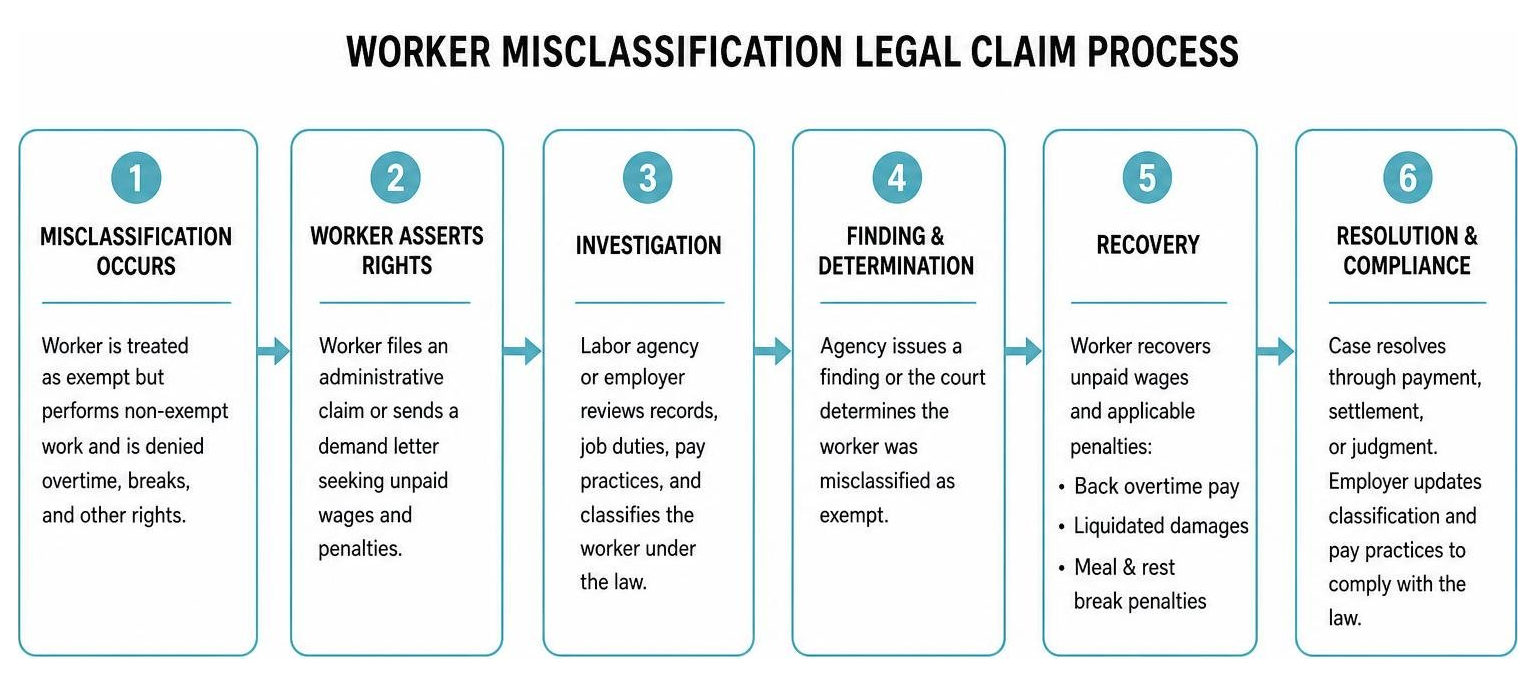
When misclassified workers enforce their rights under California labor statutes and the FLSA, employers face severe financial consequences, including:
- Back Overtime Pay: Full recovery of all unpaid overtime compensation stretching back through the applicable statute of limitations (up to three years under the FLSA for willful violations, and up to four years under California law).
- Liquidated Damages: Federal law allows courts to award double back pay as liquidated damages unless the employer proves they acted in good faith.
- Meal and Rest Break Penalties: Under California law, employees denied compliant 30-minute meal breaks or 10-minute rest breaks are entitled to one additional hour of pay at their regular rate for each workday a break violation occurred.
- Paystub and Timely Payment Penalties: Statutory penalties for failing to provide accurate itemized wage statements showing actual total hours worked and applicable hourly rates.
- Interest, Legal Fees, and Costs: Employers found liable for wage violations are required to pay statutory prejudgment interest and cover the employee’s legal expenses and court fees.
To learn more about how misclassification impacts worker rights and legal remedies, review our legal guides on All about worker misclassification, Exempt employee misclassification claims, and Are you really exempt.
Frequently Asked Questions About Worker Classification
Can a salaried employee be classified as non-exempt?
Yes. Receiving a fixed salary does not make a worker legally exempt. If a salaried employee performs non-exempt job duties or earns a salary below the required state or federal threshold, the employer must classify them as a “salaried non-exempt” worker. The employer is legally required to track all daily hours worked and pay time-and-a-half overtime for any hours logged beyond standard workweek thresholds.
Does a management job title automatically make an employee exempt?
No. Job titles carry zero weight under state or federal exemption laws. A position titled “Store Manager,” “Executive Assistant,” or “Operations Director” is non-exempt if the worker’s primary daily duties consist of routine administrative tasks, customer service, or manual labor, or if they lack genuine managerial authority to direct staff and exercise independent judgment on key business decisions.
How do state threshold laws affect federal FLSA rules?
State labor laws establish an independent floor of protection. When a state or municipal government sets a higher minimum wage or a higher salary threshold for exemption than the federal FLSA baseline, the employer must comply with the stricter state or local requirement. For example, while the federal salary threshold remains $684 per week ($35,568 per year), California employers must pay at least $1,352 per week ($70,304 per year) for white-collar workers to qualify for exemption.
Conclusion
Understanding the true definition of exempt and non exempt employee classifications is essential for every worker. Classification determines whether you receive overtime pay for long hours, whether your employer must track your working time, and whether you are protected by mandatory meal and rest break rules. Job titles, salary labels, and employer preferences never dictate exemption status—only actual pay structures and primary daily job duties control under the law.
As an Oakland-based plaintiff-side employment law firm, Aiman-Smith & Marcy brings over 25 years of collaborative litigation experience representing workers in individual lawsuits, representative PAGA actions, and class actions. We do not represent employers or corporations; our legal team is dedicated to helping individual employees recover unpaid overtime wages, combat worker misclassification, and enforce full workplace protections under California and federal law. To explore state classification standards in detail, visit our comprehensive resource to Protect your wage rights.
Laws change over time and every situation is different. For advice about your specific circumstances, consult a licensed California attorney.
Talk to ASM Lawyers Have questions about how California law applies to your situation? The team at ASM Lawyers offers consultations to help you understand your rights and options. Visit https://asmlawyers.com/contact/ to speak with an attorney about your case.
Attorney Advertising
Legal Disclaimer This article is for general informational purposes only and does not constitute legal advice. Reading this article or contacting ASM Lawyers does not create an attorney-client relationship.


