

Overview of California Sick Time Laws and Eligibility Requirements
California maintains some of the strongest worker protections in the nation. Under the California Paid Sick Leave statutory framework, codified primarily in the Healthy Workplaces, Healthy Families Act of 2014 and expanded by Senate Bill 616, paid sick time is a mandatory statutory right. Eligible employees must be provided with at least 40 hours or five days of paid sick leave per year—whichever is greater based on the worker’s regular schedule.
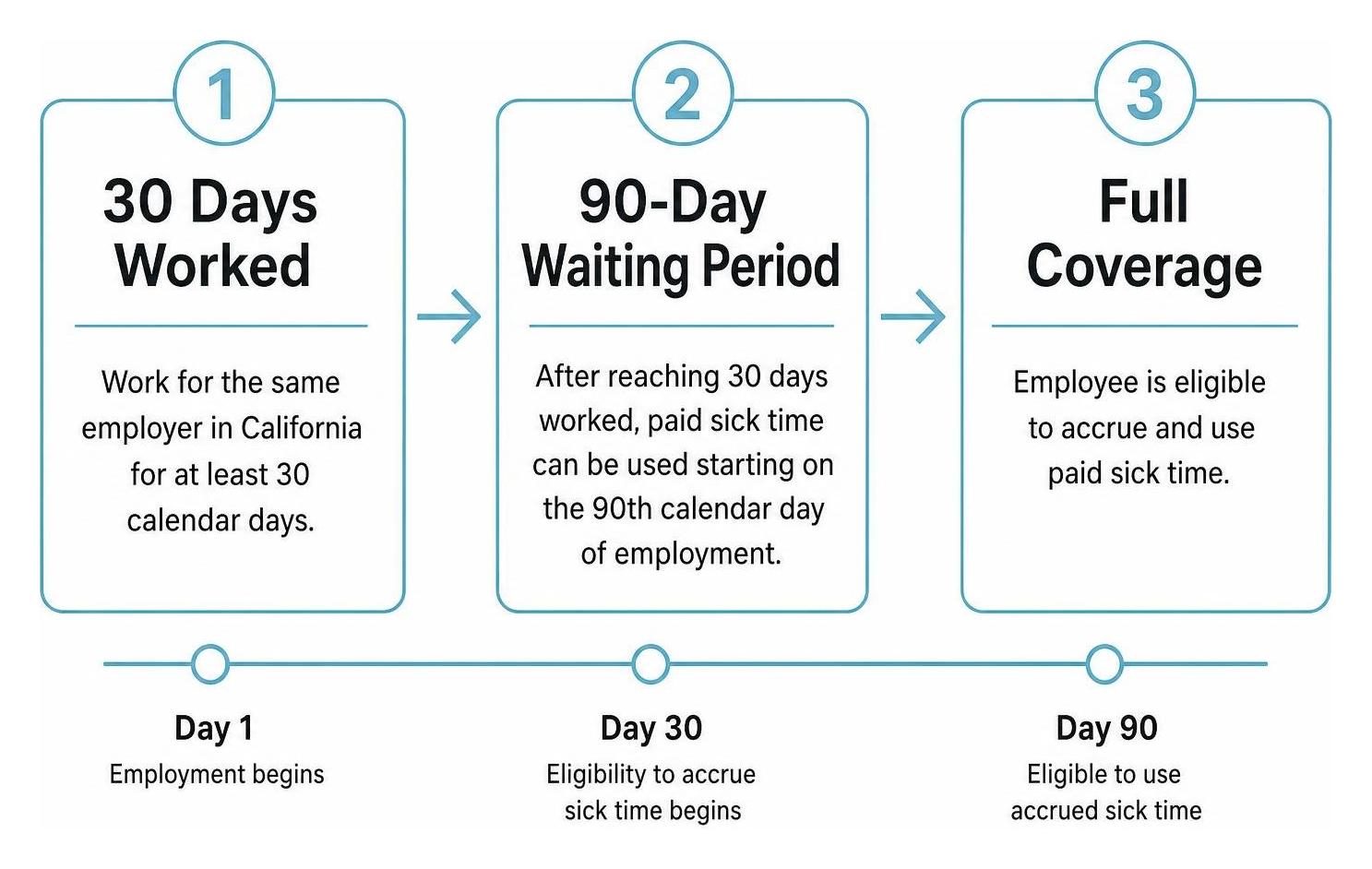
To qualify, an employee needs to work for the same employer in California for at least 30 calendar days within a 12-month period. Once that 30-day threshold is met, the worker qualifies to accrue or receive paid sick time, and becomes eligible to use that accrued time starting on their 90th calendar day of employment.
These rules apply across the board, establishing key California requirements impacting time off regardless of whether you work in an office, on a construction site, or from home.
Qualifying Criteria and Covered Employees
The law covers virtually every classification of worker in California, including:
- Full-Time Employees: Standard workers accruing leave on regular schedules.
- Part-Time Employees: Workers who log fewer hours per week but still earn sick leave proportionally.
- Temporary and Seasonal Staff: Workers brought in for short projects or seasonal rushes. It is worth noting that neither federal nor California law imposes a blanket statutory cap on how long a private employer can keep an individual classified as temporary, but temporary workers earn mandatory sick leave just like permanent staff.
- Staffing Agency Workers: Employees assigned through third-party agencies, where the staffing agency, the host company, or both act as joint employers responsible for providing paid sick time.
- Exempt Employees: Salaried executive, administrative, and professional workers. For sick time accrual purposes, exempt employees are presumed to work 40 hours per week unless their regular workweek is less.
If you are unsure about your coverage status, reviewing am I entitled to paid sick leave in California can help clarify your rights under state statutes.
Accrual vs. Front-Loading: How Leave Is Earned and Banked
California permits employers to choose between two main structures for distributing paid sick leave: standard accrual or the front-loading (lump-sum) method. Understanding the ins and outs of California PTO and sick time laws helps workers monitor whether their pay stubs accurately track their earned leave.
- The Standard Accrual Method: Under the statutory default, employees earn at least 1 hour of paid sick leave for every 30 hours worked (a 1:30 ratio), counting regular and overtime hours. Accrual begins on the very first day of work.
- Alternative Accrual Methods: Employers may use a custom accrual rate other than 1:30, provided the accrual is regular and the employee earns at least 24 hours (or 3 days) of sick leave by their 120th calendar day of employment, and at least 40 hours (or 5 days) by their 200th calendar day.
- The Front-Load (Lump-Sum) Method: Employers can avoid accrual tracking entirely by providing the full statutory minimum—at least 40 hours or five days—upfront at the beginning of each 12-month period, fiscal year, or anniversary year.
Managing Accrual Caps and California Sick Time Carryover
When employers use the accrual method, unused sick days do not vanish on December 31. State law prohibits a “use-it-or-lose-it” approach on accrued time, meaning banked hours must carry over into the following year. However, employers can apply specific statutory caps:
- Annual Usage Cap: An employer may limit an employee’s use of paid sick leave to 40 hours or 5 days per year.
- Overall Accrual Cap: An employer may cap total cumulative accrual at 80 hours (or 10 days). Once an employee’s balance hits 80 hours, accrual pauses until they use some of that banked time.
If an employer uses the front-load method and provides 40 hours or 5 days at the start of each year, they are not required to permit carryover into the next benefit year.
| Feature | Front-Load Method | Accrual Method (1:30 Ratio) |
|---|---|---|
| Initial Allocation | 40 hours / 5 days upfront | Earns 1 hour per 30 hours worked |
| Year-End Carryover | No rollover required | Mandatory rollover of unused hours |
| Overall Bank Cap | Not applicable | Can be capped at 80 hours / 10 days |
| Annual Usage Cap | 40 hours / 5 days | Can be limited to 40 hours / 5 days |
| Paystub Tracking | Must show 40 hours (or balance) | Must show running accrued balance |
Calculating California Sick Time Pay Rates and Separation Rules
Sick leave must be paid no later than the payday for the next regular payroll period after the leave was taken. For nonexempt workers, employers calculate pay using one of two methods:
- The regular rate of pay for the workweek in which the leave was taken.
- A 90-day lookback method, dividing total non-overtime wages by total non-overtime hours worked in the full pay periods covering the prior 90 days.
For exempt salaried employees, sick leave pay is calculated in the same manner as the employer calculates wages for other forms of paid leave. When analyzing exempt status under California wage-and-hour rules in 2026, the California minimum wage is $16.90 per hour, making the exempt salary threshold $1,352 per week or $70,304 annually. For specific specialized roles, such as the computer employee exemption, the federal baseline hourly rate of $27.63 is only a baseline; California law imposes a substantially higher hourly pay rate threshold to keep overtime protections intact.
Unlike accrued vacation days, California law does not require employers to cash out standalone unused sick leave when you resign or are terminated. You can read more about what happens to your vacation pay when you quit or are fired to understand the legal distinction between vacation pay and sick pay.
However, if you leave a job and are rehired by the same employer within 12 months, the employer must immediately reinstate all previously accrued, unused sick leave that was not paid out upon departure.
Permitted Reasons to Use Sick Leave and Employer Obligations
California sick leave is designed to be accessible when life happens. Under California Labor Code Section 246.5, workers may use accrued sick time for:
- Personal Health: Diagnosis, care, treatment of an existing mental or physical health condition, or preventive care (such as annual checkups, dental cleanings, or vaccinations).
- Family Care: Caring for a family member needing diagnosis, treatment, or preventive care. Under California law, “family member” includes a biological, adopted, or foster child, stepchild, legal ward, parent, stepparent, legal guardian, spouse, registered domestic partner, grandparent, grandchild, or sibling.
- Designated Person: An employee may identify one “designated person” per 12-month period for whom they can use paid sick days to provide care.
- Safe Leave: Seeking medical attention, psychological counseling, victim services, or legal relief (including restraining orders) if the employee is a victim of domestic violence, sexual assault, stalking, or other qualifying acts of violence.
- Environmental Emergencies for Agricultural Workers: Outdoor agricultural employees may use sick time to avoid hazardous smoke, extreme heat, or flooding conditions during declared state or local emergencies.
To understand other types of emergency leaves, check our guide on emergency sick leave 101 your guide to paid time off in a pinch.

Employers also carry administrative duties under the Healthy Workplace Healthy Family Act of 2014 (AB 1522). They must display the official paid sick leave poster, provide written notice of terms at hire, show available sick time on itemized wage statements (paystubs) every payday, and retain sick leave accrual and usage records for a minimum of three years.
Workplace Protections and Anti-Retaliation Rules
The law strictly shields workers who exercise their right to use paid sick days. Key protections include:
- No Replacement Worker Mandates: Under Labor Code § 246.5(b), an employer cannot condition your use of sick time on finding a coworker to cover your shift.
- Absence Control and “Point System” Prohibitions: Employers cannot assign attendance “occurrences,” penalty points, or disciplinary write-ups under an absence control policy for using accrued, available sick leave. Doing so violates both sick leave laws and California’s Kin Care protections (Labor Code §§ 233 and 234).
- Reasonable Increments: Employers may set a minimum usage increment, but that minimum cannot exceed two hours.
- Anti-Retaliation & 30-Day Presumption: Employers cannot fire, demote, suspend, threaten, or discriminate against an employee for requesting or using sick leave. Under California law, if an employer takes negative employment action against a worker within 30 days of the worker filing a complaint, cooperating with an investigation, or opposing unlawful sick leave policies, the law creates a rebuttable presumption of unlawful retaliation.
If an employer cuts your hours, issues a warning, or tampers with your earned time off, read our breakdown on i think my employer is messing with my PTO is that legal to identify unlawful practices.
Local City Ordinances and Special Industry Exemptions
While California sets a baseline minimum across the state, local cities and counties are free to enact ordinances offering more generous paid sick time. Where local municipal rules provide greater benefits, employers must follow the local law.

State law sets uniform rules for specific administrative mechanisms—such as paystub statements, calculation methods, foreseeable notice rules, timing of payment, and separation payout rules—which preempt contrary local rules. But total hour allowances are governed by the higher standard.
Major Municipal Sick Leave Ordinances in California
- San Francisco: Employers must provide 1 hour of paid sick leave per 30 hours worked. Employers with 10 or more workers must allow accrual up to 72 hours, while smaller employers can cap accrual at 40 hours.
- Oakland: Governed by Oakland workplace standards, employers with 10 or more workers must allow accrual up to 72 hours, whereas employers with fewer than 10 workers can cap accrual at 40 hours.
- Los Angeles: Requires employers to provide up to 48 hours of sick leave per year, either front-loaded or accrued at 1 hour per 30 hours worked, with an overall accrual cap of 72 hours.
- Berkeley: Mandates 1 hour per 30 hours worked, with a cap of 72 hours for employers with 25 or more workers and 48 hours for smaller employers.
For state-level standards, workers can always review official DIR paid sick leave guidelines.
Industry Exemptions and Collective Bargaining Agreements
Certain narrow employee categories are exempt or partially exempt from state sick leave requirements:
- Collective Bargaining Agreements (CBAs): Union employees covered by a valid CBA are exempt from state statutory sick leave only if the CBA expressly provides for paid sick leave, binding arbitration of disputes, and sets a regular hourly wage rate not less than 30% above the California minimum wage.
- Flight Deck or Cabin Crew: Airline flight deck and cabin crew employees covered by the federal Railway Labor Act are exempt, provided they receive compensated time off equal to state mandates.
- Public Sector Retired Annuitants: Specific public agency retirees are exempt.
Frequently Asked Questions About California Sick Leave
Can an employer require a doctor’s note before granting paid sick leave?
Under California law, an employer generally cannot deny paid sick leave simply because an employee does not provide a doctor’s note. The statute requires employers to grant sick time upon oral or written request. While an employer may request medical certification if there is clear, reasonable suspicion that the leave was taken for an unauthorized purpose, imposing blanket doctor’s note requirements for standard, short-term statutory sick days violates the spirit and text of the law.
What happens if an employee does not use all their accrued sick time?
If your employer uses an accrual policy, unused sick hours roll over to the next year, subject to the employer’s overall accrual cap (which cannot be lower than 80 hours or 10 days). Employers do not have to pay out unused standalone sick leave when your employment ends. However, if you return to the same company within 12 months, your employer must restore your prior unused sick balance.
How does paid sick leave interact with regular PTO or vacation policies?
Employers are not required to provide a separate “sick leave” bank if they offer an all-inclusive Paid Time Off (PTO) policy. However, that PTO policy must:
- Provide at least 40 hours or 5 days of leave per year.
- Allow the time to be used for all statutory sick leave purposes (including family care and safe leave).
- Comply with the statutory accrual or frontloading rates.
Crucially, because California treats all generic PTO as accrued vacation wages under Labor Code § 227.3, any unused PTO in a combined bank must be cashed out in full at your final pay rate upon termination.
Conclusion
Understanding your workplace rights is essential to ensuring you receive every hour of pay and protected leave you have earned. If your employer refuses to provide mandatory sick time, penalizes you for calling in sick, fails to show your balance on your wage statements, or retaliates against you for taking time off, you do not have to navigate the dispute alone.
Take the time to learn whether you are entitled to paid sick leave in California and stand up for your legal workplace protections.
Laws change over time and every situation is different. For advice about your specific circumstances, consult a licensed California attorney.
Talk to ASM Lawyers
Have questions about how California law applies to your situation? The team at ASM Lawyers offers consultations to help you understand your rights and options. Visit our Contact page to speak with an attorney about your case.
Aiman-Smith & Marcy is an Oakland-based boutique, plaintiff-side employment and consumer fraud law firm representing individuals in individual, PAGA, and class actions. Our collaborative team brings over 25 years of experience fighting for workers facing wage theft, discrimination, and unlawful employer retaliation.
Attorney Advertising.
Legal Disclaimer
This article is for general informational purposes only and does not constitute legal advice. Reading this article or contacting ASM Lawyers does not create an attorney-client relationship.