

California Law Sick Time Rollover: The Quick Answer
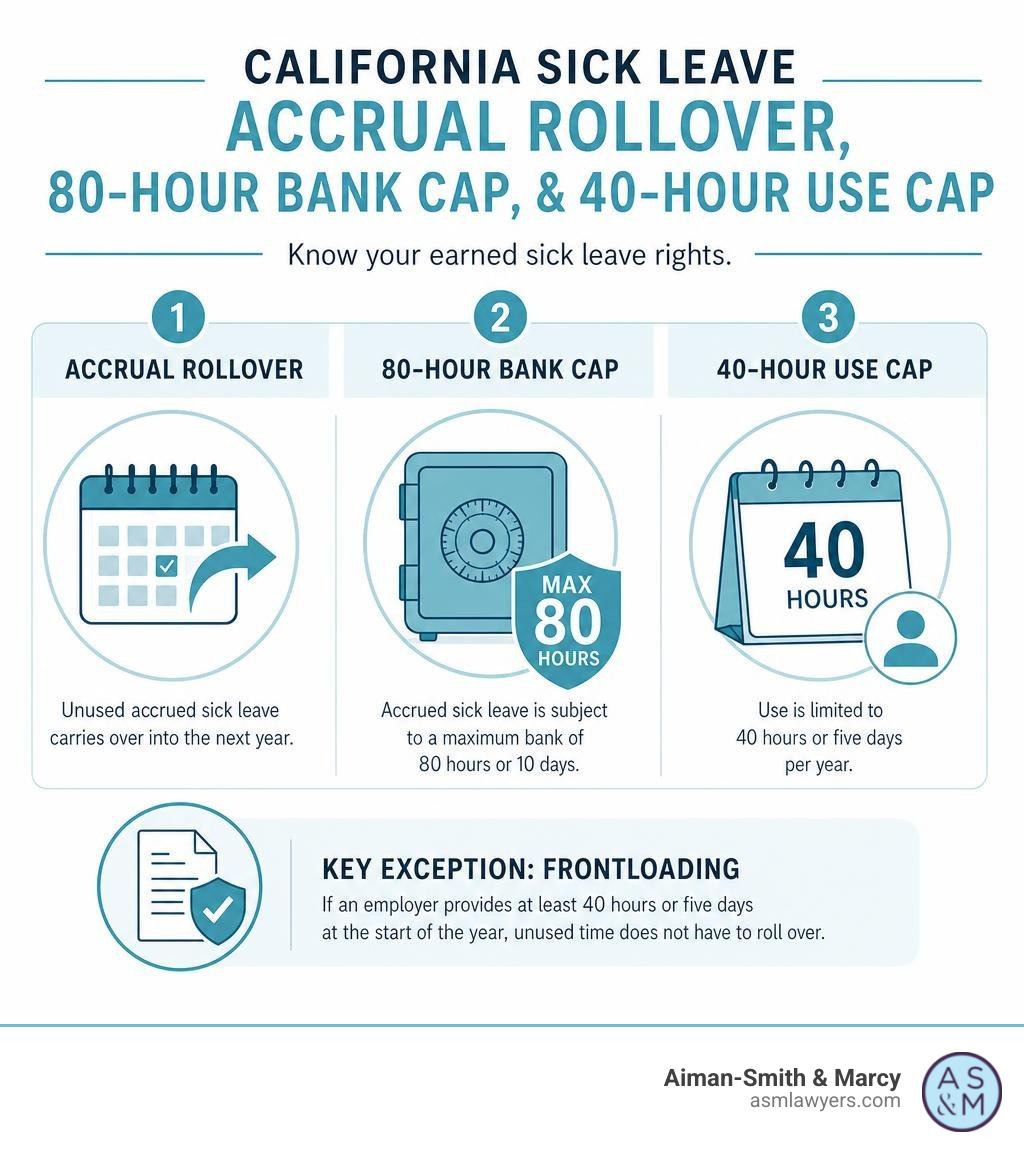
Yes. California law generally requires unused accrued paid sick leave to carry over into the next year. But an employer using an accrual policy may cap an employee’s total sick-leave bank at 80 hours or 10 days and may limit use to 40 hours or five days per year.
The key exception is frontloading. If an employer provides the full required amount of paid sick leave at the beginning of each benefit year, it generally does not have to carry unused time forward.
Here is the simple breakdown:
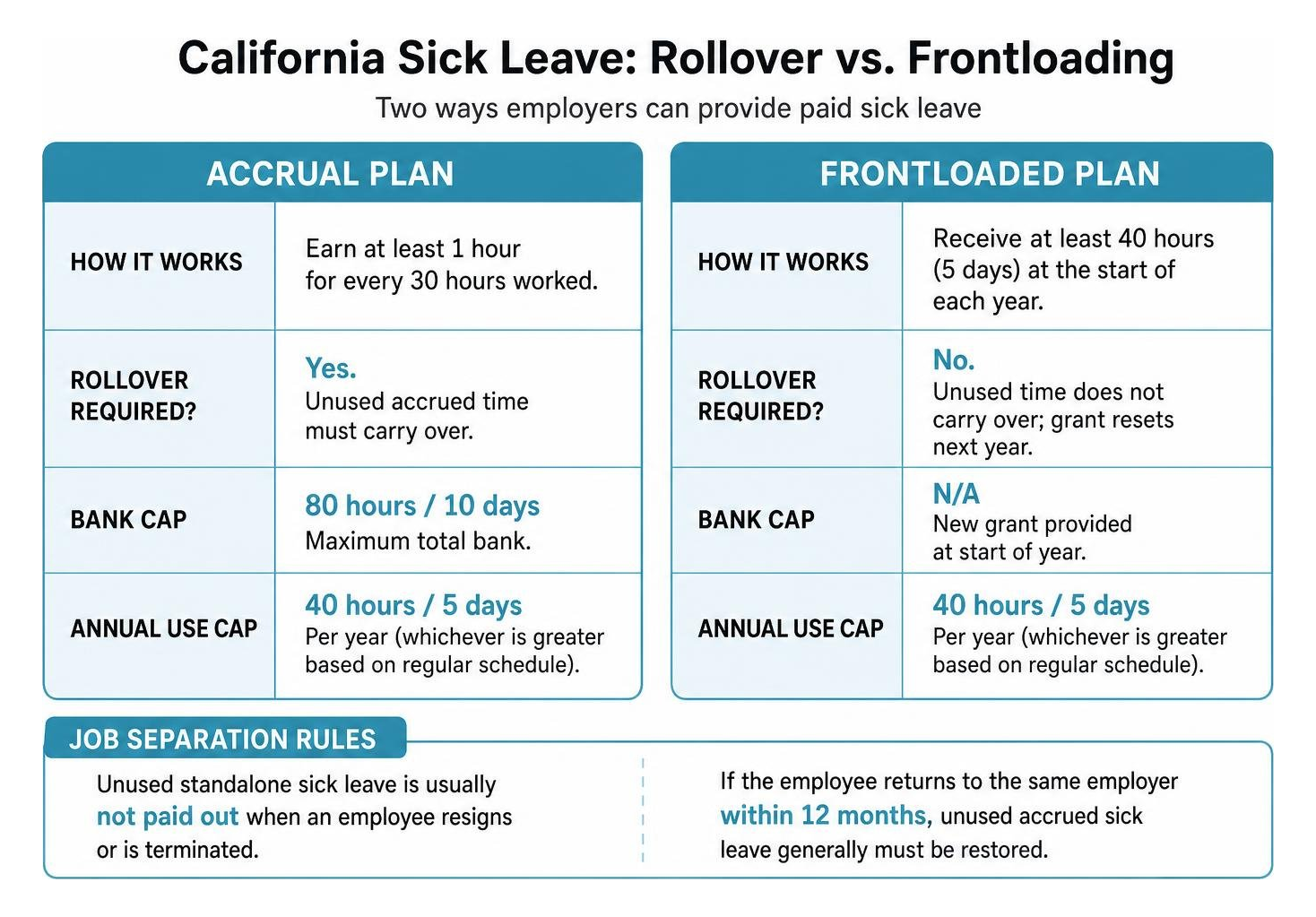
- Accrual plan: Sick leave is earned over time, usually at least 1 hour per 30 hours worked. Unused accrued time rolls over, subject to the allowed 80-hour or 10-day bank cap.
- Frontloaded plan: The employer gives at least 40 hours or five days at the start of the year. It may reset that grant at the next year without rollover.
- Job separation: Unused standalone sick leave usually is not paid out when someone resigns or is terminated. If the employee returns to the same employer within 12 months, unused accrued sick leave generally must be restored.
California’s paid sick leave rules changed significantly on January 1, 2024. Knowing whether your employer uses accrual or frontloading can help you spot an improper reset, missing balance, or denial of time you earned.
Key terms for california law sick time rollover:
How California Law Sick Time Rollover Works Under Current Statutes
The statutory baseline for paid sick leave in California stems from the Healthy Workplaces, Healthy Families Act of 2014, codified in California Labor Code § 246. Significant legislative expansions (enacted under SB 616) increased the minimum mandatory leave entitlements, raising the baseline frontloaded amount and expanding the maximum accrual caps that employers must respect.
Under California law, paid sick leave protections extend to virtually all workers across the state. An employee qualifies for mandatory paid sick leave if they work for the same employer for at least 30 days within a year in California. This broad protection covers full-time, part-time, temporary, seasonal, and per-diem workers alike.
Accrual vs. Frontloading: California Law Sick Time Rollover Rules
When assessing how rollover functions in your workplace, the first step is identifying whether your employer utilizes an accrual policy or a frontloading (upfront grant) policy. To help clarify your rights, our team created A Quick Start Guide to California Sick Time Entitlements.
- The Accrual Method: Under the statutory default, employees accrue at least 1 hour of paid sick leave for every 30 hours worked. Because this leave is earned incrementally as compensation for labor performed, statutory rules mandate that all unused accrued sick leave must carry over from year to year. Employers are prohibited from wiping out this balance at the end of a calendar or benefit year, though they may establish a maximum total accrual cap of 80 hours (or 10 days).
- The Frontloading Method: Alternatively, employers may bypass tracking accrual rates and rollover entirely by granting the full statutory requirement—a minimum of 40 hours or five days—at the start of each benefit year, calendar year, or 12-month period. Under a valid frontloaded system, the employer is not legally obligated to roll over unused hours into the subsequent year because the employee receives a fresh, full allotment immediately at the start of the new cycle.
| Policy Type | Minimum Annual Grant / Accrual Rate | Is Annual Rollover Required? | Maximum Allowable Bank Cap | Permissible Annual Usage Cap |
|---|---|---|---|---|
| Accrual Plan | 1 hour per 30 hours worked | Yes (mandatory carryover) | 80 hours / 10 days | 40 hours / 5 days |
| Frontloaded Plan | 40 hours / 5 days at start of year | No (refills at year start) | N/A (annual upfront grant) | 40 hours / 5 days |
Annual Usage Caps and Statutory Accrual Thresholds
Even when an employee banks accrued sick leave from year to year, California law allows employers to place an annual usage cap on that leave. Specifically, an employer may limit an employee’s use of paid sick leave to 40 hours or five days per year (whichever is greater based on the employee’s regular schedule). For instance, if an employee regularly works 10-hour shifts, five days equals 50 hours of leave; the employer cannot arbitrarily cut them off at 40 hours if doing so denies them their full five statutory work days.
Employees are eligible to begin using their accrued paid sick leave once they reach their 90th calendar day of employment. For employers utilizing alternative accrual methods (rather than the standard 1-per-30 calculation), the law imposes strict milestone benchmarks:
- An employee must have accrued at least 24 hours (or 3 days) of sick leave by their 120th calendar day of employment.
- An employee must have accrued at least 40 hours (or 5 days) of sick leave by their 200th calendar day of employment.
For exempt salaried workers, sick leave accrual calculations assume a standard 40-hour workweek, unless the employee’s regular scheduled workweek consists of fewer hours.
Accrual Banking, Usage Caps, and Use-It-or-Lose-It Policies

Understanding how banked leave accumulates is critical for protecting earned compensation. As we examine in The Ins and Outs of California PTO and Sick Time Laws, accrual rules prevent companies from prematurely zeroing out worker benefits.
The 80-Hour Accrual Cap and Carryover Rules
Under an accrual system, your unused sick hours accumulate over successive pay periods and roll across benefit years. However, an employer is permitted by statute to implement an overall accrual ceiling. Under current California law, an employer may cap an employee’s total accumulated paid sick leave at 80 hours or 10 days.
Once an employee’s banked sick leave reaches this 80-hour threshold, accrual may pause. As soon as the employee uses sick leave and their balance drops below 80 hours, accrual must resume at the mandated statutory rate. Employers can track this benefit year based on the calendar year, fiscal year, or the employee’s anniversary date, provided the standard is applied consistently and clearly communicated in writing.
Why Use-It-or-Lose-It Policies Are Illegal for Accrued Leave
A common violation occurs when an employer implements a traditional “use-it-or-lose-it” policy on an accrual sick leave plan. Under California law, accrued paid sick time represents an earned employee entitlement. If an employer uses an accrual system and automatically wipes out your unused accrued hours on December 31, that practice constitutes an unlawful forfeiture.
As outlined in the California Paid Sick Leave FAQs published by the Department of Industrial Relations (DIR) and the Labor Commissioner’s Office:
- Unused accrued sick days must carry over to the following year.
- An employer can only avoid carryover by providing a full, frontloaded allocation of at least 40 hours or five days at the start of each year.
- Forfeiting accrued sick leave without providing the corresponding upfront replacement violates Labor Code § 246.
Job Changes and Separation: Payouts, Forfeiture, and Rehire Rights

When an employment relationship ends—whether through voluntary resignation, layoff, or termination—the rules governing paid sick leave differ fundamentally from the rules governing standard vacation time.
For emergency situations and urgent health leaves, see our breakdown on Emergency Sick Leave 101: Your Guide to Paid Time Off in a Pinch.
Rehire Reinstatement Within 12 Months
If an employee separates from an employer and is rehired by the same employer within 12 months (one full year) from the date of separation, California Labor Code § 246(o) requires the employer to reinstate all previously accrued and unused paid sick leave.
This mandatory reinstatement rule is particularly vital for:
- Seasonal and temporary workers who return to an employer each year.
- Employees rehired following corporate restructuring, layoffs, or leaves of absence.
- Workers who return after short breaks in service.
Upon rehire, the employee is immediately entitled to use those reinstated sick days if they previously satisfied the 90-day employment threshold.
Unused Sick Leave Payout Rules Upon Termination
Unlike accrued vacation pay or combined Paid Time Off (PTO) banks, California law does not require employers to pay out unused standalone sick leave upon termination, resignation, or retirement.
- Standalone Sick Leave: If your employer maintains a designated sick leave policy separate from vacation, any unused balance remaining at separation is forfeited (unless you are rehired within 12 months).
- Combined PTO Policies: If your employer satisfies statutory sick leave obligations through a unified “All-in-One PTO” policy that combines vacation and sick time into a single bank, that entire balance is treated as vested vacation wages under California Labor Code § 227.3. In that scenario, the employer must cash out 100% of the unused PTO balance on your final paycheck at your final regular rate of pay.
Frequently Asked Questions About California Sick Leave
Does California law require sick time to roll over each year?
Yes, but only if your employer uses an accrual policy. If you earn sick leave incrementally over time (such as 1 hour per 30 hours worked), your employer must allow all unused, earned sick time to roll over into the following year. If your employer provides a frontloaded policy (granting at least 40 hours or five days upfront at the beginning of each 12-month period), they are not required to roll over unused hours because a fresh bank of leave is provided annually.
Can an employer cap sick leave rollover under California law?
Yes. Employers using an accrual system may impose a maximum banking cap of 80 hours or 10 days. Additionally, while you may have up to 80 hours banked, your employer can limit your actual usage to 40 hours or five days per benefit year. Furthermore, if a local city or municipal ordinance (such as in Oakland, San Francisco, or Los Angeles) provides more generous accrual or rollover standards, employers within those jurisdictions must comply with the standard that provides the higher benefit to the worker.
Common Employer Violations Regarding California Law Sick Time Rollover
Workers regularly encounter unlawful practices concerning sick leave accrual and rollover. Frequent violations include:
- Unlawful Use-It-or-Lose-It Wipes: Erasing accrued sick balances at the end of the year under an accrual policy without providing an upfront annual grant.
- Failure to Report Balances: Failing to display available paid sick leave balances on itemized paystubs or written wage statements each pay period (a violation of Labor Code § 246(i)).
- Imposing Sub-Statutory Caps: Capping total accrual below 80 hours (or 10 days) or limiting usage below 40 hours (or five days).
- Denying Rehire Reinstatement: Refusing to restore accrued, unused sick leave when an employee is rehired within one year.
- Retaliation: Disciplining, demoting, writing up, or terminating an employee for asserting their right to accrued sick leave or using banked sick time for covered medical purposes.
Conclusion
Understanding the rules governing paid sick leave ensures you do not lose out on earned time off when managing health conditions, family caregiving duties, or medical appointments. If your employer has unlawfully wiped your accrued sick leave, miscalculated your accruals, or retaliated against you for taking legally protected time off, you have strong legal protections under state law. You can explore more about confirming your paid sick leave rights to evaluate your situation.
At Aiman-Smith & Marcy, our Oakland-based team of attorneys works collaboratively to stand up for employees facing wage theft, leave denials, and workplace violations.
Laws change over time and every situation is different. For advice about your specific circumstances, consult a licensed California attorney.
Talk to ASM Lawyers
Have questions about how California law applies to your situation? The team at ASM Lawyers offers consultations to help you understand your rights and options. Visit our Contact page to speak with an attorney about your case.
Attorney Advertising.
Legal Disclaimer
This article is for general informational purposes only and does not constitute legal advice. Reading this article or contacting ASM Lawyers does not create an attorney-client relationship.