

Understanding Exempt Salary vs Non Exempt Salary Under the FLSA
Under the Fair Labor Standards Act (FLSA), the primary difference between exempt and non-exempt status centers on whether a worker is protected by federal minimum wage and overtime requirements. For non-exempt workers, federal law establishes a firm rule: every hour worked beyond 40 in a standard workweek must be compensated at a rate of no less than one and one-half times (1.5x) the employee’s regular rate of pay.
Exempt employees, by contrast, are excluded from overtime pay protections. Regardless of whether an exempt employee puts in 40 hours, 55 hours, or 70 hours in a given week, their gross pay typically stays identical. However, exemption is an exception to the general rule of overtime coverage, not the default. Ensuring appropriate misclassification and overtime pay compliance requires employers to meet strict statutory criteria before denying overtime wages to their staff.
Salaried Non-Exempt Workers: Bridging Exempt Salary vs Non Exempt Salary Rules
One of the most widespread myths in the workplace is that receiving a fixed salary automatically forfeits an employee’s right to overtime pay. This is flatly incorrect. An employee can receive a steady weekly or monthly salary and still be legally classified as non-exempt.
When a non-exempt employee is paid a salary, that salary covers only a predetermined base number of hours (typically 40 hours per week). To calculate overtime for a salaried non-exempt employee:
- Determine their “regular rate” by dividing their weekly salary by the non-overtime hours it is intended to compensate (e.g., $1,000 / 40 hours = $25.00/hour).
- Calculate the overtime premium by multiplying the regular rate by 1.5 ($25.00 x 1.5 = $37.50/hour).
- Pay the overtime rate for every hour worked beyond 40 hours during that workweek.
Employers cannot evade overtime obligations by simply placing an employee on a salary. As we discuss in our comprehensive guide to hourly employees and non-exempt classifications, non-exempt salaried employees must track every hour worked, take statutory meal and rest breaks, and receive full premium pay whenever they exceed standard working limits.
Excluded Occupations: Blue-Collar Workers and First Responders
Federal regulations explicitly specify that certain professions can never be classified as exempt under the standard executive, administrative, or professional exemptions, regardless of how high their earnings might be.
- Blue-Collar Manual Laborers: Workers who perform physical labor involving repetitive operations with their hands, physical skill, and energy (such as construction workers, carpenters, mechanics, plumbers, ironworkers, and electricians) are entitled to overtime pay.
- First Responders: Police officers, detectives, firefighters, paramedics, emergency medical technicians (EMTs), and rescue workers are protected as non-exempt employees under the FLSA. The law recognizes that the primary duty of first responders involves frontline public safety and manual readiness, not managerial or administrative enterprise discretion.
The Three Legal Tests for White-Collar Exemptions
To lawfully classify an employee as exempt under the standard “white-collar” regulations, employers must demonstrate that the worker satisfies three distinct Department of Labor tests. If a position fails even one of these three elements, the worker remains non-exempt and overtime-eligible.
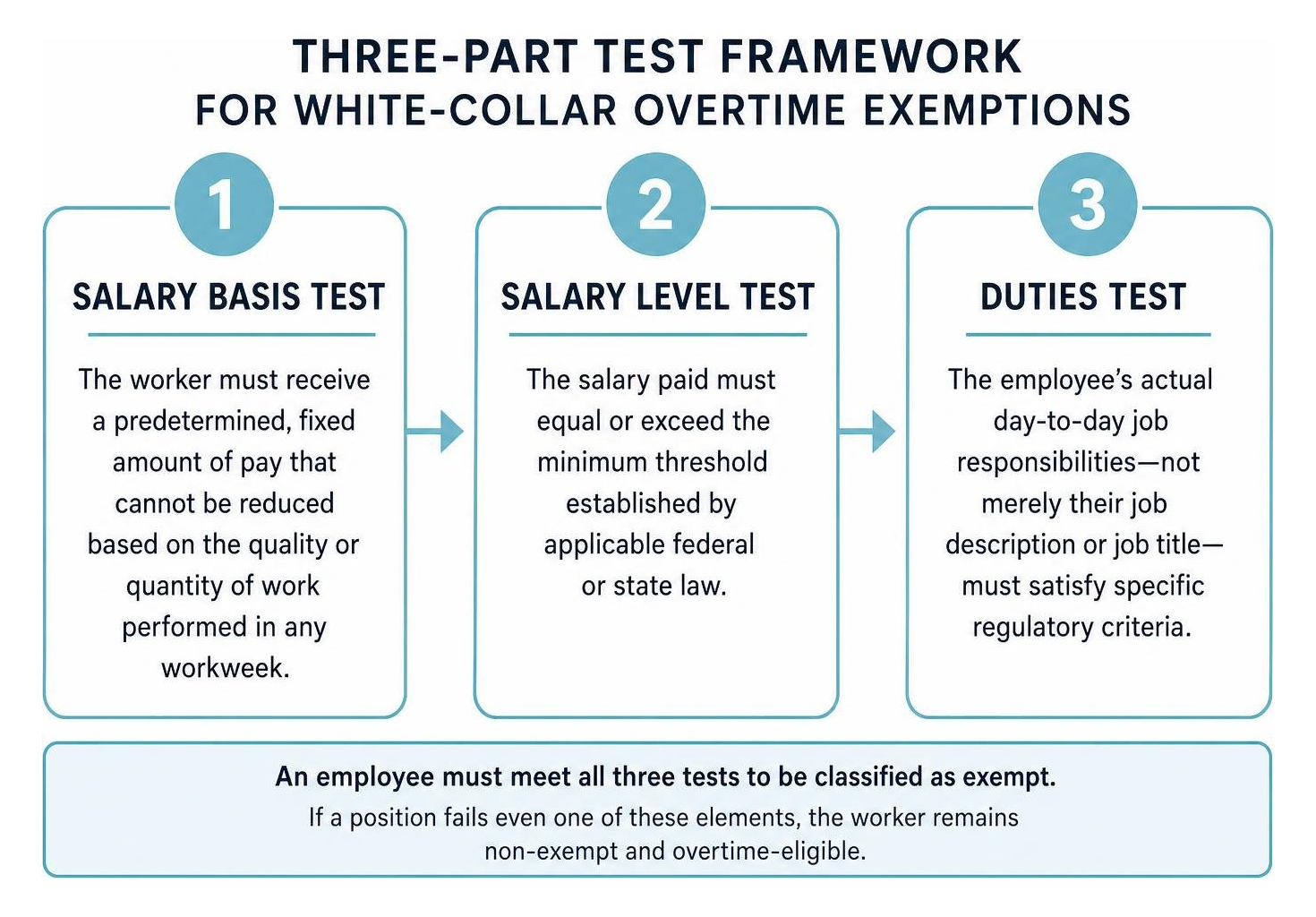
The three-part framework relies on:
- The Salary Basis Test: The worker must receive a predetermined, fixed amount of pay that cannot be reduced based on the quality or quantity of work performed in any workweek.
- The Salary Level Test: The salary paid must equal or exceed the minimum threshold established by applicable federal or state law.
- The Duties Test: The employee’s actual day-to-day job responsibilities—not merely their job description or job title—must satisfy specific regulatory criteria outlined in the DOL Part 541 compliance guide.
For a detailed breakdown of evaluating daily work against these benchmarks, read our guide on how to determine exempt vs non-exempt status.
| Exemption Category | Minimum Federal Salary Threshold | Primary Duty Requirements | Discretion & Authority Required |
|---|---|---|---|
| Executive | $684/week ($35,568/year) | Management of the enterprise, department, or recognized subdivision | Authority to hire or fire, or substantial weight given to recommendations; regularly directs 2+ full-time workers |
| Administrative | $684/week ($35,568/year) | Non-manual office work directly related to management or general business operations | Exercise of discretion and independent judgment on matters of business significance |
| Professional | $684/week ($35,568/year) | Work requiring advanced knowledge in a specialized field of science or learning | Consistent exercise of discretion and judgment; knowledge acquired by prolonged intellectual instruction |
| Computer Professional | $684/week or $27.63/hour | Systems analysis, computer programming, software engineering, or related system design | High-level conceptual and analytical work in hardware/software design or system integration |
| Outside Sales | No salary threshold requirement | Making sales or obtaining orders/contracts away from the employer’s place of business | Customarily and regularly engaged away from the employer’s physical office or worksite |
Evaluating Exempt Salary vs Non Exempt Salary: The Three-Part Test
Under federal regulations, the standard salary level threshold currently in effect is $684 per week (equivalent to $35,568 per year). Employers are permitted to use nondiscretionary bonuses and incentive payments (including commissions) paid at least annually to satisfy up to 10 percent of this standard federal salary level.
For Highly Compensated Employees (HCE), federal rules set an annual compensation benchmark of $107,432. To qualify under the streamlined HCE test, the worker must receive at least $684 per week on a salary basis and customarily and regularly perform at least one exempt duty of an executive, administrative, or professional employee.
Specific Exemption Categories and Duties Breakdown
Meeting the salary floor alone does not make an employee exempt. The duties test must be satisfied based on what the worker actually does every day:
- Executive Exemption: The employee’s primary duty must be managing the enterprise or a recognized department/subdivision. They must customarily and regularly direct the work of two or more full-time employees (or the equivalent in part-time workers) and possess genuine authority to hire or fire, or their input on hiring, firing, advancement, and promotion must carry significant weight.
- Administrative Exemption: The employee must perform office or non-manual work directly related to the management or general business operations of the employer or the employer’s customers. The role requires the regular exercise of discretion and independent judgment regarding matters of significance, rather than merely executing established operating procedures.
- Professional Exemption (Learned and Creative): Learned professionals must perform work requiring advanced knowledge in a field of science or learning acquired by a prolonged course of specialized intellectual instruction (e.g., attorneys, certified public accountants, physicians). Creative professionals must perform work requiring invention, imagination, originality, or talent in a recognized field of artistic or creative endeavor.
- Outside Sales Exemption: The worker’s primary duty must be making sales (or obtaining orders/contracts) and they must be customarily and regularly working away from the employer’s place or places of business. Inside sales representatives who sell products over the phone, internet, or from an office do not qualify.
- Computer Professional Exemption: The employee must work as a computer systems analyst, computer programmer, software engineer, or similarly skilled computer worker performing high-level systems analysis, design, testing, or modification. Federal law allows computer professionals to be paid either on a salary basis of at least $684 per week or on an hourly basis at not less than $27.63 per hour. However, it is vital to note that the $27.63 hourly figure is only the federal baseline and that state law may require higher pay rates to keep overtime rights intact.
Many workers discover that their actual duties do not match their corporate titles. If you believe your responsibilities have been mischaracterized, review our analysis on supervisors mislabeling workers as exempt.
State-by-State Salary Thresholds and Strict Duties Variations in 2026

The FLSA sets a federal floor, not a ceiling. Under federal preemption principles, whenever a state or local jurisdiction enacts wage-and-hour standards that provide greater protection to workers, employers operating in that jurisdiction must comply with the stricter standard.
In 2026, multiple states mandate salary levels substantially above the federal $684 weekly threshold:
- Washington: Maintains the highest state salary threshold in the nation at $1,541.70 per week ($80,168.40 annually).
- California: Pegs its salary threshold to twice the state minimum wage for full-time work, requiring $1,352 per week ($70,304 annually).
- New York: Applies regional tiers, setting higher minimum thresholds for New York City, Long Island, and Westchester County compared to upstate regions.
- Colorado and Maine: Both enforce state-specific thresholds adjusted upward with annual inflation formulas.
California Exemption Standards and the 50 Percent Rule
California wage-and-hour law provides some of the most robust worker protections in the country. To qualify as an exempt white-collar employee in California in 2026, two primary criteria must be met:
- The California Salary Threshold: Under California law, an exempt employee must earn a fixed monthly salary equivalent to no less than two times the state minimum wage for full-time employment (40 hours per week). With the California minimum wage at $16.90 per hour in 2026, the minimum salary threshold for exemption is $1,352 per week, which equals $70,304 per year.
- The Strict Quantitative Duties Test (The 50% Rule): Unlike federal law, which looks broadly at an employee’s “primary duty,” California enforces a strict quantitative rule. An employee must spend more than 50 percent of their working time actively engaged in exempt tasks.
If a store manager or supervisor in California spends 60 percent of their shift stocking shelves, operating cash registers, cleaning, or assisting customers, they do not qualify as exempt under California law—even if they earn well over $70,304 per year. The California DLSE overtime exemptions guidelines make clear that job titles carry no weight; the actual distribution of working hours controls exemption status.
Permissible Pay Deductions, Misclassification Risks, and Legal Remedies
To maintain an exempt classification, the salary basis rule requires that an employee receive their full salary for any week in which they perform work, regardless of how many or how few hours they log.
Under DOL Fact Sheet #17G, permissible deductions from an exempt salary are strictly limited to:
- Full-day absences for personal reasons other than sickness or disability.
- Full-day absences due to sickness or disability if deducted in accordance with a bona fide sick leave plan or policy.
- Offsets for jury duty pay, witness fees, or military temporary duty pay.
- Penalties imposed in good faith for infractions of major safety rules.
- Full-day unpaid disciplinary suspensions imposed in good faith for workplace conduct infractions.
- Pro-rated salary for the initial or terminal week of employment.
- Unpaid leave taken under the Family and Medical Leave Act (FMLA).
Improper deductions—such as docking an exempt employee’s pay for a partial-day absence, reducing salary because the business is closed on a holiday, or docking pay due to low operating volume—violate the salary basis rule and can destroy the exemption across entire job classifications. To learn more about what employers are prohibited from doing to your compensation, see our guide on what your employer cannot do to an exempt salary.
Employer Penalties and Employee Recovery in Misclassification Claims
When an employer misclassifies an employee as exempt, the financial and legal consequences are substantial. Impacted workers can bring claims to recover significant compensation:
- Back Overtime Pay: Recovery of all unpaid 1.5x overtime hours (and in California, double-time premiums for shifts over 12 hours or 7th consecutive day work).
- Statute of Limitations: Under the FLSA, employees can recover back wages going back two years from the filing date, or three years if the employer committed a willful violation. In California, state wage claims can reach back up to three or four years under the California Labor Code and Business & Professions Code § 17200.
- Liquidated Damages: Courts may award liquidated damages equal to 100 percent of the unpaid overtime wages, effectively doubling the financial recovery for workers.
- Meal and Rest Break Premiums: In California, misclassified employees are often denied statutory break periods and can recover one additional hour of pay at their regular rate for each workday a meal or rest break was missed.
- Attorneys’ Fees and Statutory Interest: Prevailing employees are entitled to statutory interest on unpaid wages and reimbursement of reasonable attorneys’ fees and litigation costs.
To understand how misclassification claims are structured, read our overview on exempt employee misclassification.
Frequently Asked Questions About Salary Classifications
Can an employer pay an exempt employee an hourly wage?
With limited exceptions, no. The foundational requirement for white-collar exemptions is the salary basis test, which mandates a guaranteed, predetermined minimum weekly salary. The primary exception under federal law is for computer professionals, who may be paid on an hourly basis of at least $27.63 per hour (though state rules, including California, require substantially higher hourly compensation or specific salary thresholds to maintain exempt status).
Does paying an annual salary automatically make an employee exempt?
No. Paying a salary satisfies only the method-of-payment requirement. To be legally exempt from overtime, the employee must also be paid at or above the statutory salary threshold ($684/week federally; $1,352/week in California in 2026) and their day-to-day duties must satisfy the specific legal criteria for executive, administrative, professional, computer, or outside sales roles.
Can an employer voluntarily classify an exempt worker as non-exempt?
Yes. Employers have full legal discretion to treat any worker as non-exempt. While an employer cannot lawfully treat a non-exempt worker as exempt, they are entirely free to provide greater worker protections by paying overtime, tracking hours, and providing non-exempt wage benefits to an employee who might otherwise satisfy the white-collar exemption tests.
Conclusion
Understanding your rights under wage-and-hour laws is vital to ensuring you receive every dollar you earn. Whether an employer labels your compensation as an exempt salary or an hourly wage, your actual job responsibilities and statutory pay thresholds determine your right to overtime pay, mandatory meal breaks, and rest periods.
If you are working in California, review our detailed guide on California exempt vs non-exempt employee classification to evaluate your workplace rights under state standards.
Laws change over time and every situation is different. For advice about your specific circumstances, consult a licensed California attorney.
Talk to ASM Lawyers
Have questions about how California law applies to your situation? The team at ASM Lawyers offers consultations to help you understand your rights and options. Visit our Contact page to speak with an attorney about your case.
Attorney Advertising.
Legal Disclaimer: This article is for general informational purposes only and does not constitute legal advice. Reading this article or contacting ASM Lawyers does not create an attorney-client relationship.