

Understanding Wage and Hour Violations in Oakland
If you need an Oakland wage attorney, start by looking for a plaintiff-side employment firm that handles wage and hour claims on a contingency fee basis, meaning you pay no upfront fees and the attorney collects a percentage only if you recover. Verify that the firm has experience with California wage law, including overtime, meal and rest breaks, and misclassification claims, before scheduling a consultation. Once you have shortlisted counsel, gather your pay stubs, time records, and any written communications about hours or pay so the attorney can evaluate your case efficiently.
Wage theft takes many shapes across the East Bay, from subtle time shaving on digital timecards to outright refusal to pay mandated minimums. Workers in retail, hospitality, tech, construction, and healthcare often bear the brunt of these unlawful payroll practices. If you suspect your employer’s pay policies fail to meet legal standards, assessing whether an employer violated California wage laws is your vital first step toward financial recovery.
Unpaid Overtime, Minimum Wage, and Off-the-Clock Work
California law strictly requires employers to pay non-exempt workers overtime at 1.5 times their regular pay rate for all hours worked beyond 8 in a single workday or 40 in a workweek. Double-time pay—twice the regular hourly rate—kicks in when an employee works more than 12 hours in a single workday, or over 8 hours on their seventh consecutive workday.
Common violations occur when managers pressure staff to complete pre-shift safety prep, mandatory gear donning, or post-shift closing duties off the clock. Exploring your legal options to recover unpaid overtime wages ensures that every minute of labor is properly compensated.
A widespread myth among employers is that placing a worker on a salary automatically eliminates overtime obligations. In 2026, California requires exempt executive, administrative, or professional employees to earn at least two times the state minimum wage ($16.90 per hour) for full-time work, establishing an exempt salary threshold of $1,352 weekly or $70,304 annually. Even if a worker meets this pay threshold, their actual job duties must remain primarily exempt in nature.
Similarly, special rules govern tech roles under the computer employee exemption. While the federal baseline wage sits at $27.63 per hour, state law establishes far higher California-specific rate requirements that employers must satisfy to exempt specialized software engineers and computer professionals from overtime.
Meal and Rest Break Violations and On-Call Pay
California grants workers substantial protection regarding daily breaks:
- Meal Breaks: A 30-minute, uninterrupted, duty-free meal break must be provided before the end of the fifth hour of work. A second 30-minute meal break is required before the end of the tenth hour.
- Rest Periods: A net 10-minute paid rest break is required for every four hours worked (or major fraction thereof).
- Break Premiums: If an employer fails to provide a lawful meal or rest break, they must pay the employee one extra hour of pay at their regular rate for each workday a meal break violation occurred, plus one additional hour for rest break violations.
Reviewing the common ways employers unlawfully deny meal and rest breaks reveals how often workplaces shortchange staff by demanding workers stay on premises or monitor radios during breaks.
Standby and on-call time trigger similar disputes. Under state standards, compensation rules for California on-call employees dictate that when employers place severe geographical or response-time restrictions on workers during their standby shifts, that time counts as compensable hours worked.
Independent Contractor Misclassification and Expense Reimbursement
To evade payroll taxes, minimum wage rules, and mandatory benefits, some companies improperly label employees as 1099 independent contractors. Under California’s ABC test, a worker is presumed to be an employee unless the hiring entity proves:
- The worker is free from the company’s control and direction in performing work;
- The work falls outside the usual course of the company’s business; and
- The worker is customarily engaged in an established independent trade or business.
Regarding staffing arrangements, it is important to understand that neither federal nor California law imposes a blanket statutory cap on how long a private employer can keep an individual classified as temporary. However, misclassifying long-term staff to deny statutory rights remains actionable.
Furthermore, under Labor Code Section 2802, companies must fully reimburse staff for all necessary expenditures incurred in carrying out their job duties. Understanding employee expense reimbursement under California law protects your right to claim reimbursement for vehicle mileage, personal cell phone use for business duties, home internet for remote work, and mandatory uniforms or equipment.
Oakland vs. California Wage Laws: Local Standards and Protections
Oakland employees enjoy a dual layer of protection: California’s robust Labor Code alongside specialized municipal ordinances enforced by the City of Oakland Department of Workplace and Employment Standards.
| Provision | California State Standard (2026) | Oakland Municipal Standard |
|---|---|---|
| Minimum Wage Rate | $16.90 / hour baseline | Local rate adjusted annually for inflation (higher than state baseline) |
| Exempt Salary Threshold | $1,352 / week ($70,304 / year) | Follows California state threshold standards |
| Paid Sick Leave Accrual | 1 hour per 30 hours worked (up to 40 hours/5 days annual usage minimum) | 1 hour per 30 hours worked; up to 40 hours cap for small employers, 72 hours cap for employers with 10+ workers |
| Local Enforcement Agency | CA Labor Commissioner (DIR / DLSE) | Oakland Department of Workplace and Employment Standards |
Local Minimum Wage Ordinances and Paid Sick Leave Rules
Oakland’s local minimum wage ordinance applies to all employees who perform at least two hours of work within Oakland city limits during any calendar week, regardless of immigration status or employer headquarters. Because the city adjusts its baseline rate each year based on the Consumer Price Index (CPI), it consistently remains higher than the statewide baseline.
Oakland’s paid sick leave ordinance provides enhanced benefits over the baseline state framework:
- Large Employers (10 or more workers): Employees can accrue and carry over up to 72 hours of paid sick leave.
- Small Employers (fewer than 10 workers): Employees can accrue up to 40 hours of paid sick leave.
Sick leave accrues at the rate of one hour for every 30 hours worked, giving local staff meaningful security when personal or family health needs arise.
Statutory Deadlines and Retaliation Protections for Oakland Workers
Filing deadlines—known as statutes of limitations—strictly govern when you must initiate a wage recovery action:
- Two Years: Oral wage agreements and statutory penalties not tied to back pay.
- Three Years: Violations of California wage orders, unpaid minimum wage, overtime, meal and rest break premiums, and statutory expense reimbursements.
- Four Years: Breach of written employment contracts or claims brought under California’s Unfair Competition Law (Business & Professions Code § 17200).
California Labor Code Section 1102.5 provides rigorous whistleblower protections. An employer cannot discharge, demote, suspend, or retaliate against any employee who discloses or questions suspected wage theft. Workers subjected to retaliation can secure reinstatement, recovery of lost earnings, and civil penalties against wrongdoers.
When and Why to Hire an Oakland Wage Attorney
Calculating what an employer owes requires navigating base pay, premium rates, waiting time penalties (up to 30 days of wages under Labor Code Section 203 for unpaid final paychecks), and statutory interest. An experienced wage advocate builds an evidence-backed case to recover everything you are owed.
Individual Wage Claims vs. Class Action Lawsuits
When payroll violations affect an entire shift, division, or company, collective litigation is often the most effective path forward. Joining with coworkers through representation by California class action lawyers enables employees to challenge widespread corporate wage suppression. Workers can also utilize the Private Attorneys General Act (PAGA) to seek civil penalties on behalf of themselves, their colleagues, and the State of California.
Evaluating Experience, Track Record, and Fee Arrangements with an Oakland Wage Attorney
When seeking counsel, look for legal teams dedicated exclusively to plaintiff-side employee advocacy. Most wage and hour attorneys work on a contingency fee basis, meaning workers pay no upfront fees or retainers; legal fees are collected solely as a percentage of the financial recovery won through settlement or trial. Under California labor statutes, fee-shifting provisions also require non-compliant employers to pay the worker’s reasonable legal fees upon a successful outcome.
Step-by-Step: Preparing Your Wage Claim or Legal Action

Taking proactive, organized steps will streamline the resolution of your claim.
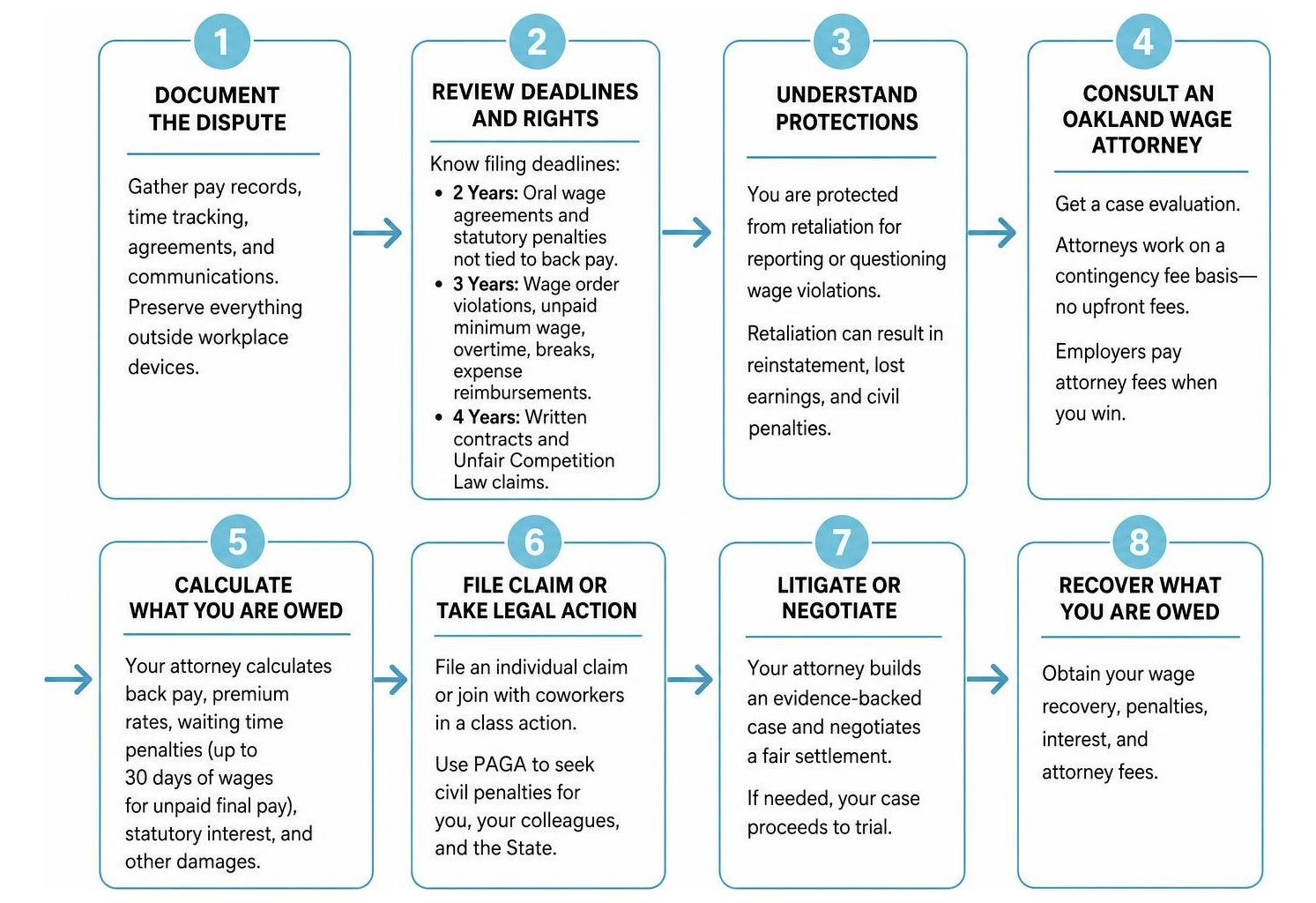
What Documentation to Gather Before Meeting an Oakland Wage Attorney
Collect and preserve the following items outside of workplace devices:
- Pay Records: All itemized pay stubs, direct deposit summaries, and year-end W-2s or 1099s.
- Time Tracking: Personal calendars, timesheets, badge-swipe histories, and login/logout logs.
- Written Policies: Employee handbooks, offer letters, compensation plans, and job descriptions.
- Communications: Emails, text messages, and written memos discussing hours, schedules, reimbursements, or pay adjustments.
- Expense Records: Invoices, phone bills, mileage logs, and receipts for business-related purchases.
Filing with Administrative Agencies vs. Pursuing Civil Litigation
Workers can seek recovery through several channels:
- Oakland Department of Workplace and Employment Standards: For local minimum wage and sick leave ordinance enforcement.
- California Labor Commissioner’s Office (DLSE): For administrative wage claims adjudicated through informal settlement conferences and formal Berman hearings.
- California Superior Court: For individual civil lawsuits, PAGA representative actions, and multi-plaintiff class actions that allow full discovery and access to statutory remedies.
Reviewing guidance on reporting when you are not properly paid will help clarify which venue matches the size and complexity of your dispute.
Frequently Asked Questions About Oakland Wage Claims
How much does it cost to hire an Oakland wage attorney?
Plaintiff-side employment attorneys typically handle wage claims on a contingency fee basis. You pay nothing out of pocket, and attorney fees are paid as a percentage of the total recovery obtained from your employer.
What should I do if my employer fires me for asking about unpaid wages?
Document the entire sequence of events immediately, including all written and verbal exchanges. Terminating an employee for asserting their wage rights constitutes unlawful retaliation and wrongful termination under California law, entitling you to pursue back pay, emotional distress damages, reinstatement, and punitive penalties.
Can undocumented workers file an unpaid wage claim in Oakland?
Yes. California labor laws protect all workers regardless of immigration status. You are legally entitled to receive the full statutory minimum wage, overtime, and mandatory break premiums for all hours worked, and employers are strictly prohibited from reporting or threatening a worker’s immigration status in response to a wage claim.
Conclusion
Every worker in Oakland deserves fair pay for every hour on the job. When employers cut corners on overtime, ignore break mandates, or misclassify workers, California and local laws provide clear remedies to make things right. At Aiman-Smith & Marcy, our collaborative team draws on more than 25 years of shared experience standing alongside workers to confront unfair labor practices and recover what they have rightfully earned.
If you need help addressing unlawful pay practices or have questions regarding wage and hour claims, contact our Oakland office to discuss your situation.
Legal Disclaimer This article is for general informational purposes only and does not constitute legal advice. Reading this article or contacting ASM Lawyers does not create an attorney-client relationship. Laws change over time and every situation is different. For advice about your specific circumstances, consult a licensed California attorney. Talk to ASM Lawyers Have questions about how California law applies to your situation? The team at ASM Lawyers offers consultations to help you understand your rights and options. Visit our Contact page to speak with an attorney about your case. Attorney Advertising.