

Find the Right Temporary Worker Option and Know Your Rights
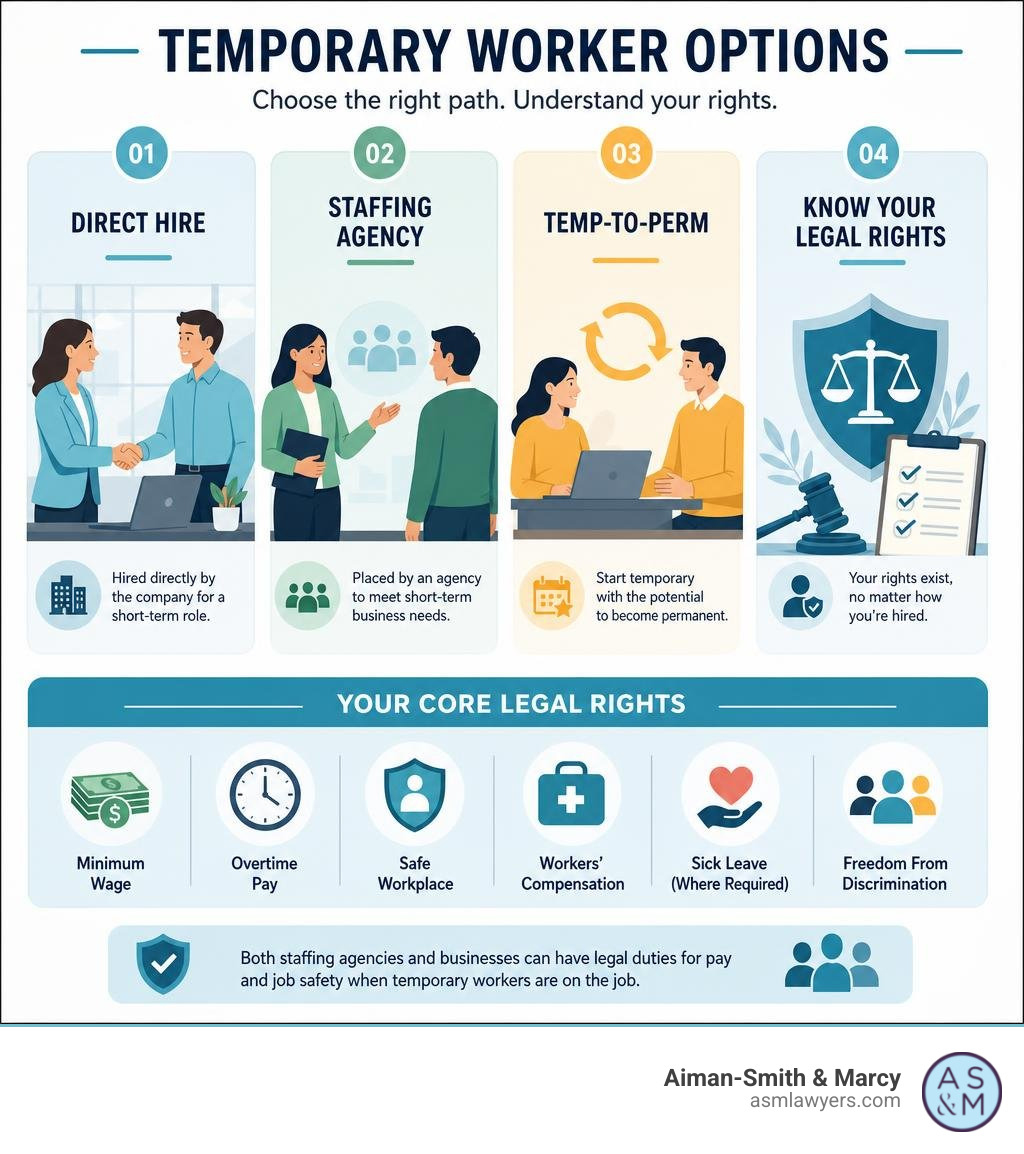
A temporary worker may be hired directly for a short-term role or placed through a staffing agency to cover seasonal demand, a leave of absence, or a defined project. To find the right option, first identify who will control the work, who will issue paychecks, how long the assignment is expected to last, and whether the role could become permanent.
For workers, the label “temporary” does not erase core legal rights. Temp employees may be entitled to minimum wage, overtime, workers’ compensation, sick leave under applicable state or local laws, freedom from discrimination, and a safe workplace. When an agency sends someone to a client site, both businesses can have duties related to pay and job safety.
For employers, the key is not simply calling a role temporary or contract work. The real working relationship matters. Misclassifying an employee as an independent contractor, or keeping someone in long-term temporary status while treating them like regular staff, can create wage, tax, benefit, and legal risks.
This guide explains the practical choices for temporary employment and the rules that matter most in California, including staffing-agency placements, temp-to-perm roles, visa options, pay rights, safety duties, and misclassification concerns. If you believe an agency or worksite has denied your rights, Aiman-Smith & Marcy is a plaintiff-side employment and consumer fraud law firm representing individuals in individual, PAGA, and class actions.
Relevant articles related to temporary worker:
Understanding Your Legal Rights as a Temporary Worker
Understanding Your Rights as a Temporary Worker begins with recognizing that temporary employment is not a legal loophole. Too often, workers are told that because their role is short-term, seasonal, or arranged through a third-party agency, standard labor protections do not apply to them. That is entirely false. Temporary employees enjoy broad statutory protections under state and federal law, covering everything from minimum wage and daily overtime to safe working conditions and freedom from unlawful workplace retaliation.
Under the joint employment doctrine, when a staffing agency assigns you to work at a host employer’s facility, both businesses generally share legal accountability. If you face unsafe conditions on a construction site, an industrial warehouse floor, or an office, you have the protected right under the Occupational Safety and Health Act (OSH Act) to report hazards without fear of retaliatory firing, shift cancellations, or demotions. Whistleblower protections protect temporary employees who speak up about dangerous environments, illegal pay practices, or fraudulent corporate activities.
Key Differences: Temporary Worker vs. Independent Contractor vs. Direct Employee
The law distinguishes workers based on the economic reality and operational control of the relationship—not arbitrary labels.
| Worker Category | Behavioral & Operational Control | Tax Form Issued | Applicable Legal Standards | Key Workplace Protections |
|---|---|---|---|---|
| Temporary Employee (W-2) | Directed and supervised by host employer and/or staffing agency regarding hours, tools, and tasks. | Form W-2 (taxes withheld by agency or host employer). | Joint employment doctrine, Fair Labor Standards Act (FLSA), California Labor Code. | Minimum wage, overtime, paid sick leave, workers’ compensation, meal and rest breaks. |
| Direct Permanent Employee (W-2) | Direct, ongoing control and supervision by a single employer. | Form W-2 (taxes withheld directly by employer). | Standard state and federal employment laws. | Full statutory benefits, company health and retirement plans, standard wage and hour protections. |
| Independent Contractor (1099) | Worker maintains independent business control, sets schedule, uses own tools, and directs task execution. | Form 1099-NEC (no tax withholding; self-employment tax). | IRS Common Law Test, DOL Economic Reality Test, California ABC Test. | Exempt from overtime, minimum wage, workers’ comp, and statutory paid sick leave. |
At the federal level, the IRS Common Law Test focuses heavily on behavioral control, financial control, and the relationship of the parties, while the Department of Labor applies an economic reality test. In California, the stringent ABC test establishes a legal presumption that a worker is an employee unless the hiring entity proves:
- The worker is free from the control and direction of the hiring entity in connection with the performance of the work;
- The work performed is outside the usual course of the hiring entity’s business; and
- The worker is customarily engaged in an independently established trade, occupation, or business of the same nature as the work performed.
If an entity controls your daily schedule, tells you how to perform your tasks, and provides your tools, you are an employee—not an independent contractor.
OSHA Standards, Safe Workplaces, and Staffing Agency Joint Liability
Temporary workers are frequently placed in high-risk environments, such as manufacturing plants, shipping hubs, and construction sites. Because temporary staff may be less familiar with day-to-day hazards, both the staffing agency and the host employer share dual responsibility for worker safety under OSHA regulations.
The staffing agency cannot simply dispatch workers and ignore on-site dangers; it holds a statutory duty of inquiry to inspect the client’s worksite and confirm that safety protocols meet legal standards. Meanwhile, the host employer must provide site-specific hazard communication, job-specific training, and all necessary personal protective equipment (PPE). Both entities are jointly liable for maintaining compliant injury logs and preventing workplace accidents. When agencies or hosts try to deflect liability onto one another, understanding Who Is the Real Boss? Understanding Joint Employment with Staffing Agencies helps clarify how joint liability protects your safety and wage rights.
Exploring Staffing Options and Temporary Employment Models
Navigating the contingent talent market requires understanding the structural differences between direct hiring, third-party placements, and specialized nonimmigrant visa programs.
Direct Hiring vs. Staffing Agency Placements and Temp-to-Perm Contracts
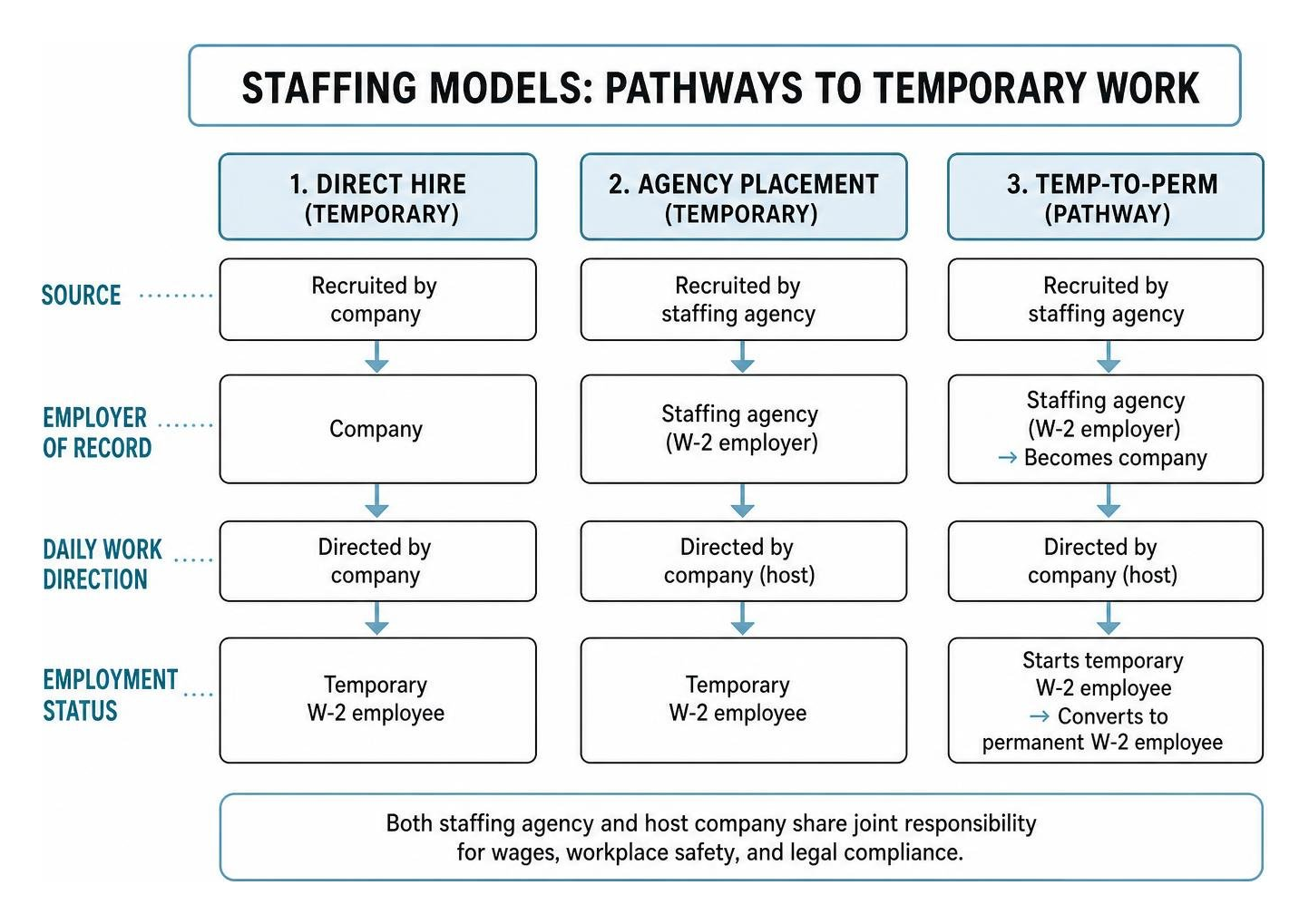
When companies need short-term help, they generally choose between two models: hiring temporary staff directly onto their own payroll or contracting with a staffing agency.
Direct temporary hiring means the business handles recruitment, onboarding, and payroll administration internally. In agency placements, the staffing firm acts as the primary employer of record, managing W-2 tax withholdings, unemployment insurance, and workers’ compensation, while the client business directs daily operations.
Many organizations use temp-to-perm agreements, which allow both the company and the worker to evaluate compatibility before making a long-term commitment. As detailed in our guide Try Before You Buy: The Guide to Temporary-to-Hire Agreements, these trial conversion periods must comply with strict statutory standards. Under California Labor Code § 201.3 (2025), staffing agencies must adhere to specialized payday rules, generally paying temporary workers on a weekly basis regardless of the client’s internal payroll schedule.
U.S. Visa Options for Hiring a Foreign Temporary Worker
For organizations seeking international talent, federal immigration law provides specific pathways under the nonimmigrant visa framework. According to Temporary (Nonimmigrant) Workers | USCIS, there are 11 primary temporary worker visa categories that authorize foreign nationals to work in the United States for fixed durations.

Key nonimmigrant temporary worker classifications include:
- H-1B: Specialty occupations requiring theoretical and practical application of a body of highly specialized knowledge and a bachelor’s degree or higher.
- H-2A: Temporary or seasonal agricultural work.
- H-2B: As outlined by the H-2B Temporary Non-agricultural Program | U.S. Department of Labor, this program permits employers to hire foreign workers for temporary non-agricultural services or labor, provided the employer establishes a temporary need (one-time occurrence, seasonal need, peak load need, or intermittent need) and obtains a temporary labor certification.
- L-1A/L-1B: Intra-company transferees for managerial, executive, or specialized knowledge roles.
- O-1: Individuals with extraordinary ability in the sciences, arts, education, business, or athletics.
- TN: NAFTA/USMCA professional classification for eligible Canadian and Mexican citizens.
Most nonimmigrant worker categories require the sponsoring employer to file Form I-129 (Petition for a Nonimmigrant Worker) with USCIS. Sponsoring employers must also navigate evolving regulatory mandates, including English language proficiency standards for commercial vehicle operators and proper Form I-539 filings for dependent family members seeking status changes or extensions.
Wage Rules, Duration Limits, and Workplace Benefits
A comprehensive understanding of your rights requires reviewing Need to Know: Temporary Employee in California. Under the Affordable Care Act (ACA), temporary employees who work an average of 30 or more hours per week (or 130 hours per month) must be offered compliant health coverage by applicable large employers. Furthermore, under the Employee Retirement Income Security Act (ERISA), temporary employees who work at least 1,000 hours during a 12-month period may qualify for participation in employer retirement benefit plans.
Temporary employees are fully covered under state workers’ compensation insurance from their very first hour on the job. In addition, California requires statutory paid sick leave accrual, guaranteeing that temporary workers earn paid time off to address illnesses or care for family members.
Overtime, On-Call Pay, and California Wage Requirements
For 2026, California’s statewide minimum wage is $16.90 per hour for all employers. This wage floor drives the administrative, executive, and professional exemption tests: an employee must earn an exempt salary threshold of at least two times the state minimum wage for full-time work, which equals $1,352.00 per week ($70,304 annually).
Unless a valid exemption applies, temporary employees are non-exempt and entitled to California’s daily and weekly overtime protections:
- Time-and-a-half (1.5x) for all hours worked beyond 8 hours up to 12 hours in a single workday, and for the first 8 hours on the seventh consecutive day of work.
- Double time (2x) for all hours worked beyond 12 hours in a single workday, and for all hours worked beyond 8 hours on the seventh consecutive day.
When evaluating technical roles, the computer employee exemption federal baseline of $27.63 per hour is only a federal starting point; California state law mandates significantly higher hourly compensation thresholds to exempt computer professionals from overtime. If you are required to remain available on standby, California Employees Should Be Paid While On-Call when the employer imposes restrictions that prevent you from using your time freely. If your employer fails to pay these statutory premiums, you have the right to take legal action and Recover Unpaid Overtime Wages.
Duration Guidelines, Break-in-Service Rules, and the Permatemp Problem
In private-sector employment, there is no blanket statutory cap under federal or California law that limits how long an employer may keep an individual classified as a temporary worker. In contrast, public sector employers and university systems frequently establish strict internal rules—such as limiting temporary assignments to 11 or 12 consecutive months, capping intermittent schedules at 988 hours per year, or requiring a mandatory 31-day break in service before an assignment can be renewed.
In the private sector, keeping a worker indefinitely in a temporary classification creates the legal issue known as a Permatemp. Permatemps work alongside regular, permanent staff for months or years, performing identical core duties under identical supervision, yet they are denied the health coverage, retirement benefits, equity incentives, and paid leave provided to permanent employees.
The legal precedent established in landmark cases such as Vizcaino v. Microsoft affirmed that long-term temporary workers who meet the common-law definition of an employee are legally entitled to participate in company-wide employee benefit plans, regardless of temporary labels or staffing agency contracts.
Risks of Worker Misclassification and Employer Penalties
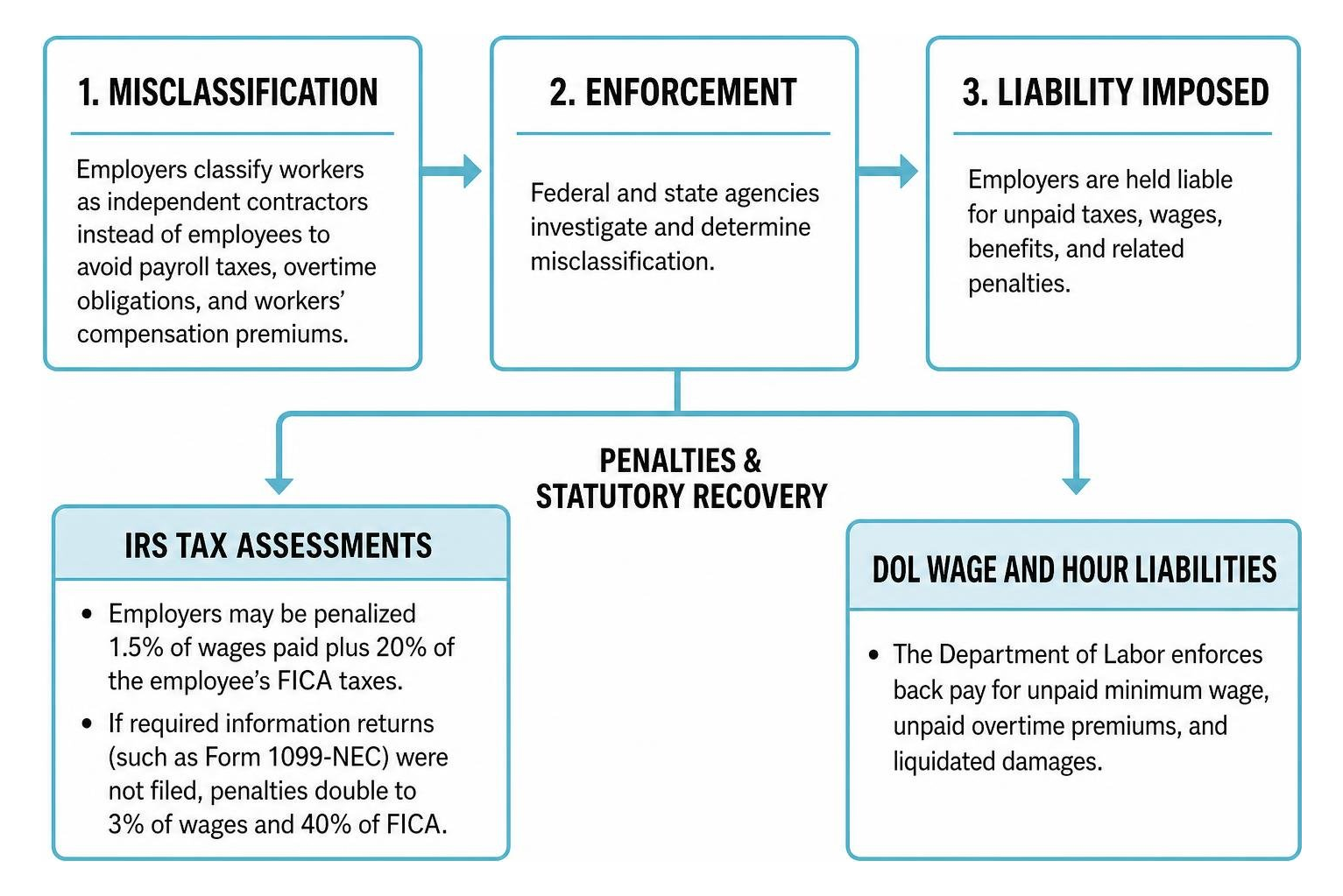
When employers attempt to evade payroll taxes, overtime obligations, and workers’ compensation premiums by misclassifying staff, they engage in unlawful Worker Misclassification.
Legal and Financial Consequences of Worker Misclassification
Employers that misclassify temporary employees as independent contractors face substantial exposure under federal and state enforcement mechanisms:
- IRS Tax Assessments: Employers may be penalized 1.5% of wages paid plus 20% of the employee’s FICA taxes. If the employer failed to file required information returns (such as Form 1099-NEC), these statutory penalties double to 3% of wages and 40% of FICA.
- DOL Wage and Hour Liabilities: The Department of Labor enforces back pay for unpaid minimum wage, unpaid overtime premiums, and liquidated damages.
- California Civil Penalties: Under the California Labor Code and the Private Attorneys General Act (PAGA), employers face civil penalties ranging from $5,000 to $25,000 per willful misclassification violation, plus mandatory reimbursement for unpaid employment taxes, workers’ compensation back-premiums, and statutory interest.
How to Recognize Misclassification and Pursue Legal Remedies
You may be misclassified if:
- You are told you are an independent contractor (Form 1099), but a supervisor controls your schedule, tasks, and daily procedures.
- You perform work that is central to the company’s regular business operations.
- You were required to sign a contractor agreement as a condition of getting hired for an hourly role.
- The company provides your laptop, tools, safety equipment, or uniform.
When misclassification affects multiple workers across an enterprise, experienced California Class Action Lawyers can aggregate claims to recover unpaid overtime, meal and rest break premiums, statutory interest, and civil penalties for the entire workforce.
Frequently Asked Questions About Temporary Employment
How long can an employee remain in a temporary status?
In private-sector employment, there is no statutory cap under California or federal law limiting how long an employee can remain classified as temporary. However, public sector institutions and universities often enforce internal policies limiting temporary work to 11 or 12 consecutive months (or a maximum of 988 hours for intermittent staff), followed by a mandatory 31-day break in service. In private companies, long-term temporary arrangements risk creating unlawful permatemp liabilities if the worker is denied standard employee benefits while being treated as a permanent team member.
Are temporary staff eligible for health insurance and paid sick leave?
Yes. Under the Affordable Care Act (ACA), temporary employees working 30 or more hours per week (or 130 hours per month) for an applicable large employer must be offered qualifying healthcare coverage. Under California law, temporary workers accrue and are entitled to use statutory paid sick leave. Furthermore, under ERISA guidelines, temporary employees who complete at least 1,000 hours of service in a 12-month period may be entitled to participate in company retirement plans.
What should you do if your paycheck is missing hours or overtime pay?
First, compile all your records, including timesheets, shift schedules, badge-swipe data, and pay stubs. Immediately notify both your staffing agency and the host employer in writing to request an audit of the missing pay. Because staffing agencies and host employers are often joint employers, both may be held liable for unpaid wages, meal break premiums, and statutory late-payment penalties under California Labor Code Section 201.3. If the discrepancy is not resolved, you can pursue an individual wage claim, a PAGA action, or class action litigation.
Conclusion
Whether you were hired for a seasonal project, placed through a commercial staffing agency, or engaged on a temp-to-hire trial, your legal rights to fair wages, overtime premiums, and a safe workplace remain fully protected under the law.
If you suspect you have been denied overtime, subjected to unsafe working conditions, or misclassified as a contractor, evaluate your situation: Are You a Temporary Worker or a Misclassified Employee?
Aiman-Smith & Marcy is an Oakland-based boutique, plaintiff-side employment and consumer fraud law firm representing individuals in individual, PAGA, and class actions. Our collaborative team of attorneys brings 25+ years of experience advocating for workers facing workplace discrimination, unpaid wages, and unlawful corporate employment practices.
Talk to ASM Lawyers
Have questions about how California law applies to your situation? The team at ASM Lawyers offers consultations to help you understand your rights and options. Visit our Contact page to speak with an attorney about your case.
Laws change over time and every situation is different. For advice about your specific circumstances, consult a licensed California attorney.
Attorney Advertising.
Legal Disclaimer
This article is for general informational purposes only and does not constitute legal advice. Reading this article or contacting ASM Lawyers does not create an attorney-client relationship.