
When False Workplace Statements Put Your Reputation at Risk
Workplace defamation happens when an employer, manager, or coworker shares a false statement of fact about an employee with another person and the statement harms the employee’s reputation, career, or job prospects.
A harsh review or an unpleasant opinion is not automatically defamation. But a false claim that someone stole money, committed fraud, harassed a coworker, or cannot perform their job can have serious consequences – especially when it is shared with HR, clients, coworkers, or a prospective employer.
| Quick answer | What it means |
|---|---|
| What counts | A false statement presented as fact, not simply criticism or opinion |
| Who may be responsible | A supervisor, coworker, HR representative, former employer, or sometimes the employer itself |
| Common forms | Written statements are libel; spoken statements are slander |
| Why it matters | False accusations can affect promotions, discipline, references, future jobs, and professional standing |
| Deadline | Defamation claims often have short filing periods, commonly one or two years depending on the state |
Workplace rumors, false disciplinary write-ups, and damaging job references can create real anxiety about your livelihood and future. The legal question is not whether a statement felt unfair. It is whether it was a false factual claim, who received it, why it was made, and what harm followed.
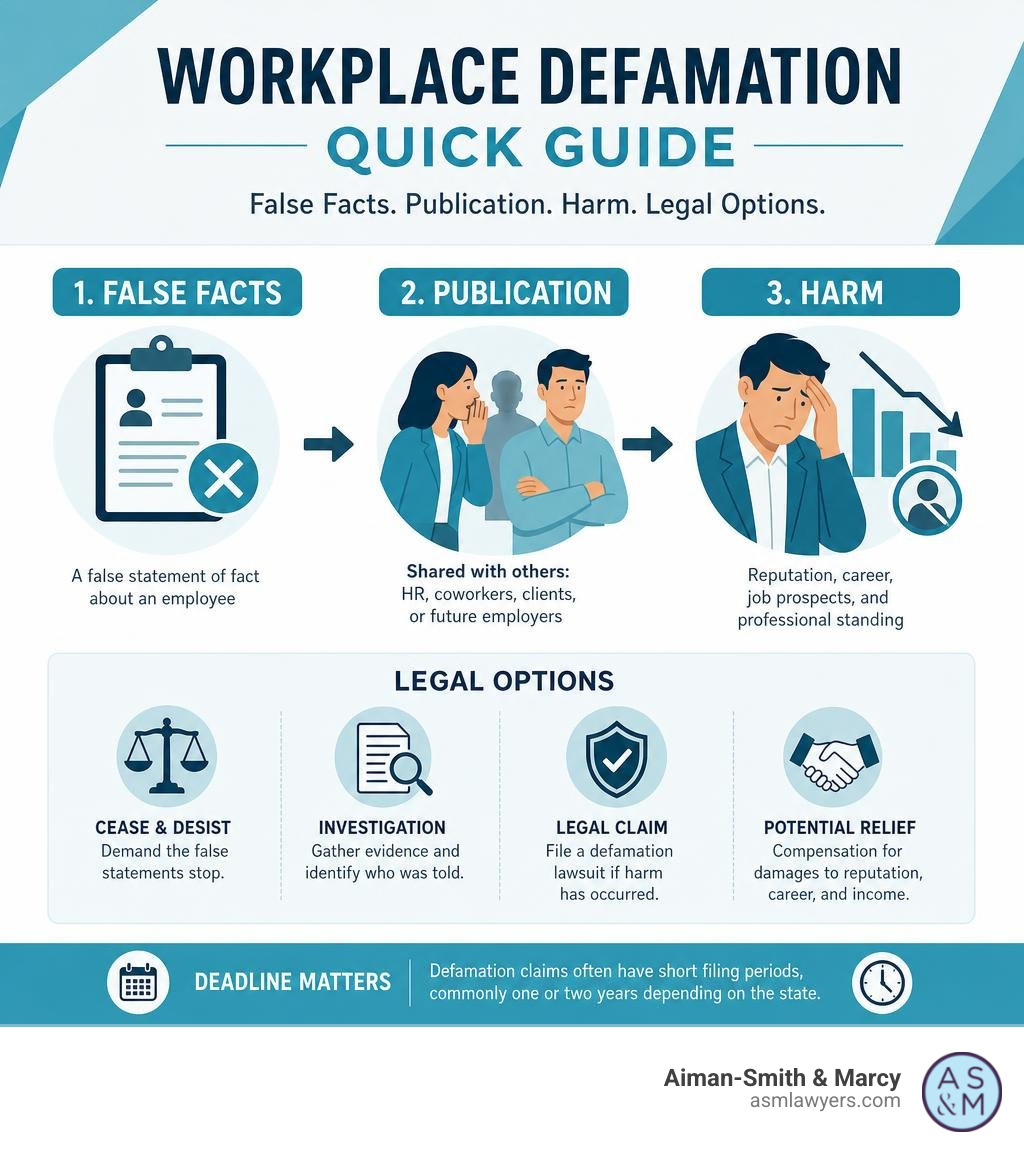
What Is Workplace Defamation and How Does It Differ From Performance Reviews?
In any office or job site, feedback and performance discussions happen daily. However, there is a strict legal distinction between an unfair workplace performance evaluation and actionable workplace defamation.
To constitute legal defamation, a statement must be an objective assertion of fact that is provably false, rather than an expression of opinion. For example, if a manager states, “I feel your presentation was disorganized and did not meet leadership standards,” that is a protected statement of subjective opinion. Regardless of how harsh or demoralizing that appraisal feels, courts do not treat pure evaluations as defamatory content.
Conversely, if a supervisor falsely reports, “You altered financial records on June 10 to hide missing funds,” that is an assertion of concrete, testable fact. If untrue, made to a third party, and damaging to your career, it crosses the line into workplace defamation.
Even non-verbal conduct can sometimes communicate a defamatory message. For instance, publicly having an employee escorted off company premises by armed security guards when no threat or crime occurred can convey a false impression of criminal behavior to watching colleagues.
Libel vs. Slander in the Workplace Context
Defamation comes in two distinct legal varieties: written and spoken.
- Libel: Written, printed, or digitally recorded defamatory statements. In modern workplaces, libel typically occurs in performance reviews, internal email threads, Slack or Teams channels, written disciplinary memos, or formal termination notices. Because written statements create a permanent documentary record, libel is often easier to substantiate in court.
- Slander: Spoken defamatory communications. Slander occurs during verbal meetings, phone calls, reference conversations with prospective employers, or office gossip. Proving slander often relies on witness testimony, contemporary notes, or indirect circumstantial evidence.
Understanding whether a statement is libel or slander helps determine how evidence must be gathered. For a deeper breakdown of verbal false statements on the job, review our detailed guide on whether Is Slander in the Workplace Legal?.
Understanding Defamation Per Se in Workplace Defamation Claims
In standard defamation lawsuits (known legally as defamation per quod), an employee must present specific evidence demonstrating direct financial loss, such as a denied promotion or lost wages. However, certain statements are considered so severe that the law automatically presumes reputational harm without requiring explicit proof of monetary injury. This is known as defamation per se.
In the employment context, statements generally qualify as defamation per se if they falsely accuse an employee of:
- Committing a crime involving moral turpitude or dishonesty (such as theft, embezzlement, or fraud).
- Professional incompetence or a complete lack of integrity in carrying out their official employment duties.
- Possessing a loathsome or contagious disease.
- Serious sexual misconduct in the workplace.
When an employer or manager makes false claims attacking your professional competence or accusing you of workplace crimes, courts recognize that your career standing is naturally undermined.
The Five Essential Elements to Prove a Workplace Defamation Claim
Winning a defamation lawsuit requires satisfying specific legal hurdles. While exact statutory definitions vary by jurisdiction, an employee must establish five essential elements to prove a claim of workplace defamation:
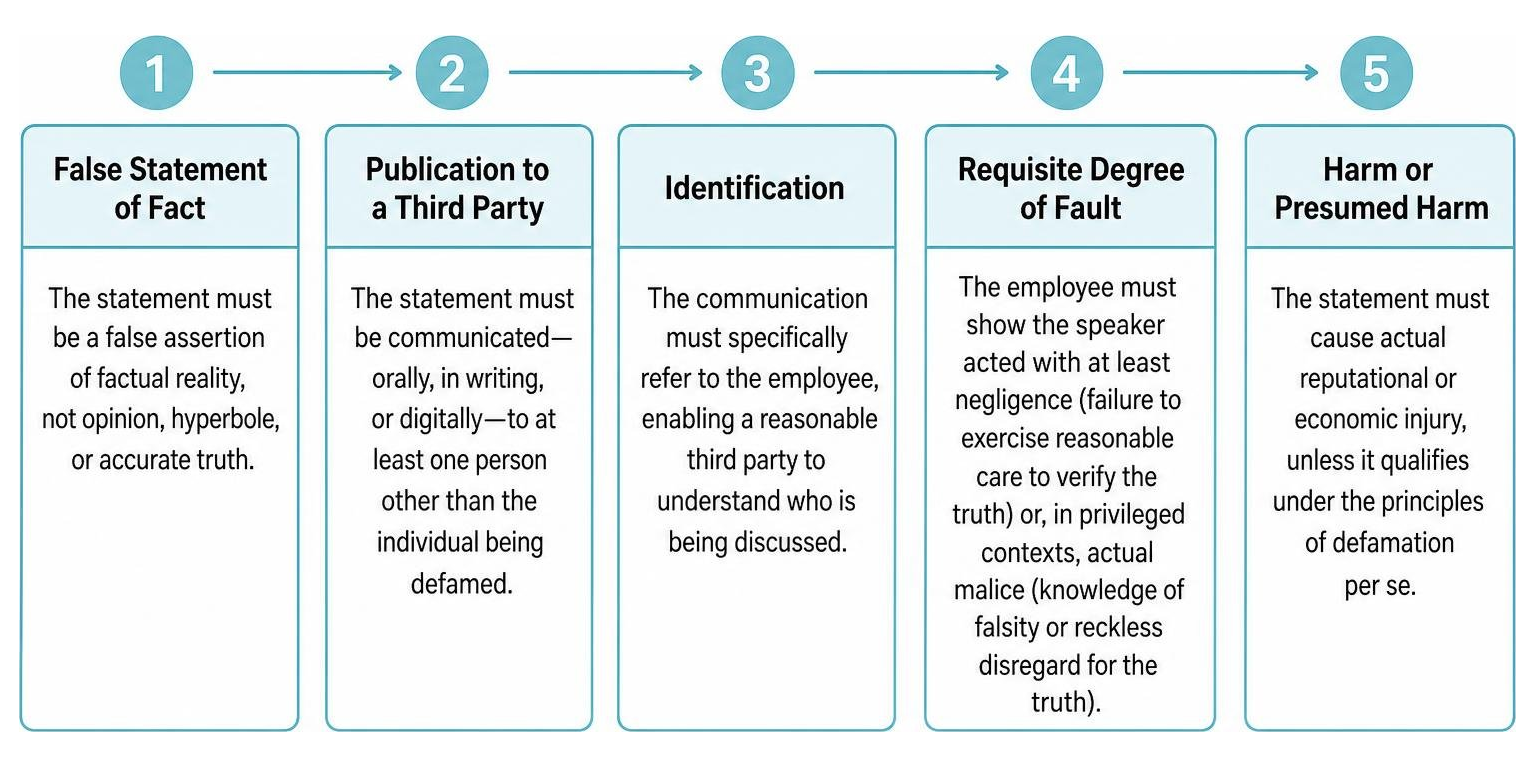
- A False Statement of Fact: The statement must be a false assertion of factual reality, not a protected opinion, hyperbole, or accurate truth.
- Publication to a Third Party: The statement must be communicated—orally, in writing, or digitally—to at least one person other than the individual being defamed.
- Identification: The communication must specifically refer to the employee, enabling a reasonable third party to understand who is being discussed.
- Requisite Degree of Fault: The employee must show the speaker acted with at least negligence (failure to exercise reasonable care to verify the truth) or, in privileged contexts, actual malice (knowledge of falsity or reckless disregard for the truth).
- Harm or Presumed Harm: The statement must cause actual reputational or economic injury, unless it qualifies under the principles of defamation per se.
To better understand how damages operate depending on the nature of the false claim, evaluate the differences outlined in the Workplace Defamation Guide:
| Claim Type | Requirement for Proof of Economic Loss | Common Workplace Examples |
|---|---|---|
| Defamation Per Se | Presumed (No specific monetary loss needed) | False claims of embezzlement; false accusations of professional incompetence; false allegations of illegal drug distribution at work. |
| Defamation Per Quod | Required (Must prove exact financial/career loss) | Untrue claims that an employee missed a project deadline, took an unscheduled extended lunch, or misfiled a single routine client document. |
The Role of Publication and Intra-Corporate Communications
The “publication” requirement is frequently a contested battleground in workplace defamation litigation. Legal publication simply means that the defamatory statement reached a third party. If a manager makes a false accusation against you in a private, one-on-one conversation with no anyone else present or listening, legal publication has not occurred.
However, modern workplaces rely on internal corporate networks. How do courts handle false statements shared strictly between supervisors, HR representatives, or department executives?
Historically, some jurisdictions followed a common law “no-publication” rule, viewing internal communications between corporate managers as single acts within the corporation itself. Today, an increasing number of state courts have abandoned this outdated doctrine. In modern practice, sharing a false factual claim with HR or upper management constitutes legal publication. Although these internal statements may qualify for conditional legal defenses like qualified privilege, they still satisfy the initial publication threshold needed to build a case.
Understanding Compelled Self-Publication in Workplace Defamation Disputes
What happens if an employer fires you based on a fabricated charge—such as false accusations of theft—and keeps the reason internal, but you are forced to explain that reason when applying for new jobs?
Under the doctrine of compelled self-publication, an employee can satisfy the publication element even if the employer never directly spoke to prospective employers. This doctrine applies when:
- The employer provides a false, defamatory reason for termination to the employee.
- It is entirely foreseeable that the employee will be forced to disclose this reason to prospective employers during job interviews.
- The former employee is under strong economic compulsion to repeat the false statement to explain their employment gap.
At least eight states—including California, Minnesota, Iowa, and Missouri—recognize compelled self-publication. This doctrine prevents employers from hiding behind silence while forcing workers to repeat false, career-damaging allegations during subsequent job searches.
Legal Defenses Employers Use Against Defamation Claims
When employees assert legal claims for workplace defamation, employers frequently rely on affirmative legal defenses. Understanding these defenses helps clarify where a claim stands:
- Truth and Substantial Truth: Truth is an absolute defense to defamation. If an employer’s statement is factually accurate—or substantially true in its essential details—the claim fails, regardless of how harmful the statement is to the employee’s career.
- Pure Opinion: Expressions of pure evaluative opinion cannot be proven false and are protected under common law and First Amendment principles.
- Absolute Privilege: Certain official statements receive absolute legal protection. Statements made during formal administrative hearings (such as unemployment compensation hearings or state labor commission proceedings) or judicial filings cannot form the basis of a defamation lawsuit.
Overcoming Qualified Privilege and Showing Malice
The defense most frequently raised by employers is qualified privilege (sometimes called the common interest privilege). This privilege protects routine business communications—such as internal performance appraisals, disciplinary investigations, and job reference checks—when made in good faith among individuals sharing a common professional interest.
However, qualified privilege is not absolute. An employee can overcome this defense by proving that the employer acted with actual malice or abused the privilege.
To prove actual malice, you must show that the person making the statement:
- Knew the statement was false when they made it, OR
- Acted with reckless disregard for whether the statement was true or false, OR
- Was motivated primarily by personal animus, hatred, or an intent to injure the employee.
For instance, if a former supervisor gives a bad job reference claiming you were caught stealing, despite knowing an internal investigation completely cleared you of all wrongdoing, the supervisor loses the protection of qualified privilege. For more insight on how employee rights interact with corporate management protocols, see our detailed guide on Dealing with Workplace Complaints.
Damages, Blacklisting, and Statutes of Limitations
When an employee successfully proves workplace defamation, several types of monetary damages may be available:
- Economic Damages: Compensation for measurable financial losses, including lost back pay, lost future earning capacity, lost benefits, and expenses incurred searching for new employment.
- Non-Economic Damages: Recovery for personal harm, including emotional distress, anxiety, loss of professional standing, damage to personal reputation, and humiliation.
- Punitive Damages: Additional financial penalties awarded in cases involving egregious malice, intent, or fraud, designed to punish wrongdoers and deter future misconduct.
In California, state law provides explicit protections against post-employment character assassination. Under California Labor Code section 1050, any person or employer who misrepresents a former employee’s service or conduct to prevent them from obtaining secondary employment may be guilty of a misdemeanor and civilly liable for triple damages (treble damages). This statutory safeguard deters employers from blacklisting workers seeking new employment opportunities.
It is critical to note that defamation claims carry some of the shortest statutes of limitations in employment law. In many states, including California, employees have just one to two years from the exact date the defamatory statement was spoken or published to file a court action. Missing this strict statutory window permanently bars your legal recovery. Learn more about state-specific legal protections in the Workplace Defamation Fact Sheet.
Linking Defamation to Wrongful Termination Claims
Workplace defamation frequently coincides with wrongful discharge. Employers often attempt to manufacture false, negative narratives—accusing an employee of misconduct or poor performance—to cover up illegal discrimination or retaliation.
When an employer fabricates a reason for discharge, the false statements serve two distinct legal roles:
- They establish independent grounds for a workplace defamation claim.
- They serve as evidence of pretext in a wrongful termination claim, proving the employer’s stated reason for firing was a lie designed to hide illegal retaliation.
If you suspect false write-ups were used to justify an unlawful firing, read our breakdown on what to do if you Think You Were Fired for the Wrong Reasons? and review our broader overview on Wrongful Termination Overview.
Actionable Steps to Take Immediately After Being Defamed
If you discover that false statements are harming your standing at work or ruining your job hunt, taking organized steps immediately will help protect your rights:

- Preserve All Written Evidence: Immediately take screenshots, print hard copies, or download relevant emails, text messages, Slack logs, performance evaluations, and written warnings. Store these documents on a personal device outside of your employer’s computer network.
- Document Spoken Statements Contemporaneously: Write detailed notes immediately after learning of verbal statements. Record the precise words used, the date, time, location, speaker, and names of any coworkers or third parties who overheard the remarks.
- Collect Proof of Falsity: Gather objective company records, timecards, sales reports, or email chains that disprove the false claim. For example, if you are accused of missing a deadline, locate timestamped submission receipts.
- Track Tangible Harm: Keep a log of all rejection letters, withdrawn job offers, rescinded promotions, or sudden disciplinary actions that followed the false statement.
- Consult Internal Procedures Carefully: Review your employee handbook to follow formal internal grievance channels. For step-by-step guidance on creating a clean evidentiary record, read our advice on Documenting Workplace Harassment.
- Avoid Counterproductive Confrontation: Resist the urge to argue online or retaliate on social media, as unscripted public statements can complicate your legal position. For strategies on navigating high-stress employment separations, check out What to Do When Getting Fired.
Frequently Asked Questions About Workplace Defamation
What is the statute of limitations for filing a workplace defamation claim?
In most jurisdictions, defamation claims carry very short deadlines—typically one to two years from the date the false statement was made or published. In California, the general statute of limitations for libel or slander under Code of Civil Procedure Section 340(c) is one year. Because the clock begins ticking immediately upon publication, consulting legal counsel promptly is vital.
Can a negative job reference qualify as workplace defamation?
Yes, but only if the former employer makes false factual assertions rather than giving a subjective opinion. If a former boss falsely claims you stole property or were terminated for gross negligence when you resigned voluntarily, that false reference can constitute actionable defamation. However, if the employer simply expresses a protected opinion or confirms neutral facts like employment dates, it is not actionable.
What damages can an employee recover in a workplace defamation lawsuit?
An employee can recover economic damages (lost wages, lost future income, job search costs), non-economic damages (compensation for emotional distress, loss of professional reputation, and personal embarrassment), and in egregious cases involving malicious conduct or statutory blacklisting under California Labor Code 1050, punitive or triple damages.
Conclusion
A damaged professional reputation can cast a shadow over your career, impacting your earning potential and professional relationships. Understanding the clear legal distinction between subjective criticism and actionable workplace defamation allows workers to respond effectively when false claims threaten their livelihoods.
When false accusations cross the line from unfair management into illegal libel or slander, legal protections exist to set the record straight and recover lost compensation. Exploring your options under employment law ensures that your career is judged on your actual work, not fabrications.
For more information on handling verbal misrepresentations, review our detailed guide on Legal Options for Workplace Slander.
Laws change over time and every situation is different. For advice about your specific circumstances, consult a licensed California attorney.
Talk to ASM Lawyers
Have questions about how California law applies to your situation? The team at ASM Lawyers offers consultations to help you understand your rights and options. Visit https://asmlawyers.com/contact/ to speak with an attorney about your case.
Aiman-Smith & Marcy is a plaintiff-side employment and consumer fraud law firm representing individuals in individual, PAGA, and class actions.
Attorney Advertising
Legal Disclaimer: This article is for general informational purposes only and does not constitute legal advice. Reading this article or contacting ASM Lawyers does not create an attorney-client relationship.


