
When Knowing What Happened Isn’t Enough: Proving Harassment in the Workplace
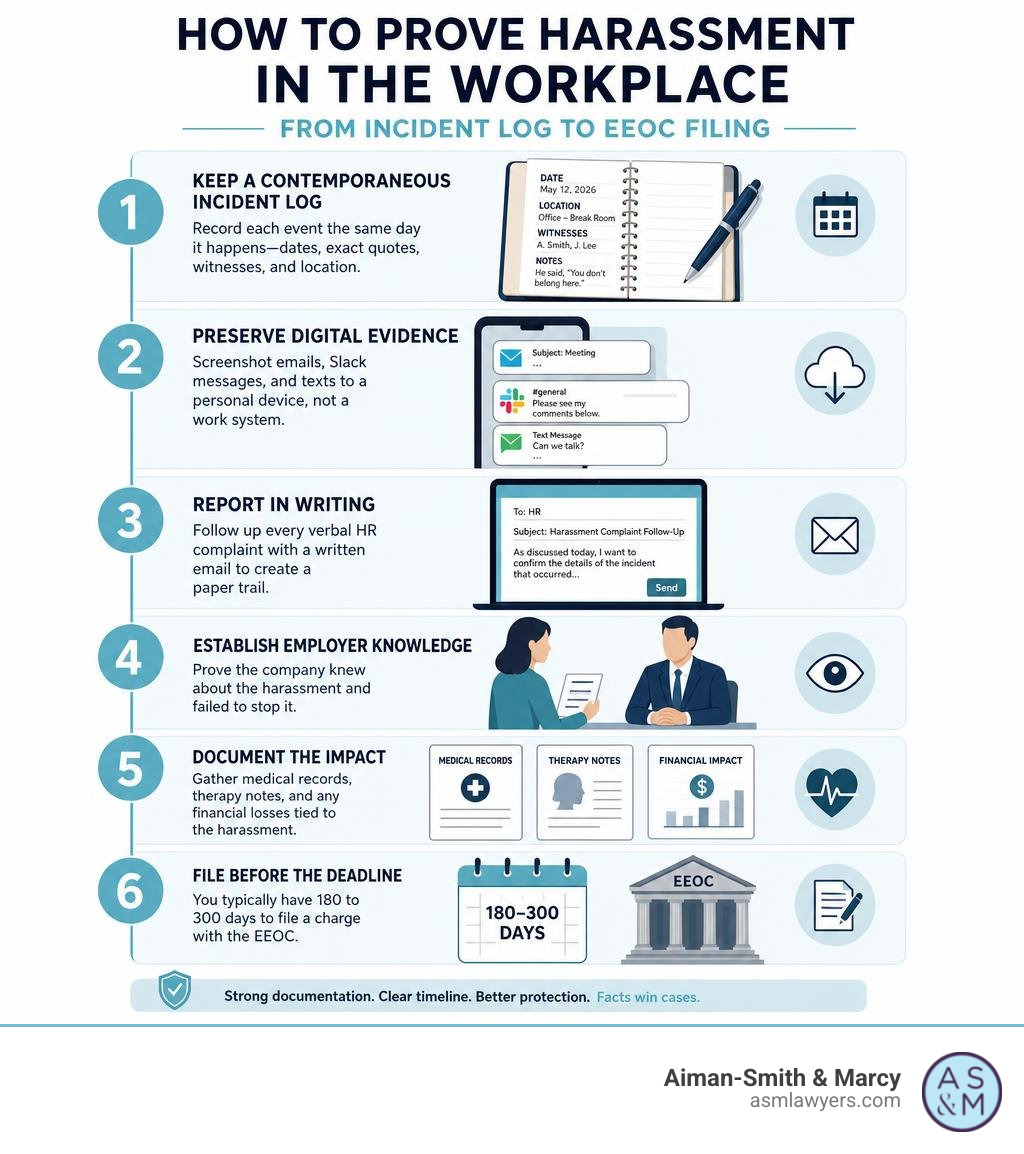
How to prove harassment in the workplace comes down to one thing: documentation. Here’s a quick overview of what it takes:
- Keep a contemporaneous incident log — record each event the same day it happens, with dates, exact quotes, witnesses, and location.
- Preserve digital evidence — screenshot emails, Slack messages, and texts to a personal device, not a work system.
- Report in writing — follow up every verbal HR complaint with a written email to create a paper trail.
- Establish employer knowledge — prove the company knew about the harassment and failed to stop it.
- Document the impact — gather medical records, therapy notes, and any financial losses tied to the harassment.
- File before the deadline — you typically have 180 to 300 days to file a charge with the EEOC.
Harassment at work is deeply stressful. But feeling harassed and proving harassment are two very different things.
Courts don’t rule on emotions. They rule on facts — and facts require evidence. As one legal resource puts it plainly: “Your memory is not evidence. Your documentation is.”
Most employees don’t realize this until it’s too late. Messages get deleted. Witnesses forget. HR claims no record exists. And a valid, serious claim falls apart — not because nothing happened, but because nothing was captured.
The good news? You don’t need to be a lawyer to build a strong record. You just need to know what to document, how to store it, and when to act.
In this guide we’ll walk you through every step of proving workplace harassment — from the legal standard you need to meet, to the specific evidence that wins cases.
Understanding the Legal Standard: What Constitutes Workplace Harassment?
Before we dive into collecting screenshots and writing logs, we need to understand what the law actually considers “harassment.” Under federal law—specifically Title VII of the Civil Rights Act of 1964, the Americans with Disabilities Act (ADA), and the Age Discrimination in Employment Act (ADEA)—workplace harassment is a form of employment discrimination.
However, general workplace incivility, a demanding boss, or a rude coworker does not automatically constitute illegal harassment. To cross the line into unlawful territory, the behavior must meet two primary criteria:
- It must be based on a protected characteristic: The offensive conduct must target a protected class, such as race, color, religion, sex (including pregnancy, sexual orientation, and gender identity), national origin, age (40 or older), disability, or genetic information.
- It must be severe or pervasive: The conduct must be intense enough (severe) or happen frequently enough (pervasive) to alter the conditions of your employment and create an abusive environment.
In California, our local laws provide even stronger protections. Under the California Fair Employment and Housing Act (FEHA), the legal threshold is lower and broader. While federal law generally requires an employer to have 15 or more employees to be sued for harassment, California’s FEHA harassment protections apply to all employers with one or more employees.
If you are wondering whether your situation meets these criteria, it is helpful to read our detailed guide on What is a Hostile Work Environment to understand the legal thresholds. Understanding these boundaries is the first step in recognizing when a difficult job has crossed the line into illegal Workplace Discrimination Harassment.
The Four-Element Framework of a Hostile Work Environment
If you are building a legal case for a hostile work environment, courts and administrative agencies like the California Civil Rights Department (CRD) look at a specific four-element proof framework. To win, you and your legal team must prove each of these four elements:
- Element 1 — Connection to a Protected Characteristic: You must show that the hostile conduct occurred because of your protected class (e.g., gender, race, age, or disability). If a boss is equally mean to everyone regardless of their background, they might just be a bad boss. But if their hostility is directed specifically at you because of your protected status, it is discriminatory. You can explore more about What Actions Constitute Discrimination to see how courts define these behaviors.
- Element 2 — Severe or Pervasive Conduct: The behavior cannot be a single, isolated offhand comment unless it is incredibly severe (such as a physical assault). Instead, courts look for a steady pattern of unwelcome behavior that poisons the work environment over time.
- Element 3 — Subjective and Objective Hostility: The environment must be hostile from two perspectives. Subjectively, you must personally find the conduct abusive and unwelcome. Objectively, a “reasonable person” in your position must also find the environment hostile, intimidating, or abusive.
- Element 4 — Employer Liability: You must prove that the employer is legally responsible. If a supervisor harassed you, the employer may be strictly liable. If a coworker or customer harassed you, you must show that the employer knew (or should have known) about the behavior and failed to take immediate and appropriate corrective action.
Quid Pro Quo vs. Hostile Work Environment
Workplace sexual harassment generally falls into two distinct categories: Quid Pro Quo and Hostile Work Environment. Understanding the difference is vital because they have different standards of proof and liability.
- Quid Pro Quo (Latin for “this for that”): This occurs when a supervisor uses their authority to demand sexual favors in exchange for a job benefit (like a promotion, raise, or keeping your job). A single incident of quid pro quo is enough to establish a claim, and the employer is typically held strictly liable because the harasser used their official supervisory power.
- Hostile Work Environment: This involves unwelcome comments, jokes, physical touching, or visual displays that make it incredibly difficult to do your job. It does not require an explicit demand for sexual favors or direct economic injury (like being fired), but it does require showing that the conduct was severe or pervasive.
| Feature | Quid Pro Quo Harassment | Hostile Work Environment |
|---|---|---|
| Perpetrator | Must be a supervisor or someone with authority | Can be a supervisor, coworker, client, or contractor |
| Frequency Required | Can be a single, isolated incident | Typically requires a pattern of severe or pervasive conduct |
| Core Trigger | Job benefits/terms are conditioned on sexual favors | Severe/pervasive conduct poisons the work environment |
| Employer Liability | Almost always strict (automatic) liability | Depends on whether the employer knew and failed to act |
| Economic Harm | Often involves direct financial or job loss | No economic injury or discharge is required to file |
If you are experiencing subtle, ongoing issues and aren’t sure if they qualify, take a look at our analysis on whether Do You Know 5 of the Most Common Signs of Sexual Harassment to help evaluate your situation.
How to Prove Harassment in the Workplace: The Essential Evidence Checklist

When it comes to the law, what you know happened doesn’t matter as much as what you can prove. This is the absolute foundation of any legal action. To build a robust case, you need to systematically gather multiple categories of proof.
Relying on memory alone is a recipe for a dismissed claim. To ensure you have a solid foundation, refer to this checklist of evidence types that we look for when building a case:
- Written Logs: A daily, contemporaneous journal of events.
- Digital Footprints: Saved emails, Slack messages, text messages, and call logs.
- Witness Statements: Written accounts from coworkers who saw or heard the harassment.
- Internal Reports: Copies of written complaints submitted to HR or management, along with their responses.
- Comparative Evidence: Documentation showing that employees outside your protected class were treated better.
- Impact Documentation: Medical records, therapy invoices, and performance evaluations showing the physical, mental, and professional toll the harassment took on you.
For a deeper look into why these specific materials matter, you can read more about Workplace Harassment Law: How to Win With Evidence. Different forms of misconduct require different approaches, so it is also helpful to review the various Types of Workplace Discrimination to ensure your evidence directly aligns with your legal claim.
Building Comparator Evidence to Show Differential Treatment
One of the most powerful, yet frequently overlooked, types of evidence is comparator evidence. This involves comparing how your employer treated you versus how they treated a similarly situated coworker who does not share your protected characteristic.
For example, if your supervisor constantly criticizes and disciplines you for arriving five minutes late, but completely ignores a coworker of a different race or gender who consistently arrives thirty minutes late, that is comparator evidence. It demonstrates that the rules are being applied selectively based on a protected trait rather than objective company policy.
To build strong comparator evidence, you should document:
- The names and job titles of coworkers in similar roles.
- Specific instances where those coworkers committed the same minor infractions but faced no disciplinary action.
- Differences in promotions, prime project assignments, or scheduling.
If you are struggling to identify these patterns in your own office, read our guide on How to Tell If You Are Being Discriminated Against at Work for practical examples of covert bias.
Documenting Financial and Emotional Impact to Prove Harm
Harassment often inflicts severe emotional and financial damage. To recover compensation (damages) in a lawsuit, you must document exactly what the harassment cost you.
- Emotional and Physical Harm: The stress of a hostile work environment can manifest as anxiety, depression, insomnia, migraines, or high blood pressure. If you seek medical treatment or mental health counseling, those records serve as powerful, objective evidence of the subjective harm you suffered. Ask your doctor or therapist to explicitly document in your medical chart that your symptoms are linked to workplace stress and harassment.
- Financial Impact: Keep track of any out-of-pocket expenses, such as therapy copays, prescription medication costs, and lost wages if you had to take unpaid leave to escape the hostile environment.
If you are experiencing these severe impacts, it is a strong signal that you should protect yourself. Read our resource on Sexual Harassment Why You Should Talk to a Lawyer to understand how these damages are calculated and recovered.
Step-by-Step Guide to Preserving Digital and Written Proof

The moment you suspect you are being harassed, you must take active steps to preserve all electronic and physical evidence. A common mistake is leaving evidence on work computers, company-issued phones, or corporate cloud accounts.
If you are fired, suspended, or locked out of your accounts, that evidence is gone forever. You must store everything on personal devices that your employer cannot access or wipe.
For a comprehensive look at the reporting and preservation process, see the guide on Sexual Harassment at Work: Document and Report It.
Maintaining an Admissible Incident Log: How to Prove Harassment in the Workplace with Contemporaneous Records
A contemporaneous record is a log written at or near the time of the event. In court, a log written on the day of the incident carries exponentially more legal weight than a summary written months later from memory. Your log should be kept in a secure personal notebook or a private, password-protected digital document on your personal phone or computer.
To make sure your log is legally persuasive and admissible, each entry should include these 8 required fields:
- Date and Time: Exactly when the incident occurred.
- Location: Where it happened (e.g., “in the breakroom,” “via Zoom,” or “at the offsite conference”).
- The Harasser: The name and job title of the person engaging in the conduct.
- Witnesses: The full names of anyone who saw, heard, or was nearby during the incident.
- Exact Quotes and Details: Write down exactly what was said and done. Use direct quotes where possible, even if they contain offensive or explicit language. Avoid vague summaries like “He was mean to me.” Instead, write: “He said, ‘[Exact words].'”
- Your Response: Note how you responded. Did you tell them to stop? Did you walk away? Showing that the conduct was unwelcome is essential.
- Protected Characteristic Connection: Explain why the conduct was linked to your protected class (e.g., “This comment was made immediately after I mentioned my pregnancy”).
- Immediate Impact: Document how it made you feel and how it affected your ability to do your job (e.g., “I felt humiliated and had to leave the floor to compose myself for 15 minutes”).
Maintaining this level of detail is critical. For more on what to do before taking formal legal steps, read our guide on Sexual Harassment Steps to Take Before Hiring a Lawyer.
Capturing and Storing Digital Evidence Safely: How to Prove Harassment in the Workplace Using Electronic Footprints
Digital communications are incredibly hard for harassers to deny. However, you must capture them correctly to ensure they are admissible.
- Screenshots: When taking screenshots of text messages, Slack, Teams, or WhatsApp threads, do not just capture a single offensive sentence. Capture the entire conversation context—what was said before and after. Ensure the sender’s name, phone number or profile, and the timestamp are clearly visible.
- Email Metadata: If you receive harassing emails, do not just forward them to your personal email account, as this can sometimes strip out critical metadata or violate corporate data-forwarding policies. Instead, print them to PDF and save them, ensuring you preserve the full email headers (which contain routing data, exact timestamps, and server info).
- Rolling Purges: Be aware that many modern companies use automated systems to purge Slack or Teams histories every 30 to 90 days. Do not wait to save these files; export or screenshot them immediately.
For a highly detailed technical breakdown of saving electronic proof, refer to the How to Prove a Hostile Work Environment: Evidence Guide (2026) | WORKWARS.
Establishing Employer Liability: Notice and the Failure to Act
Your employer is not automatically liable for every bad thing that happens in the workplace. To hold the company legally responsible for harassment by a coworker, client, or vendor, you must prove that the employer knew or should have known about the harassment and failed to take prompt, effective corrective action.
Under the law, “notice” is everything. If you never report the harassment through the proper channels, the employer can escape liability by claiming they had no idea it was happening. This is known as the Faragher-Ellerth defense under federal law.
However, in California, FEHA imposes strict liability on employers if the harasser is a supervisor. This means that if a manager or supervisor harasses you, the company is generally liable even if you didn’t report it to HR. But if the harasser is a peer or non-employee, establishing notice is still a strict requirement.
To learn more about how employer liability functions, review our article on Workplace Discrimination Harassment Can Employees hold their employers accountable.
The Verbal-to-Written Follow-Up Technique
One of the most common ways employers defeat harassment claims is by claiming they have no record of your complaints. They might say, “We had a casual chat, but she never formally reported harassment.”
To prevent this, use the verbal-to-written follow-up technique. Every single time you have a conversation with HR, a supervisor, or a manager about unfair treatment, follow up immediately with a written email from your personal account (or sent to them with a copy saved to your personal records).
Your email should look like this:
Subject: Summary of our meeting on [Date] regarding workplace conduct
Dear [HR Manager Name],
Thank you for meeting with me today at [Time] to discuss my concerns. As we discussed, I wanted to formally reiterate that I am experiencing unwelcome and offensive conduct from [Harasser’s Name], which I believe is based on my [protected characteristic, e.g., gender/race].
Specifically, during our meeting, I reported that on [Date of incident], [Harasser] did/said [brief description of the conduct]. This behavior is making it incredibly difficult for me to perform my job duties and is creating a hostile work environment.
I appreciate your commitment during our meeting to investigate this matter and take corrective action. Please let me know if you need any additional information or copies of my documentation to proceed.
Best regards,
[Your Name]
This simple email instantly converts an undocumented, “he-said-she-said” verbal conversation into a legally binding, timestamped paper trail of official notice. If the employer fails to act after receiving this, their liability increases dramatically.
Furthermore, if they suddenly fire or demote you after receiving this email, you have an incredibly strong claim for unlawful retaliation. If you believe your employer is punishing you for speaking up, check out our guide on Are You Facing Retaliation at Work.
Common Evidence Mistakes That Can Destroy Your Claim
Even the strongest harassment claims can be completely derailed by a few common evidentiary mistakes. When building your case, make sure you avoid these critical errors:
- Relying on Verbal-Only Complaints: If it isn’t in writing, as far as the court is concerned, it never happened. Always follow up in writing.
- Storing Evidence on Company Equipment: Never save your incident logs, screenshots, or personal notes on a work computer, company Google Drive, or work phone. If you are terminated, you will lose access to these files instantly.
- Venting on Social Media: Never, under any circumstances, post about your workplace situation, your boss, or your legal claim on social media. Defense attorneys will scour your Facebook, Instagram, TikTok, and LinkedIn profiles for any posts they can use to paint you as dishonest, vindictive, or unaffected by the alleged stress.
- Resigning Prematurely: Quitting your job before consulting an experienced employment attorney can severely damage your ability to claim lost wages. If you resign, you must prove “constructive discharge”—meaning the working conditions were so intolerable that a reasonable person would have had absolutely no choice but to quit. This is a very high legal bar to clear.
- Signing Severance Releases Under Pressure: If your employer terminates you or offers you a mutual separation, they will likely hand you a severance agreement containing a general release of all claims. Once you sign this, you waive your right to sue for harassment. Never sign these documents on the spot. In California, you have a legal right to negotiate and consult an attorney before signing.
To ensure you aren’t accidentally undermining your own rights, read our breakdown on Have Your Employee Rights Been Violated Part 1 Workplace Discrimination.
Navigating Filing Deadlines and Legal Next Steps
If you intend to file a lawsuit for workplace harassment, you cannot simply walk into a courthouse and file a complaint. You must first “exhaust your administrative remedies” by filing a formal charge with a government agency.
- The Federal Track (EEOC): Under federal law, you must file a charge of discrimination with the Equal Employment Opportunity Commission (EEOC). The standard deadline is 180 days from the date of the harassment, which can be extended to 300 days if a state agency co-enforces a similar local law. Once the EEOC completes its review, they will issue a “Notice of Right to Sue,” giving you exactly 90 days to file a lawsuit in federal court.
- The California Track (CRD): For employees in Oakland and throughout California, we almost always utilize the California Civil Rights Department (CRD), formerly known as the DFEH. Under California’s FEHA, you have a much more generous timeline: you have up to three years from the date of the last harassing incident to file a complaint with the CRD.
Because California laws offer broader protections, lower employee thresholds, and longer filing windows, working with a local attorney to navigate the CRD process is highly advantageous. To learn more about how these administrative hurdles operate, read our overview of What is Employment Discrimination.
Frequently Asked Questions about Proving Workplace Harassment
Can I legally record conversations at work to prove harassment?
No, not without extreme caution. California is a strict “two-party consent” state under California Penal Code Section 632. This means it is a crime to record a confidential communication (including in-person conversations, phone calls, or video meetings) unless all parties participating in the conversation agree to be recorded.
If you secretly record your boss harassing you, that recording is generally inadmissible in court, and you could actually face criminal liability or be fired for violating wiretapping laws.
There are very narrow exceptions to this rule, but you should never attempt to record anyone without direct legal advice. For a detailed legal analysis of this rule, read our dedicated article: Can I Legally Record Myself to Prove Workplace Harassment in California.
What if there are no witnesses to the harassment?
Many successful harassment cases involve absolutely zero third-party witnesses. Harassers rarely behave inappropriately in front of a crowd; they prefer closed offices, empty hallways, or private direct messages.
A lack of eyewitnesses does not mean your case is weak. You can prove your claim through:
- Your highly detailed, contemporaneous incident log.
- Consistent electronic footprints (texts, emails, Slack messages).
- Changes in your work performance, attendance, or health.
- Evidence of subtle microaggressions or patterns of exclusion.
If you are dealing with subtle, unwitnessed patterns of behavior, read our guide on Microaggressions at Work and Knowing Your Rights to learn how to document these behaviors effectively.
What is the deadline to file a harassment claim?
As of July 2026, the strict statute of limitations depends on which agency you file through. Under federal EEOC guidelines, you have 180 to 300 days from the date of the harassment.
However, under California’s FEHA, you have three years from the date of the unlawful conduct to file a formal complaint with the California Civil Rights Department (CRD).
Missing these deadlines will permanently bar you from seeking justice. To make sure you do not lose your right to hold your employer accountable, read our guide on the Nine Forbidden Types of Workplace Discrimination and Harassment for a breakdown of protected categories and their corresponding legal timelines.
Conclusion
Proving workplace harassment is a challenging process, but you do not have to carry this burden alone. The difference between enduring an abusive work environment and securing the justice you deserve almost always comes down to the quality of your evidence and having the right legal team in your corner.
At Aiman-Smith & Marcy, we are an Oakland-based boutique law firm specializing in employment law. Our unique strength is our highly collaborative team of attorneys who have worked together for over 25 years. We don’t just assign your case to a single associate; we pool our collective decades of experience to provide comprehensive, aggressive representation for victims of workplace harassment, discrimination, and retaliation.
If you are facing a hostile work environment and want to discuss your options, contact us today. Let us help you review your evidence, protect your rights, and guide you through every step of the process. For more information on how we can stand by your side, explore our specialized services in Workplace Discrimination Harassment.


