
Legal Elements of Defamatory Statements
When someone makes defamatory statements, civil tort law gives the injured individual a path to seek financial recovery. To successfully establish a prima facie case, a plaintiff carries the burden of proof to demonstrate that specific legal conditions were met when the communication was made.
While state laws vary in their specific jury instructions, the core framework requires demonstrating that an unprivileged, false statement of fact was communicated to someone other than the plaintiff, through the fault of the speaker, causing actual harm.
| Defamation Type | Primary Medium | Burden of Proof for Harm | Primary Damages Available |
|---|---|---|---|
| Libel Per Se | Written, printed, or fixed media | Presumed by law (no proof of economic loss required) | General, non-economic, and potential punitive damages |
| Slander Per Se | Spoken words in specific severe categories | Presumed by law (no proof of economic loss required) | General, non-economic, and potential punitive damages |
| Defamation Per Quod | Written or spoken words requiring outside context | Required (must prove actual pecuniary/special damages) | Proven economic loss, lost wages, out-of-pocket harm |
Publication, Falsity, and Harm
The legal requirement for “publication” does not require a front-page newspaper article or a viral social media broadcast. In defamation law, publication simply means that the false statement was communicated to at least one third party who understood its meaning. A private email sent to a prospective employer or a false statement spoken to a single coworker satisfies this element.
Falsity is equally fundamental. A statement must be provably false under objective facts. Truth serves as a complete defense against any defamation claim; if a statement is substantially true, no legal liability attaches, no matter how damaging or hurtful the words might be.
Finally, the plaintiff must show that the published statement caused reputational injury resulting in pecuniary damages (such as job loss, demotion, or lost client revenue) or emotional distress, unless the claim falls into a category where harm is presumed by law.
Defamation Per Se vs. Defamation Per Quod
The law distinguishes between statements that are obvious on their face and those that require external context to prove their harmful nature:
- Defamation Per Se: Applies when a statement is inherently harmful. In these cases, the law presumes reputational damage, meaning the plaintiff does not have to present specific financial receipts to recover general damages. Classic common-law categories include false accusations that someone committed an indictable crime of moral turpitude, has an infectious disease, or lacks integrity in their business, trade, or profession.
- Defamation Per Quod: Applies when the defamatory meaning is not obvious on its face and requires extrinsic evidence or context to reveal why it is harmful. In these actions, the plaintiff must specifically plead and prove “special damages”—meaning actual, quantifiable monetary loss directly caused by the statement.
The legal standard defining spoken slander per se traces back to historical jurisprudence such as POLLARD v. LYON, where the U.S. Supreme Court analyzed early common-law categories of oral defamation and confirmed that spoken accusations of personal indiscretions require proof of actual monetary injury unless they fall within recognized per se classifications.
Modern appellate courts continue to evaluate these categories carefully. For example, in Charles M. Royall v. Allen Dicks, the Appellate Court of Maryland observed that societal standards shift over time, ruling that falsely stating an individual’s sexual orientation is no longer considered defamatory per se as a matter of law, meaning plaintiffs alleging injury from such statements must properly plead defamation per quod by proving actual financial harm.
Fact, Opinion, and First Amendment Protections
American courts must balance an individual’s right to defend their reputation against robust constitutional protections for free expression under the First Amendment. Public debate can be messy, sharp, and uncomfortable, but the legal system ensures that debate is not silenced by frivolous lawsuits.
Fact vs. Opinion in Defamatory Statements
A statement must contain an assertion of verifiable fact to be actionable. Statements of pure opinion—or expressions of rhetorical hyperbole and loose, figurative language—are protected by the First Amendment.
Courts use a contextual analysis to distinguish between factual assertions and protected opinions:
- Verifiability: Can the underlying assertion be proven true or false using objective evidence?
- Context and Formatting: Where and how was the statement expressed? Social media rants or heated political debates often signal to listeners that rhetoric, rather than strict factual narrative, is being shared.
- Implied Facts: Simply adding “In my opinion” or “I think” to a sentence does not create an automatic shield. If a statement implies undisclosed, false facts—such as stating, “In my opinion, she is corrupt because she stole funds”—it remains actionable as a defamatory statement of fact.
Public Figures and the Actual Malice Standard
The constitutional rules governing defamation claims depend heavily on the public status of the person targeted by the statement:
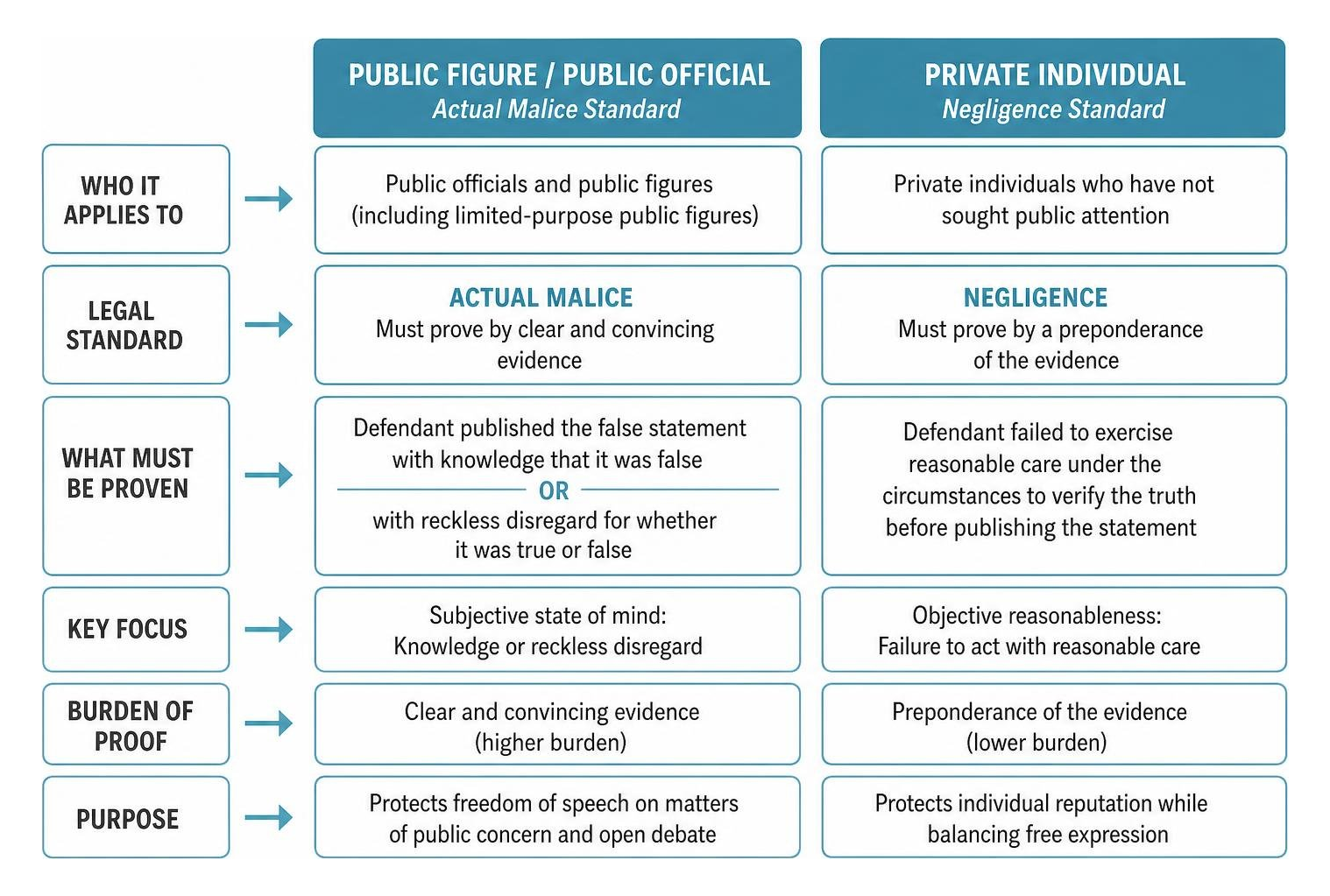
- Public Officials and Public Figures: Individuals who hold public office, as well as celebrities or figures who have thrust themselves into public controversies (limited-purpose public figures), face a higher burden of proof. Under the seminal U.S. Supreme Court ruling in New York Times Co. v. Sullivan, public plaintiffs must prove by clear and convincing evidence that the defendant acted with actual malice.
- Actual Malice Defined: Actual malice means the speaker published the false statement with knowledge that it was false, or with reckless disregard for whether it was true or false. Reckless disregard requires showing that the defendant actually harbored high subjective doubts about the truth of the publication but published it anyway.
- Private Individuals: Private persons who have not sought public attention generally only need to prove that the speaker acted with negligence—meaning a failure to act with reasonable care under the circumstances to verify the truth before speaking or writing.
Key Defenses, Retraction Statutes, and State Law Variations

When false allegations are made, a defendant may invoke recognized legal defenses to avoid liability.
Absolute and Qualified Privileges
Certain communications are protected from defamation lawsuits to protect public policy interests and encourage open communication:
- Absolute Privilege: Provides complete immunity from defamation liability, even if the speaker made the statement knowing it was false or out of pure ill will. Absolute privilege protects statements made during official judicial proceedings (such as witness testimony in court), legislative debates, and high-level executive communications.
- Qualified Privilege: Protects communications made in good faith on subjects where the speaker and recipient share a common interest or legal duty—such as workplace references, performance appraisals, and internal employer investigations. Under California Civil Code § 47(c), this protection is lost if the plaintiff proves the speaker acted with malice (ill will, hatred, or reckless disregard for the truth), in bad faith, or communicated the statement to unnecessary third parties.
>
Retraction Statutes and Damages Mitigation
Many states enforce retraction statutes that encourage the prompt correction of factual errors. Under California Civil Code § 48a, which applies specifically to daily newspapers and radio/TV broadcasts, an injured party must send a formal written retraction request within specific statutory time limits before filing suit.
If the publisher issues a prompt, equally prominent retraction, state law limits the plaintiff’s recovery strictly to proven “special damages” (direct out-of-pocket financial losses), barring recovery for presumed or punitive damages.
Defamation in the Workplace and Online Contexts

Defamatory assertions frequently occur in professional environments and modern digital platforms.
Workplace Defamatory Statements and Employee Rights
False statements in the workplace can damage an employee’s career, livelihoods, and professional standing. Workplace defamation often occurs during job reference checks, internal disciplinary reviews, or informal workplace gossip.
For workers evaluating their rights, common workplace situations include:
- Blacklisting: California law strictly protects workers from former employers who attempt to prevent them from securing new jobs. Under California Labor Code Section 1050, any person or agent who misrepresents a former employee’s record to prevent future employment can be held liable. Violations can expose wrongdoers to civil actions carrying triple damages.
- Compelled Self-Defamation: In some circumstances, an employee who is terminated based on false allegations is forced to repeat those false reasons to prospective employers during subsequent job interviews. California law recognizes compelled self-defamation, holding employers responsible for the foreseeable harm caused when an employee is forced to explain a false discharge reason.
Understanding how workplace misconduct occurs is vital for protecting your career. Learn more about your rights by exploring is slander in the workplace legal? and reviewing techniques for documenting workplace harassment. Workers facing severe hostility may also check our guide on what is a hostile work environment? to evaluate their options.
Online Publication, Social Media, and Section 230
Modern digital communication has altered how defamatory statements spread. A single post on social media, review sites, or professional forums can reach global audiences instantly.
- Platform Immunity under Section 230: Under 47 U.S.C. § 230 (Section 230 of the Communications Decency Act), interactive online platforms and social media providers are generally immune from liability for defamatory content posted by their users. The original author of the post remains legally responsible.
- Social Media Defamation: Individual users who post false factual assertions on platforms like Facebook, X, LinkedIn, or Reddit can be sued for libel. Courts treat digital posts, blogs, and text messages as written communications subject to standard defamation laws.
Frequently Asked Questions About Defamation
What is the primary difference between libel and slander?
The main distinction lies in the medium used to communicate the false statement. Libel refers to written, printed, or fixed defamatory statements (including digital posts, emails, and published photos). Slander refers to spoken, oral statements or transient gestures. Because written libel is permanent and easily shared, courts often treat libel as inherently more damaging than oral slander.
Can expressing an opinion protect someone from a defamation lawsuit?
Not automatically. Simply prefacing a statement with phrases like “I think” or “In my opinion” does not provide blanket legal protection. If the statement implies underlying false facts that can be objectively proven true or false, a court can still classify it as an actionable statement of fact.
How do retraction requests affect a defamation claim?
A formal retraction request alerts the publisher to the false statement and provides an opportunity to correct the record. In many jurisdictions, issuing a timely retraction limits the plaintiff’s potential financial recovery to proven special damages (direct monetary harm), while protecting the publisher against punitive damages.
Conclusion
Reputational integrity is vital to a person’s life, career, and peace of mind. When false defamatory statements threaten your livelihood—whether through misleading job references, malicious workplace gossip, or public character assassination—understanding your rights under the law is the first step toward reclaiming your reputation.
At Aiman-Smith & Marcy, we are an Oakland-based law firm dedicated to standing up for individuals. As a plaintiff-side practice specializing in employment and consumer law, our collaborative team of attorneys brings decades of experience fighting for workers who have suffered unlawful treatment, blacklisting, and workplace rights violations. If false statements have harmed your career, review our comprehensive legal guide on is slander in the workplace legal? to explore your rights.
Talk to ASM Lawyers Have questions about how California law applies to your situation? The team at ASM Lawyers offers consultations to help you understand your rights and options. Visit https://asmlawyers.com/contact/ to speak with an attorney about your case.
Attorney Advertising
Legal Disclaimer This article is for general informational purposes only and does not constitute legal advice. Reading this article or contacting ASM Lawyers does not create an attorney-client relationship. Laws change over time and every situation is different. For advice about your specific circumstances, consult a licensed California attorney.


