
What You Need to Know About Temporary Agency Workers
Temporary agency workers are people hired by a staffing or temp agency and then sent to work at another company — called the host employer. They do the same jobs as permanent staff, often side by side, but with less pay, fewer benefits, and far less job security.
Here is a quick snapshot of what defines temporary agency work:
- Who employs you: The staffing agency (your legal employer of record) — not the company where you actually work
- Who supervises you: The host employer (the company you’re placed with)
- Your legal status: Usually a W-2 employee of the agency, not an independent contractor
- Key risk: Both employers share responsibility for your safety and fair treatment — but each often assumes the other is handling it
This setup is called a dual-employer relationship, and it creates real confusion about your rights — especially when something goes wrong.
One anonymous temp worker put it plainly: staffing agencies treat temporary workers as expendable, and because they can easily replace them, worker safety and dignity often fall through the cracks.
If you’ve experienced unpaid wages, unsafe conditions, discrimination, or sudden loss of work — you are not alone, and you do have rights.
Understanding the Legal Rights of Temporary Agency Workers
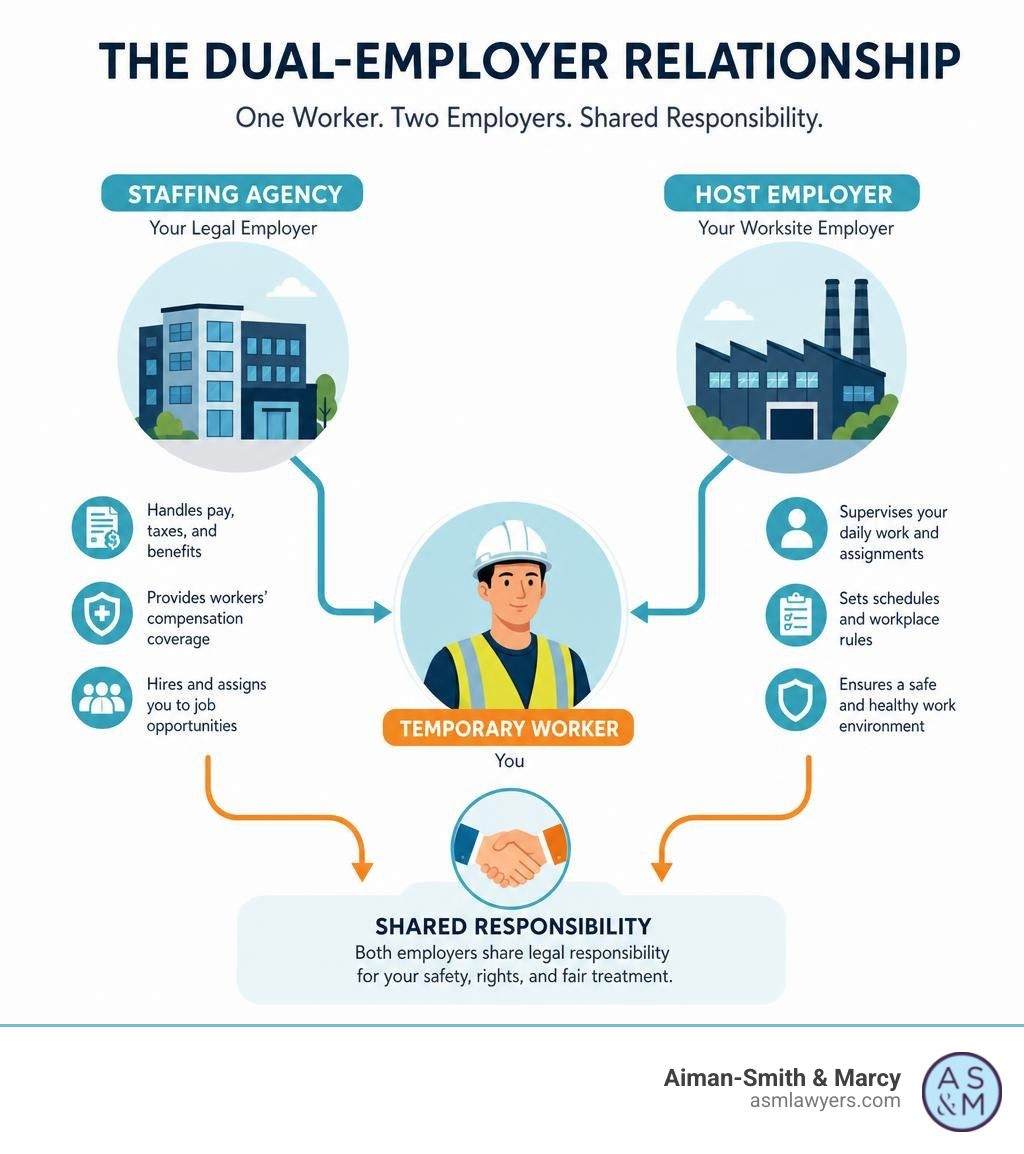
When you walk into a workplace as a temporary agency worker, you might feel like a guest in someone else’s house. But legally, you aren’t just a guest. You are protected by a web of state and federal laws designed to ensure you aren’t exploited. Under the law, temporary agency workers operate within a “dual-employer” framework. This means both your primary employer (the staffing agency) and your secondary employer (the host company) share legal responsibilities for your employment.
Understanding this relationship is key to protecting yourself. Your primary employer handles your paycheck, taxes, and workers’ compensation insurance, while your secondary employer directs your day-to-day tasks and controls your physical work environment.
To dig deeper into what this means for your daily work life, read our guide on Your Rights as a Temporary Worker and weigh the trade-offs of this setup by exploring The Pros and Cons of Temporary Work.
Defining Temporary Agency Workers vs. Direct Hires
It is easy to get confused by the alphabet soup of modern employment: direct hires, temp workers, independent contractors, and gig workers. Let’s break down the differences:
- Direct Hires: These are traditional employees hired directly by the company. They are on the company’s payroll, receive company benefits, and have a direct line of communication with HR.
- Temporary Agency Workers: You are recruited, vetted, and paid by a staffing agency, which places you at a client company. You are a W-2 employee of the agency, meaning they withhold taxes and handle payroll.
- Gig Workers and Independent Contractors: These are self-employed individuals (often 1099 workers) who control how and when they work.
In California, the distinction between a true temporary employee and an independent contractor is strictly enforced. If a host company treats you like an employee but calls you an independent contractor to avoid paying benefits or payroll taxes, you may be misclassified. To find out where you stand, check out our article: Are You a Temporary Worker or a Misclassified Employee?.
Temp Agency vs. Staffing Agency: Key Differences
While people often use the terms interchangeably, there are distinct operational differences between a standard temp agency and a broader staffing agency. Choosing the right one depends on your immediate and long-term career goals.
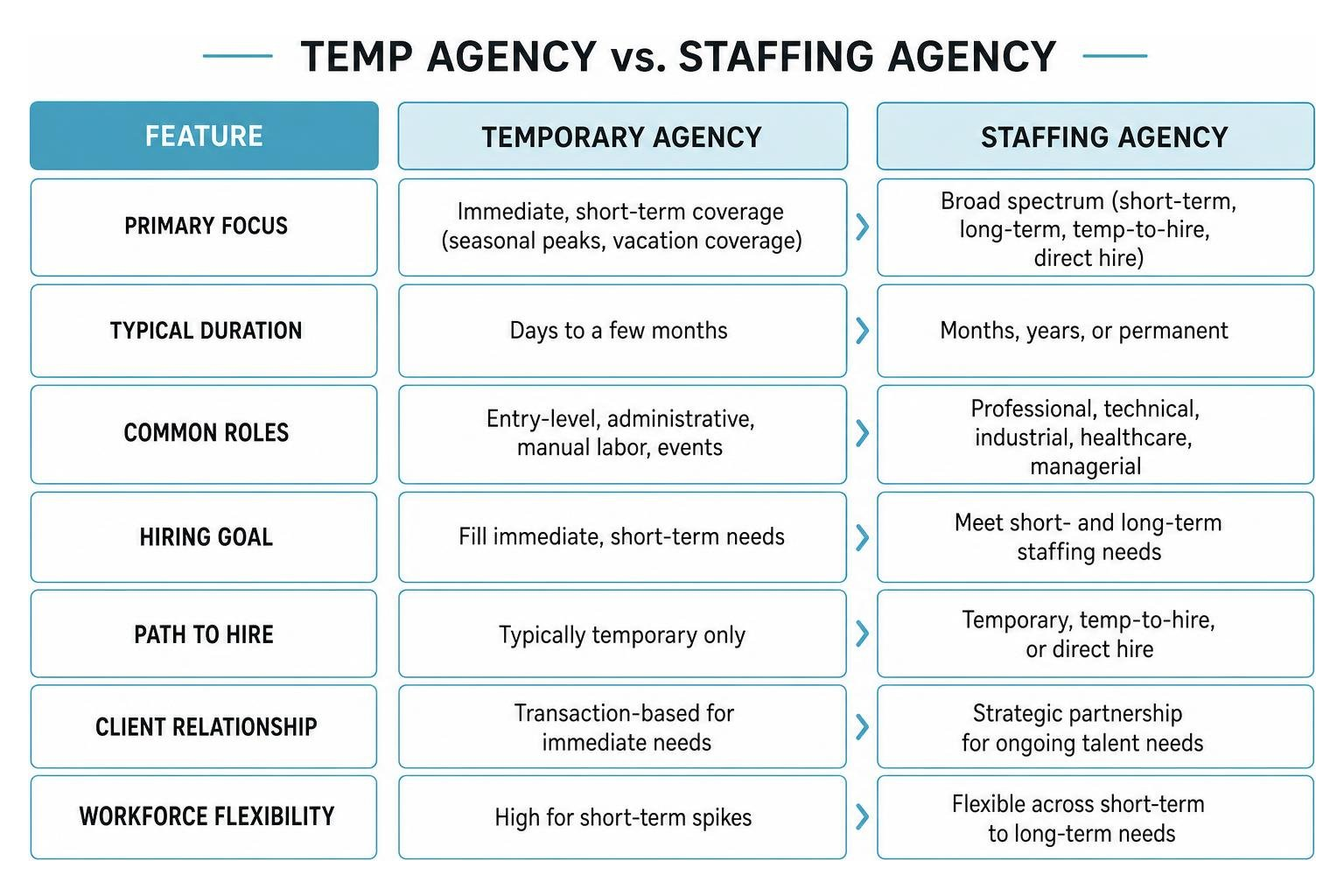
| Feature | Temporary Agency | Staffing Agency |
|---|---|---|
| Primary Focus | Immediate, short-term coverage (seasonal peaks, vacation coverage) | Broad spectrum (short-term, long-term, temp-to-hire, direct hire) |
| Typical Duration | Days to a few months | Months, years, or permanent |
| Common Roles | Entry-level, administrative, manual labor, events | Professional, technical, industrial, healthcare, managerial |
| Employer of Record | Almost always the temporary agency | The agency (for contract roles) or the client (for direct hire) |
| Conversion Fees | Standard if the client wants to hire the worker early | Pre-negotiated transition terms and direct-hire placement fees |
If you need fast cash or a highly flexible schedule, a temporary agency is excellent for plugging employment gaps. If you are looking to build a career or transition into a permanent role, a staffing agency that offers temp-to-hire or direct-hire placements is usually the better route.
Joint Employer Responsibilities and Workplace Safety
One of the most dangerous myths in the staffing world is that host employers do not have to worry about the safety of temporary workers because “they belong to the agency.” This is completely false.
Under federal law, the Occupational Safety and Health Administration (OSHA) views the staffing agency and the host employer as joint employers. This means both share the legal duty to keep you safe. Host employers cannot contract away their safety liabilities, and staffing agencies cannot blindly trust that a host site is safe.
For a comprehensive breakdown of these federal standards, you can read the official guidance on Protecting Temporary Workers | Occupational Safety and Health Administration .

Safety Training and Liability for Temporary Agency Workers
How is safety split in practice? Think of it as a team effort:
- The Staffing Agency (Primary Employer): Must provide general safety and health training. They must also actively inquire about the hazards at the host employer’s site, conduct site visits, and ensure the host company is providing a safe environment. Ignorance of hazards is not a legal defense for the agency.
- The Host Employer (Secondary Employer): Must provide site-specific and task-specific safety training. They must train you on the exact machinery you will use, provide proper personal protective equipment (PPE), and include you in all safety briefings.
Under California’s strict Cal/OSHA rules, every employer must maintain a written Injury and Illness Prevention Program (IIPP) under Title 8 Section 3203. If a staffing agency knows a host site is unsafe and fails to pull its workers or demand corrections, the agency can be cited and fined alongside the host employer.
If you are currently working on a temporary assignment in California, make sure to read our practical Tips for Temporary Workers in California to protect your health and safety on the job.
Legal Frameworks and Equal Treatment Protections
Equal treatment is a fundamental human right, but in many parts of the world, it is also a strict legal requirement for temporary agency workers. While the United States is still catching up in some areas, international standards provide a powerful blueprint for what fair treatment should look like.
In Europe, for example, the landmark Directive – 2008/104 – EN – EUR-Lex establishes the principle of equal treatment. This directive mandates that temporary agency workers must receive the same basic working and employment conditions (such as pay, working hours, and rest periods) as if they had been recruited directly by the host company from day one.
Furthermore, countries like Ireland enforce these rights under local laws, which you can explore on the Agency workers information page. These laws ensure that temporary workers have equal access to collective facilities like company canteens, childcare centers, and transport services.
The 12-Week Qualifying Period and International Standards
A key feature of international temp worker protections is the prevention of artificial structural loopholes. In the United Kingdom, The Agency Workers Regulations 2010 introduce a 12-week qualifying period. After working 12 continuous weeks in the same role with the same hirer, a temporary worker is legally entitled to the exact same pay and holiday benefits as a permanent peer.
To prevent companies from simply firing and rehiring workers to reset this clock, strict anti-avoidance measures are detailed in the statutory framework, which you can read in full via the official 105792COVS document. These rules ensure that short breaks or minor role adjustments do not break the continuity of your qualifying period.
California Labor Laws and Temp Worker Protections
While California does not have a strict “12-week equal pay” statute like the UK, we have some of the strongest labor protections in the United States. Under the California Labor Code, temporary agency workers are entitled to:
- Full Wage and Hour Protections: You must receive the local minimum wage, proper overtime pay (time-and-a-half after 8 hours in a day or 40 hours in a week), and double-time where applicable.
- Meal and Rest Breaks: You are legally entitled to an uninterrupted, unpaid 30-minute meal break for shifts over 5 hours, and a paid 10-minute rest break for every 4 hours worked.
- Protection Against Wage Theft: Your agency must provide you with an itemized wage statement (pay stub) every pay period showing your rate of pay, hours worked, and all deductions.
If your agency or host employer is violating these basic rights, you don’t have to take it lying down. Learn more by reading What You Need to Know as a Temporary Employee in California.
Challenges, Discrimination, and Legislative Victories
Despite these legal protections, temporary agency workers face systemic hurdles. Academic research, such as the study Producing Precarity: The Temporary Staffing Agency in the Labor Market | Qualitative Sociology | Springer Nature Link , reveals how some staffing agencies systematically cultivate and reproduce structural vulnerability. By keeping a large “periphery” of underutilized workers on their books, agencies can maximize their profits while keeping workers in a state of constant insecurity and compliance.
This precarity is not felt equally. It is deeply tied to issues of race, immigration status, and occupational segregation.

Overrepresentation and Safety Risks in Blue-Collar Roles
The data paints a stark picture of who carries the heaviest burdens in the temporary staffing industry:
- Racial Disparities: Black workers make up 25.9% of temporary workers, despite representing only 12.1% of the overall workforce. Similarly, Latinx workers comprise 25.4% of temp workers, compared to 16.6% of all workers.
- Manufacturing and Warehousing Segregation: Black workers represent 33.0% of temp workers in manufacturing and warehousing, but only 15.5% of overall workers in that sector. Latinx workers make up 30.9% of temp workers in these roles, compared to 23.9% of the overall manufacturing workforce.
- Significant Wage Gaps: Temp workers in blue-collar roles face massive pay penalties compared to direct hires:
- Transportation and Material Moving: Temp workers earn a median hourly wage of $15.33, compared to $18.24 for all workers — a 16.0% pay gap.
- Production: Temp workers earn $15.53 vs. $19.19 for all workers — a 19.1% pay gap.
- Construction and Extraction: Temp workers earn $18.45 vs. $24.31 for all workers — a 24.1% pay gap.
These high-risk industries — industrial/warehouse placements make up roughly 36% of all staffing placements — are where safety hazards and wage violations are most heavily concentrated.
Recent Legislative Victories: Bills of Rights
In response to these systemic inequalities, workers and advocates have won major legislative victories across the country.
In New Jersey, the Temporary Workers’ Bill of Rights went into effect, mandating that temporary workers in key occupational groups receive the same average pay and benefits as permanent employees performing the same work.
Similarly, the Illinois Temp Worker Fairness and Safety Act has placed strict transparency and safety training requirements on agencies and host employers alike.
While California does not yet have a single, unified “Temp Worker Bill of Rights,” our existing joint-employment doctrines, strict Cal/OSHA enforcement, and robust anti-discrimination laws provide powerful legal tools to fight back against exploitation.
Transitioning to Permanent Employment and Choosing Credible Agencies
For many, temporary work is a stepping stone. A “temp-to-hire” arrangement allows you to showcase your skills on the job with the goal of transitioning to a permanent, direct-hire role.
However, this transition is often blocked by “permatemping” — a practice where host employers keep workers in temporary status indefinitely to avoid paying benefits. This is often enforced through contracts between the agency and the host company containing restrictive “conversion fees” that penalize the host employer for hiring you directly before a certain timeframe (such as 180 days) has passed.
Evaluating and Choosing a Credible Temporary Agency
To avoid exploitative agencies, you must know how to vet them before you sign on the dotted line. Here are the actionable steps you should take:
- Ask About the Employer of Record: Ensure the agency is a legitimate W-2 employer that handles payroll taxes and workers’ compensation. Avoid agencies that try to classify you as a 1099 independent contractor.
- Inquire About Conversion Timelines: Ask upfront: “What is the exact process, timeline, and fee structure for transitioning to a permanent direct-hire role with the client?”
- Check Their Safety Record: Ask the agency how they inspect host worksites and what their policy is if you encounter an unsafe condition. A credible agency will have a clear, written IIPP and will encourage you to report hazards.
- Avoid Fees: Legitimate agencies never charge job seekers a fee to find them work or place them in a job.
Frequently Asked Questions about Temp Staffing
Navigating the temp world can leave you with a lot of questions. Here are the answers to some of the most common queries we hear from workers.
Can a temporary agency worker transition to a permanent role?
Yes. Many placements are structured as temp-to-hire. However, host employers are often bound by contract clauses requiring them to pay the staffing agency a conversion fee if they hire you permanently before a set period. Always ask your agency recruiter about these timelines so you can plan your career progression transparently.
Who is liable if a temporary worker is injured on the job?
Under the dual-employer doctrine, both the staffing agency and the host employer share responsibility. Generally, your medical bills and lost wages will be covered by the staffing agency’s workers’ compensation insurance. However, if the host employer’s severe negligence caused your injury, or if Cal/OSHA finds safety violations, the host employer can face heavy citations and fines.
What rights do temporary workers have against discrimination and retaliation?
You have the exact same rights as permanent employees. Under federal law (Title VII) and the California Fair Employment and Housing Act (FEHA), it is strictly illegal for either the staffing agency or the host employer to discriminate against you based on race, gender, age, religion, disability, or sexual orientation. Furthermore, if you report a safety hazard or unpaid wages, both employers are legally prohibited from retaliating against you (such as firing you, cutting your hours, or “ghosting” you on future assignments).
Conclusion
Temporary agency workers are the backbone of California’s most vital industries, from logistics in the Central Valley to manufacturing in the Bay Area. But flexibility should never come at the cost of your safety, your dignity, or your hard-earned wages.
At Aiman-Smith & Marcy, we are a boutique, Oakland-based law firm specializing in employment law. Our close-knit, collaborative team of attorneys has worked together for over 25 years, fighting tirelessly for workers facing discrimination, unpaid wages, and unlawful workplace practices. We understand the complex joint-employer relationships that define temporary work, and we know how to hold both agencies and host employers accountable.
If you believe your rights have been violated, or if you suspect you have been misclassified, we are here to help. Contact us today for a confidential consultation, and let’s discuss how we can stand up for your rights together. To get started, read our guide: Are You a Temporary Worker or a Misclassified Employee?.


