
When Your Paycheck Comes from One Company but Your Boss Is Another
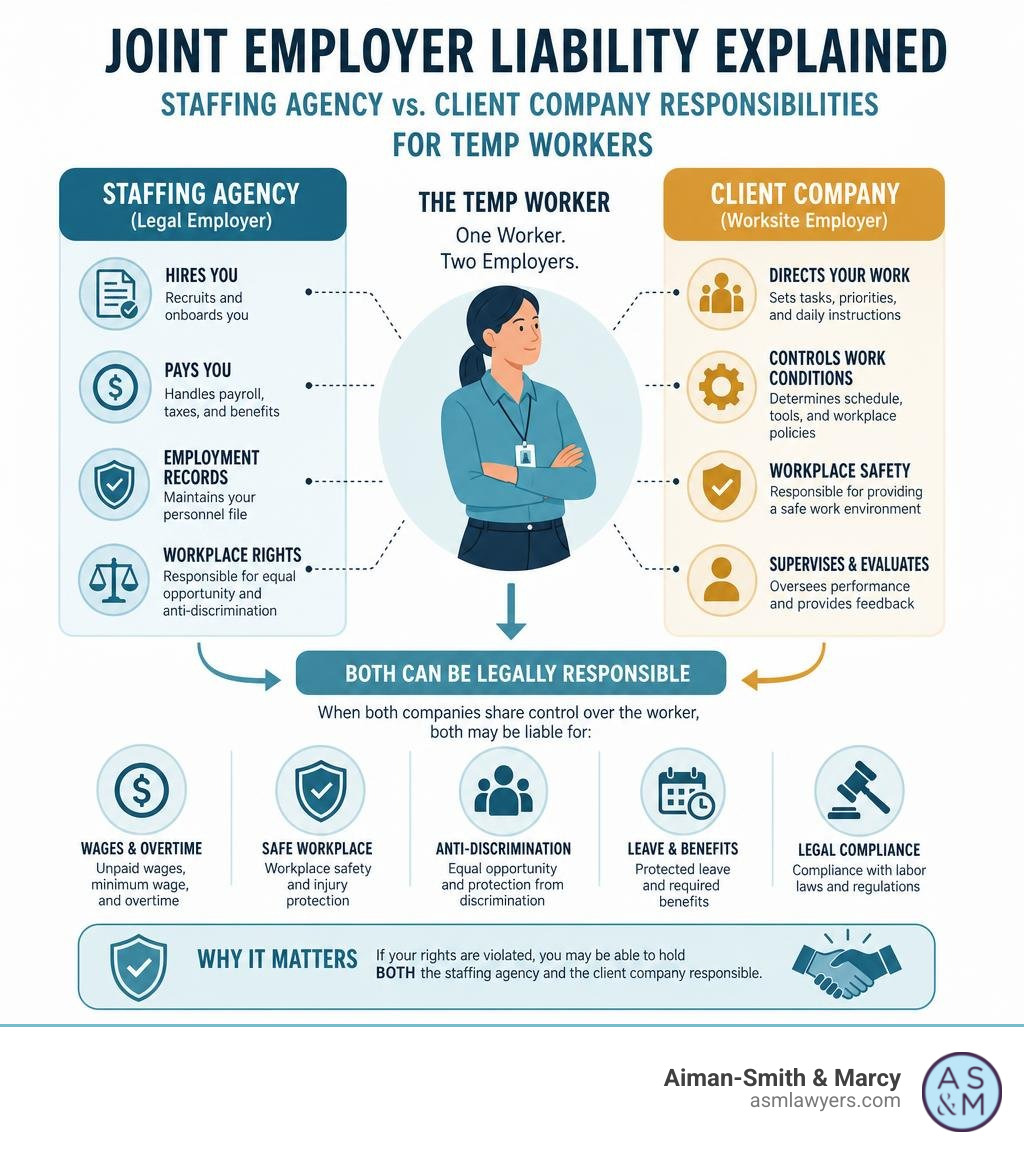
A temp agency joint employer relationship exists when two companies — a staffing agency and a client business — both share legal responsibility for the same worker at the same time.
Here is a quick breakdown of what that means for you:
- Who is the staffing agency? The company that hired you, puts you on payroll, and sends you to work somewhere else.
- Who is the client company? The business where you actually show up, take orders, and do your work every day.
- What is joint employment? When both of those companies are considered your legal employer — making both potentially liable for your wages, safety, and other workplace rights.
- Why does it matter? If your staffing agency fails to pay your wages, discriminates against you, or violates your rights, you may be able to hold the client company responsible too — not just the agency.
This matters more than most people realize. Today, roughly 3.2 million workers in the U.S. hold jobs through temp and staffing agencies. Between April 2020 and July 2022, 62% more temp workers were hired — meaning millions of people entered working arrangements where the lines of legal responsibility were blurry from day one.
As one labor policy researcher put it plainly: “The firm that appears on a worker’s paycheck is often not the firm that dictates the terms of that worker’s job.”
That gap — between who pays you and who controls you — is exactly where joint employer law lives. And for workers in Oakland and across California, understanding that gap can be the difference between recovering what you are owed and walking away with nothing.
I’ll walk you through exactly how joint employment works, what your rights are, and what legal protections apply to your situation.
Navigating the Temp Agency Joint Employer Relationship

When you are hired as a temporary worker, you enter a three-way relationship. On one side is the staffing agency (the primary employer), on another is the client company (the third-party business that needs your labor), and on the third side is you. This setup is often called co-employment or joint employment.
With over 3.2 million temporary help and staffing agency jobs in the United States, this “fissured workplace” model is incredibly common. Because of a 62% hiring increase in temporary workers between 2020 and 2022, regulatory agencies and courts have had to look closely at who is actually responsible when things go wrong on the job.
If you are a temporary worker, you have rights. Knowing whether you are dealing with a temp agency joint employer relationship is the first step in enforcing those rights. You can learn more about your foundational protections in our guide on Your Rights as a Temporary Worker.
Vertical vs. Horizontal Joint Employment
To understand joint employment, federal and state regulators look at how the companies are structured. There are two primary types of joint employment:
- Vertical Joint Employment: This is the classic staffing agency arrangement. It occurs when a worker is hired by an intermediary company (the staffing agency) to perform work that directly benefits another company (the client company). The worker is economically dependent on both entities to make a living.
- Horizontal Joint Employment: This occurs when an employee works separate hours for two or more associated or commonly controlled companies during the same workweek. For example, if you work 25 hours as a security guard for Company A and another 20 hours for Company B, but both companies are owned by the same parent corporation and share operations, they are horizontal joint employers. Under the Fair Labor Standards Act (FLSA), your hours across both locations would be aggregated, meaning you would be owed 5 hours of overtime.
For almost all temporary workers placed at a job site, vertical joint employment is the model that determines their rights.
The Concept of Economic Reality for a Temp Agency Joint Employer
To figure out if a company is actually a joint employer, courts don’t just look at what a written contract says. They look at the “economic reality” of the situation.
Under the FLSA, the definition of “employ” is incredibly broad: “to suffer or permit to work.” If a client company has the power to direct your work, control your schedule, or influence your pay, the law says they are “permitting” you to work, making them a joint employer.
To measure this, courts frequently use the Bonnette test, which stems from a landmark 1983 Ninth Circuit Court of Appeals case (Bonnette v. California Health & Welfare Agency). This test uses a four-factor control framework to determine joint employment:
- Hiring and Firing: Does the client company have the authority to hire or fire you?
- Supervision and Control: Does the client company supervise your daily work, set your schedule, or dictate your job duties?
- Rate and Method of Payment: Does the client company determine how much you get paid or how you are compensated?
- Employment Records: Does the client company maintain employment records such as timecards, payroll files, or tax documents?
If a client company meets these factors, they cannot hide behind a contract that claims you are “only” an employee of the temp agency. To see how these rules are shifting nationally, you can read about how the DOL Proposes New Joint Employer Rule to clarify these exact standards.
Federal Legal Frameworks and Joint Employer Tests

Federal employment laws are not unified. Different federal agencies use different tests to decide if a temp agency joint employer relationship exists. This means a client company might be considered your joint employer for wage disputes, but not for union organizing, or vice versa. This lack of a single statutory definition has led to a highly unstable legal landscape.
As organizations like American Compass point out in their analysis on the Joint Employer Standard: Restore Responsibility, this instability often leaves vulnerable workers holding the bag when undercapitalized subcontractors go bankrupt.
The NLRB Standard: 2020 Rule vs. Vacated 2023 Rule
The National Labor Relations Board (NLRB), which governs workers’ rights to organize and bargain collectively, has gone through a political tug-of-war over its joint employer rule:
- The 2023 Expanded Rule: In late 2023, the NLRB issued a rule stating that a company could be deemed a joint employer if it possessed the reserved right to control essential terms of employment, even if it never actually exercised that control. This meant that if a contract simply said a client company could set your schedule, they were a joint employer, even if the staffing agency did all the scheduling in practice.
- The 2024 Vacatur & 2026 Reinstatement: A federal district court vacated the 2023 rule. In response, on February 25, 2026, the NLRB issued a “ministerial” action officially withdrawing the 2023 regulation and reinstating the narrower 2020 joint employer standard.
Under the current 2020 standard, an entity must possess and exercise substantial direct and immediate control over your essential terms of employment. Contractually reserved but unexercised authority, or indirect control, is no longer enough on its own to make a company a joint employer under the National Labor Relations Act. For a deeper look into this regulatory shift, check out the analysis on how the NLRB Withdraws 2023 Joint Employer Rule.
FMLA Joint Employer Responsibilities: Primary vs. Secondary Employers
Under the Family and Medical Leave Act (FMLA), joint employment responsibilities are divided into “primary” and “secondary” employers. The temporary staffing agency is almost always the primary employer, while the client company is the secondary employer.
Both companies must count you when determining if they meet the FMLA’s coverage threshold of 50 employees within a 75-mile radius. However, their day-to-day responsibilities differ significantly:
| Responsibility | Primary Employer (Staffing Agency) | Secondary Employer (Client Company) |
|---|---|---|
| FMLA Notices & Leave Administration | Yes, must provide notices and process leave | No, but must not interfere with leave |
| Maintaining Health Benefits | Yes, must keep benefits active during leave | No |
| Job Restoration | Yes, must place you in an equivalent job | Yes, if they continue using the agency’s services |
| Record Keeping | Must keep full FMLA and payroll records | Must keep basic payroll and identifying data |
A secondary employer cannot retaliate against you for taking FMLA leave, nor can they tell the staffing agency to replace you simply because you requested family or medical leave.
The Proposed 2026 Unified DOL Joint Employer Rule
Because of the confusion caused by different standards, the U.S. Department of Labor (DOL) published a Notice of Proposed Rulemaking on April 23, 2026. The goal of this proposed rule is to create a single, unified nationwide standard for joint employment across three key federal laws: the FLSA, the FMLA, and the Migrant and Seasonal Agricultural Worker Protection Act (MSPA).
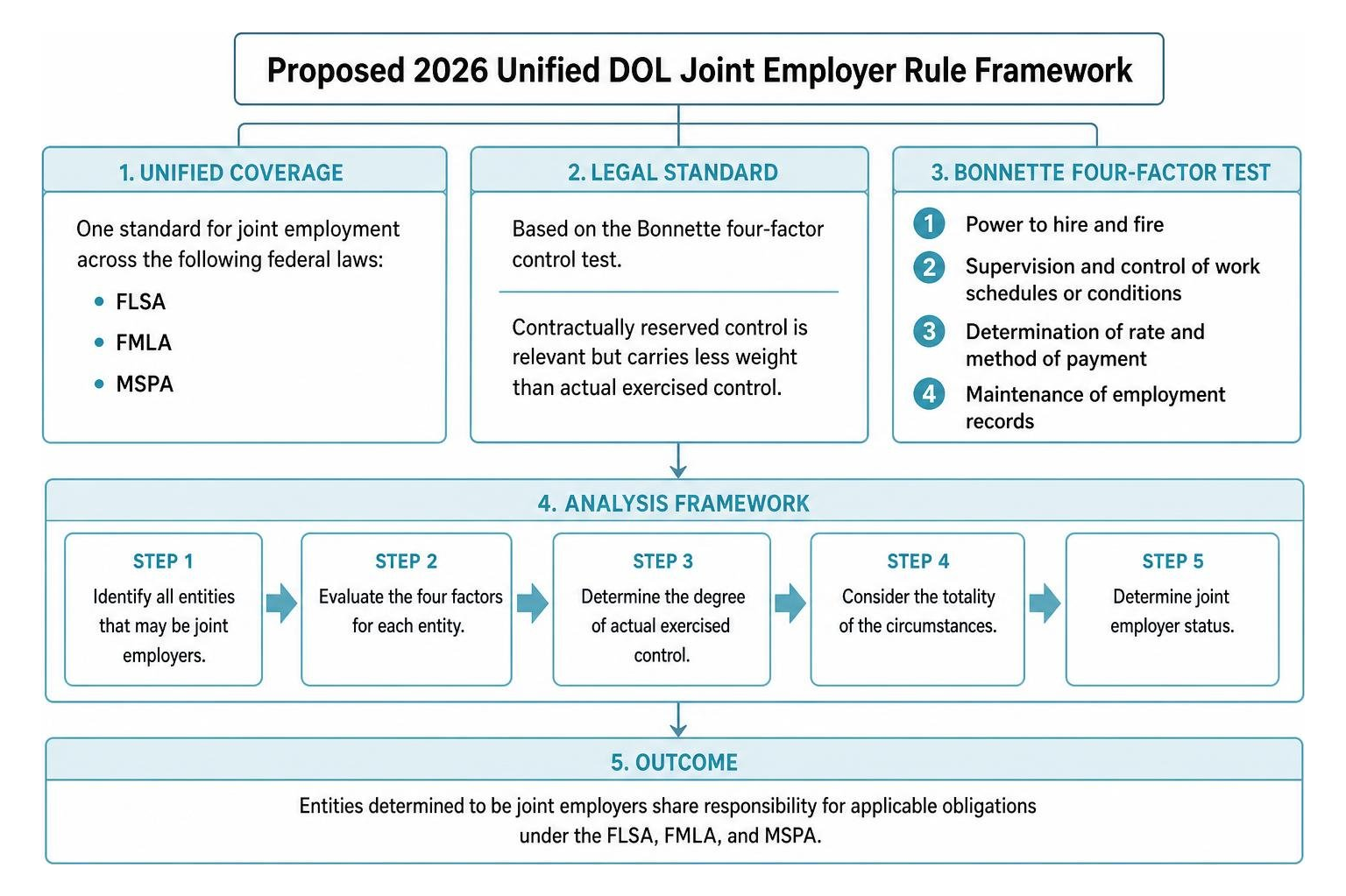
This proposed rule focuses heavily on the four-factor Bonnette control test, but it clarifies that while contractually reserved control is relevant, actual exercised control carries much more weight. You can read the detailed proposal directly on the Federal Register 2026-07959 page, or view a legal breakdown of its implications in the article Consistency and Clarity: DOL Proposes Unified Joint-Employer Standard.
California-Specific Protections for Temporary Workers
While federal rules are constantly shifting, California has built some of the strongest protections for temporary workers in the entire country. If you are working in Oakland or anywhere else in California, you do not have to rely solely on unstable federal standards. California state laws provide clear, powerful avenues to hold client companies liable for workplace violations.
If you are navigating these waters, it helps to understand the unique landscape of our state. We encourage you to read our comprehensive guide on What You Need to Know as a Temporary Employee in California.
California Labor Code Section 2810.3 and AB 1897
In 2014, California passed Assembly Bill 1897, which created California Labor Code Section 2810.3. This law is a massive shield for temporary workers.
Under Section 2810.3, a client employer (referred to as a “lead business” or “client employer”) shares strict civil liability with its labor contractors (the staffing agencies) for:
- The payment of all unpaid wages.
- The failure to secure workers’ compensation insurance.
This means that if your staffing agency goes bankrupt, fails to pay your overtime, or steals your wages, you can sue the client company directly to recover what you are owed. You do not have to prove the client company had “direct control” over your schedule under complex federal tests. If you worked on their premises and they used the labor contractor, they are jointly liable.
To learn how to protect yourself on the job, take a look at our practical Tips for Temporary Workers in California.
California Laws on Misclassification and the Temp Agency Joint Employer
Many companies try to avoid joint employer liability by labeling their workers as “independent contractors” or “temporary consultants” when they are actually employees. California combats this through Assembly Bill 5 (AB 5) and the strict ABC test.
Under the ABC test, a worker is presumed to be an employee unless the hiring entity can prove three things:
- A: The worker is free from the control and direction of the hiring entity in connection with the performance of the work.
- B: The worker performs work that is outside the usual course of the hiring entity’s business.
- C: The worker is customarily engaged in an independently established trade, occupation, or business of the same nature as that involved in the work performed.
If you are placed at a client company through a staffing agency, but the client company treats you like an independent contractor to avoid paying benefits or payroll taxes, you may be a misclassified employee. We specialize in fighting these battles. You can read more about your rights and legal remedies in our article on being a Misclassified Temporary Worker.
Liabilities and Best Practices in Joint Employment
When joint employment is established, both the staffing agency and the client company face joint and several liability. This means a worker can seek 100% of their damages from either company, or a mix of both.
Potential Liabilities for Wage Theft, Safety, and Discrimination
The legal consequences of joint employment span several major areas of labor law:
- Wage Theft and Unpaid Overtime: Under the FLSA and California Labor Code, joint employers are jointly liable for minimum wage violations, unpaid overtime, and missed meal or rest breaks. If a client company relies on a thinly capitalized staffing agency that fails to pay its workers, the client company faces the “collection risk” of paying those back wages out of its own pocket.
- Workplace Safety (OSHA): Under federal and California OSHA rules, both the staffing agency and the client company are responsible for workplace safety. The client company must ensure a safe physical environment and provide site-specific safety training, while the staffing agency must ensure general safety training is completed.
- Workplace Discrimination and Sexual Harassment: Under Title VII of the Civil Rights Act and California’s Fair Employment and Housing Act (FEHA), joint employers can be held liable if they fail to address discrimination, sexual harassment, or retaliation. If a supervisor at a client company harasses a temporary worker, both the client company and the staffing agency (if they fail to take corrective action) can be sued.
Best Practices for Staffing Agencies and Client Companies
To avoid triggering joint employer liability under federal tests, client companies often attempt to structure their relationships carefully. According to the article DOL’s Joint Employer Proposal: What Employers Should Watch Now, businesses are advised to take several precautions:
- Route Discipline Through the Agency: Client companies should never directly discipline or fire a temporary worker. Instead, they should report performance issues to the staffing agency manager, who handles the disciplinary action.
- Avoid Direct Scheduling: Client companies should set production goals or shift needs, but let the staffing agency assign specific workers to those shifts.
- Keep Records Separate: Client companies should not keep personnel or payroll records for temporary workers, leaving that entirely to the staffing agency.
- Do Not Mix Workforces: Temporary workers should not be included in internal company directories, company-wide email lists, or employee-only events to prevent them from appearing as direct employees.
Frequently Asked Questions about Joint Employment
Who is liable if a temp agency fails to pay my wages?
In California, both the staffing agency and the client company are jointly liable. Under California Labor Code Section 2810.3, you can hold the client company directly responsible for unpaid wages, overtime, and wage theft, regardless of whether they directly managed your payroll.
Do temporary employees count toward FMLA coverage thresholds?
Yes. Under federal FMLA rules, jointly employed workers must be counted by both the staffing agency and the client company when determining if they meet the 50-employee threshold within a 75-mile radius.
Can a client company fire a temp worker directly?
While a client company can ask a staffing agency to remove a worker from their specific job site, they should not fire the worker from the staffing agency itself. If a client company’s supervisors directly terminate a temp worker, it serves as strong evidence of direct employer control in a joint employment lawsuit.
Conclusion: We Fight for California’s Temporary Workers
If you are working through a staffing agency in California, you are not a second-class citizen. You have the right to a safe workplace, fair pay, and a job free from discrimination and harassment. When those rights are violated, the law does not let client companies hide behind a staffing contract to escape liability.
At Aiman-Smith & Marcy, we are an Oakland-based boutique law firm specializing in employment law. Our collaborative team of attorneys has worked together for over 25 years, providing representation for temporary workers facing wage theft, discrimination, and misclassification.
If you believe your rights have been violated, or if you suspect you are being treated as a temporary worker when you should be classified as a permanent employee, we are here to help.
Contact us today to speak with an experienced attorney, or read our detailed guide: Are You a Temporary Worker or a Misclassified Employee? to learn more about how we can recover what you are owed.


