
What Is Temporary to Hire — and Why It Matters for Workers
A temporary to hire agreement is a work arrangement where you start a job on a short-term basis — usually through a staffing agency — with the possibility of becoming a permanent employee after a trial period.
Here’s the quick version:
- What it is: A trial period (typically 90 to 180 days) where you work for a company before either side commits permanently
- Who pays you: The staffing agency, not the company you work at — at least during the trial
- What happens after: The company can offer you a permanent role, extend the trial, or end the assignment
- Your status: You are a W-2 employee of the staffing agency, not an independent contractor
- The catch: You may not receive full benefits, paid time off, or job security until — and unless — you convert to permanent
It sounds straightforward. But for workers in California, the details hiding inside these arrangements can have serious consequences — from unpaid wages to misclassification to suddenly losing a job you thought was becoming permanent.
As of 2023, 6.9 million Americans — about 4.3% of the workforce — held contingent positions like these, up from 3.8% in 2017. That’s a lot of people navigating arrangements they may not fully understand.
In this guide we’ll walk you through exactly how temp-to-hire agreements work, what your rights are, and what to watch out for before you sign anything.
Understanding the Temporary to Hire Employment Model
At Aiman-Smith & Marcy, we often see workers who enter these arrangements thinking they are already “part of the team.” In reality, the legal and financial structures of a temporary to hire agreement are very different from standard employment.

When you accept a temp-to-hire role, you are entering a triangular relationship. The staffing agency acts as your primary employer (the Employer of Record). They handle your payroll, withhold your taxes, and provide whatever basic benefits you might qualify for. The client company — the place where you actually show up to work every day — is simply hosting you for a trial period.
To help make sense of how this differs from other common job structures, we have broken down the three main employment paths:
| Feature | Temporary Staffing | Direct Hire | Temp-to-Hire |
|---|---|---|---|
| Employer of Record | Staffing Agency | Client Company | Staffing Agency (initially), then Client Company |
| Primary Purpose | Short-term project or seasonal coverage | Permanent, long-term placement | Mutual evaluation for a permanent role |
| Benefits Eligibility | Limited agency benefits | Immediate company benefits | Delayed until permanent conversion |
| Duration | Fixed end date | Indefinite | Typically 90 to 180 days |
Is Contract-to-Hire the Same as Temporary to Hire?
In the modern job market, you will hear the terms “contract-to-hire” and “temporary to hire” used almost interchangeably. Legally and operationally, they are highly similar, but there are a few subtle differences in how they are used in the industry.
Contract-to-hire is a term most commonly found in highly specialized or professional fields, such as IT, engineering, and creative services. These roles often require a specific technical skill set. Temporary to hire, on the other hand, is more frequently associated with light industrial, manufacturing, administrative, and clerical roles.
Regardless of the label, both models function as a trial period. During this phase, you are paid on a W-2 basis by the staffing agency, not as a 1099 independent contractor. If you want to dive deeper into how these contract dynamics work, you can read more about Contract to Hire: What It Means and When It Makes Sense to understand the strategic side of these agreements.
Key Differences: Temp-to-Hire vs. Temporary Staffing vs. Direct Hire
To understand your rights, you must know exactly which bucket your job falls into.
- Direct Hire: The company recruits you, hires you, and places you directly onto their payroll from day one. You get their standard benefits package immediately, and there is no middleman.
- Temporary Staffing: You are hired to cover a specific, short-term gap. This might be to cover a parental leave, help with a seasonal surge, or assist with a specific project. There is generally no expectation of a permanent job offer at the end. If you want to see how businesses utilize these short-term setups, check out Temporary Staffing Solutions | Hire Top Talent Fast with Vaco.
- Temp-to-Hire: This is the middle ground. It begins as a temporary assignment, but both you and the employer enter the agreement with the explicit goal of transitioning you to a permanent role on the company’s direct payroll.
How the Temp-to-Hire Process Works
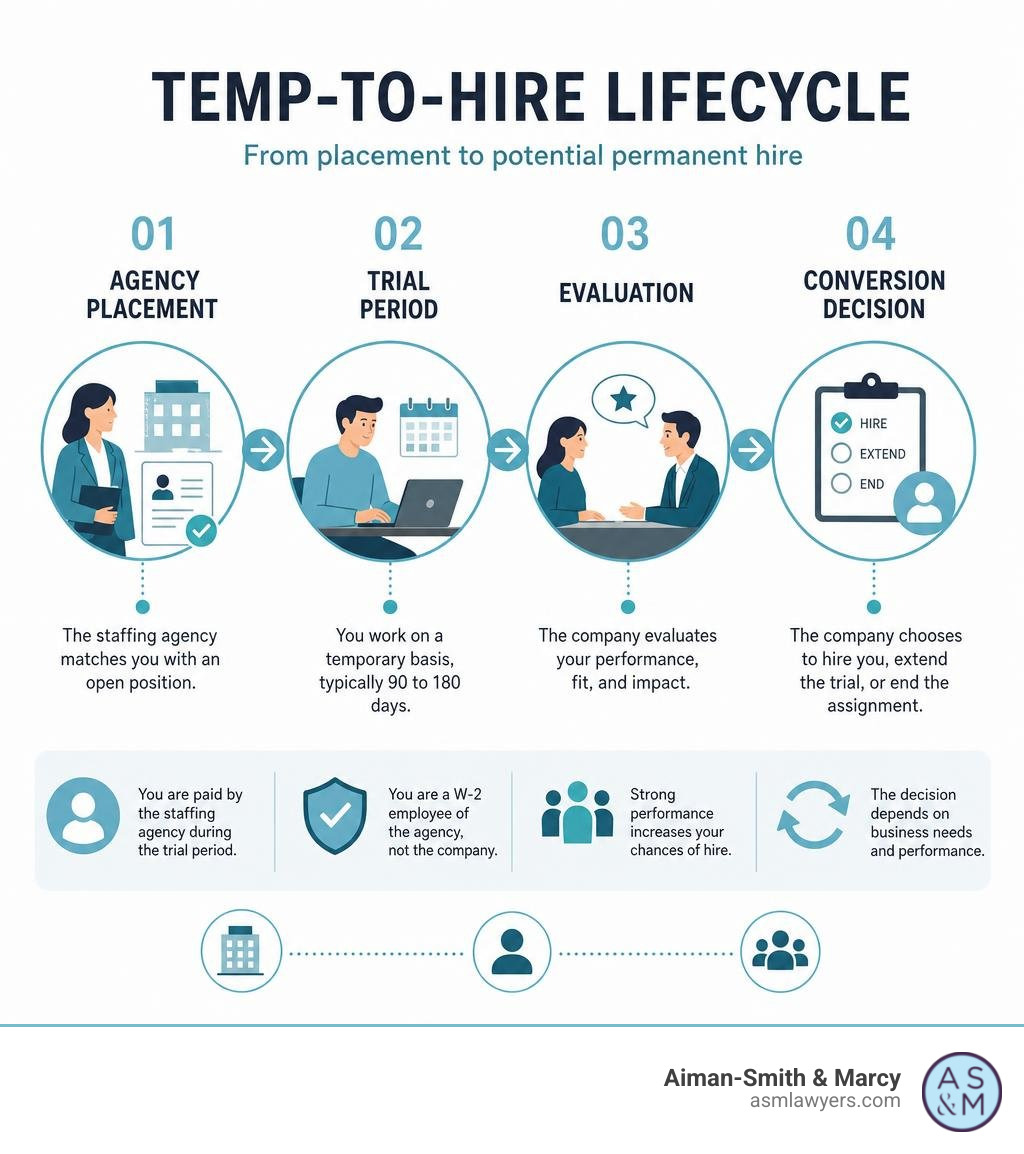
The journey from a temporary associate to a direct, permanent employee is a structured process. It is helpful to view this transition as a multi-stage timeline.

How Staffing Agencies Facilitate Temporary to Hire Placements
Staffing agencies are the brokers of the temp-to-hire world. They handle the initial recruitment, run background checks, verify work authorization, and screen candidates to find a strong match.
Because they act as the Employer of Record during your trial phase, they also shield the client company from immediate administrative burdens like payroll processing and workers’ compensation liability. Agencies often utilize advanced matching tools to connect workers with open roles. For a look at how specialized agencies manage this process, you can explore Contract to Hire | Staffing Solutions | Aquent.
Typical Duration and Conversion Factors
A standard temp-to-hire trial period usually lasts between 90 and 180 days. This window gives both parties enough time to evaluate whether the relationship makes sense for the long haul.
Whether you successfully transition to a permanent role depends on several key conversion factors:
- Performance Metrics: Are you meeting your daily and weekly output goals?
- Attendance and Reliability: Do you show up on time and communicate clearly?
- Cultural Fit: Do you work well with the existing team and adapt to the company’s work style?
- Budget Approval: Does the client company have the financial green light to add a permanent full-time equivalent (FTE) to their payroll?
The Advantages of Temp-to-Hire Agreements
There is a reason these arrangements have grown so popular. When done right, they offer a low-risk way for both sides to test the waters. We discuss these dynamics in our guide on The pros and cons of temporary work.
Benefits for Employers
For businesses, the temp-to-hire model is an excellent tool for managing risk.
- Lower Turnover: By trialing an employee before making a permanent offer, companies can avoid the high costs of a bad hire.
- Headcount Flexibility: It allows managers to scale their workforce up or down based on fluctuating seasonal demands or shifting project budgets.
- Reduced Administrative Burden: The staffing agency handles the initial onboarding paperwork, payroll taxes, and benefits administration, keeping the company’s internal HR overhead low.
Benefits for Job Seekers
For workers, a temp-to-hire role is not just an extended job interview; it is also an opportunity to audit the employer.
- Mutual Evaluation: You get to test out the company’s management style, workplace culture, and daily operations before committing to a long-term role.
- Career Transitions: If you are changing industries, temporary assignments offer a lower barrier to entry, helping you build a portfolio and gain valuable experience.
- Foot in the Door: Many premier employers use temp-to-hire arrangements exclusively for entry-level and mid-level roles, meaning these contracts are often the only way to get noticed. You can learn more about navigating these opportunities in our article on Your rights as a temporary worker.
The Disadvantages and Risks of Temp-to-Hire Agreements
While the benefits are clear, we must also look at the darker side of these arrangements. For many workers, the “trial period” can feel like a period of second-class citizenship.

Drawbacks for Employers
Employers face their own set of challenges with this model.
- Limited Talent Pool: Many top-tier candidates who are currently employed will not leave a permanent role with secure benefits to take a temporary “trial” position.
- Agency Buyout Clauses: Staffing agencies make their money through conversion fees. If an employer wants to hire you permanently before the agreed-upon contract window is up, they must pay a hefty buyout fee to the agency.
- Training Gaps: Temporary workers may not receive the same depth of onboarding and safety training as direct hires, which can lead to productivity drops or safety risks.
Drawbacks for Job Seekers
For employees, the risks are often much higher and more personal.
- Delayed Benefits: You will typically not have access to the client company’s health insurance, retirement match, or paid time off (PTO) during your temporary phase. This can leave you vulnerable for months.
- Lack of Job Security: As a temporary worker, you can be let go at a moment’s notice with very little recourse, even if your performance has been excellent.
- Wage Disparities: Staffing agencies take a cut of the hourly rate the client company pays. This means you might earn less per hour than direct employees doing the exact same work right next to you.
Key Legal Risks and Worker Protections
In California, the law does not allow employers to use the “temporary” label as a shield to bypass worker protections. Whether you are temporary, contract-to-hire, or permanent, you are protected by robust state labor laws.
One of the most complex legal realities of temp-to-hire arrangements is joint employer liability. Under California law, both the staffing agency and the client company can be held responsible for wage and hour violations, workplace harassment, and discrimination. If a client company denies you meal breaks or fails to pay overtime, both they and the agency may be on the hook. To understand how these boundaries can blur, read our guide: Are you a temporary worker or a misclassified employee?
Worker Misclassification and the “Permatemp” Risk
A major risk for contingent workers is the phenomenon of the “permatemp.” This happens when an employer keeps a worker in a “temporary” or “contract” status indefinitely to avoid paying benefits, providing job security, or complying with standard labor protections.
In California, workers are protected by strict misclassification laws, including Assembly Bill 5 (AB 5). If an employer directs how, when, and where you work, and you are performing core business tasks, you are a W-2 employee — not an independent contractor. If you believe your employer is keeping you in limbo unlawfully, you should review our resources on identifying a Misclassified temporary worker and learn why CA temporary workers: you are not contractors if… you meet certain legal criteria.
California-Specific Labor Laws for Temporary Workers
California has some of the strongest worker protection laws in the nation. Under the California Labor Code, temporary and temp-to-hire workers have explicit rights that cannot be waived by a contract:
- Pay Transparency: Employers must provide the pay scale for the position you are applying for, even if it is a temporary role.
- Meal and Rest Breaks: You are entitled to a paid 10-minute rest break for every four hours worked, and an unpaid 30-minute meal break if you work more than five hours.
- Overtime Pay: You must be paid time-and-a-half for any hours worked over 8 in a day or 40 in a workweek.
- Paid Sick Leave: In California, the statewide minimum requires employers to provide at least 40 hours (or 5 days) of paid sick leave annually. Standard accrual is 1 hour for every 30 hours worked, with usage available starting on the 90th day of employment.
To ensure you are being treated fairly under our state’s unique rules, take a look at our guide on what you Need to know temporary employee in California and read our practical Tips for temporary workers in California.
Frequently Asked Questions About Temp-to-Hire
What industries most commonly use temp-to-hire arrangements?
Temp-to-hire arrangements are highly prevalent across several major sectors:
- Manufacturing and Logistics: Warehouses and factories use them to scale up during peak seasons and identify reliable machine operators and assembly workers.
- Administrative and Clerical: Offices frequently use temp-to-hire for receptionists, data entry clerks, and executive assistants.
- Healthcare Support: Facilities often hire medical billers, administrative staff, and lab technicians through this model.
- Information Technology: Tech firms use contract-to-hire to evaluate developers, support technicians, and project managers on live codebases before extending permanent offers.
To see how these arrangements are utilized across specific regions and sectors, you can read about a Temp to Hire Staffing Agency | Michigan and Ohio for a broader look at regional industry applications.
What should job seekers do to successfully transition to a permanent role?
To successfully convert from a temporary associate to a direct hire, you should treat the assignment like a long-term audition:
- Act Like a Permanent Employee: Show up on time, dress according to the company’s code, and follow all safety protocols meticulously.
- Be Proactive: Do not just wait for tasks to be assigned. If you finish your work early, volunteer to help team members or ask for additional responsibilities.
- Communicate with Your Recruiter: Keep in touch with your staffing agency coordinator. Let them know you want to convert to permanent, and ask for feedback on your performance.
- Upskill Continuously: Take advantage of any training programs or certifications offered by the agency or client company.
For more strategic advice, check out our More tips for temporary workers in California.
Do temp-to-hire workers have rights under post-COVID labor standards?
Yes. The post-COVID job market has brought permanent changes to workplace safety, remote work accommodations, and paid leave standards. Temporary workers are fully entitled to a safe, healthy work environment under California OSHA guidelines. If a client company offers remote or hybrid work options, temporary workers in similar roles must be treated equitably and provided with the necessary tools to perform their duties safely. You can read more about these shifting dynamics in our article on Your rights as a temporary worker in the new post-COVID job market.
Conclusion
A temporary to hire agreement can be an excellent stepping stone to a rewarding, permanent career. It gives you the chance to test-drive an employer, build your resume, and prove your value on the job.
However, these agreements can also leave workers vulnerable to wage theft, unfair treatment, and sudden job loss without the benefits or security they deserve. If you are working in California, you must remain vigilant, understand your rights under the state’s strict labor laws, and recognize when an employer is crossing the line from a fair trial period into unlawful exploitation.
If you believe your rights have been violated, that you have been misclassified, or that you are owed unpaid wages, we are here to help. At Aiman-Smith & Marcy, we are an Oakland-based boutique law firm with a collaborative team of attorneys who have worked together for over 25 years. We specialize in representing workers in workplace discrimination, unpaid wages, and class actions.
Do not let an employer take advantage of your “temporary” status. To learn more about your rights or to speak with an experienced employment attorney, read our comprehensive guide: Are you a temporary worker or a misclassified employee? and reach out to us today.


