
Thinking of Taking a Temp Job? Here’s What Temporary Workers Should Know
If a company is trying to hire temp workers, the key question for workers is whether the assignment respects your rights from day one:
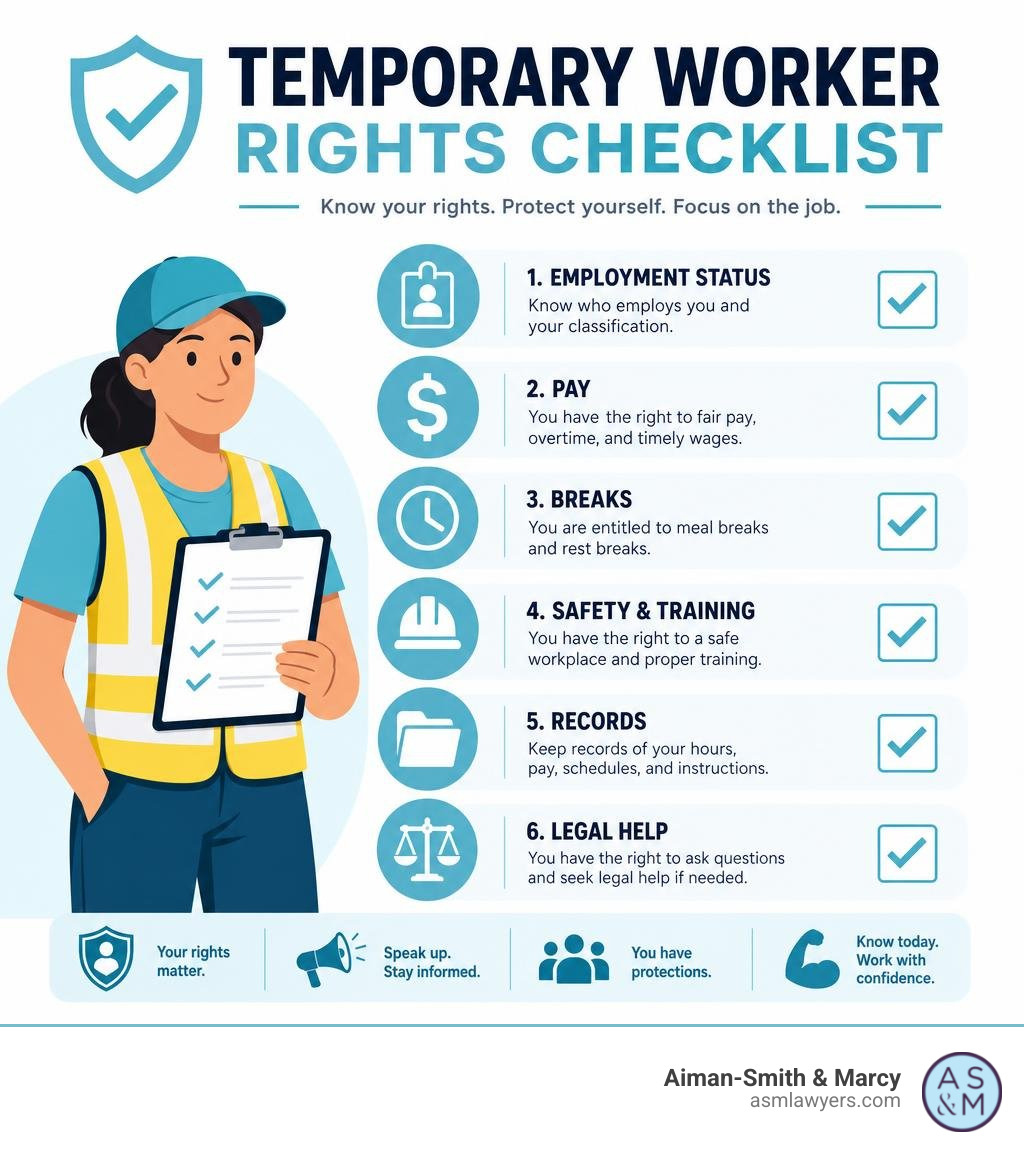
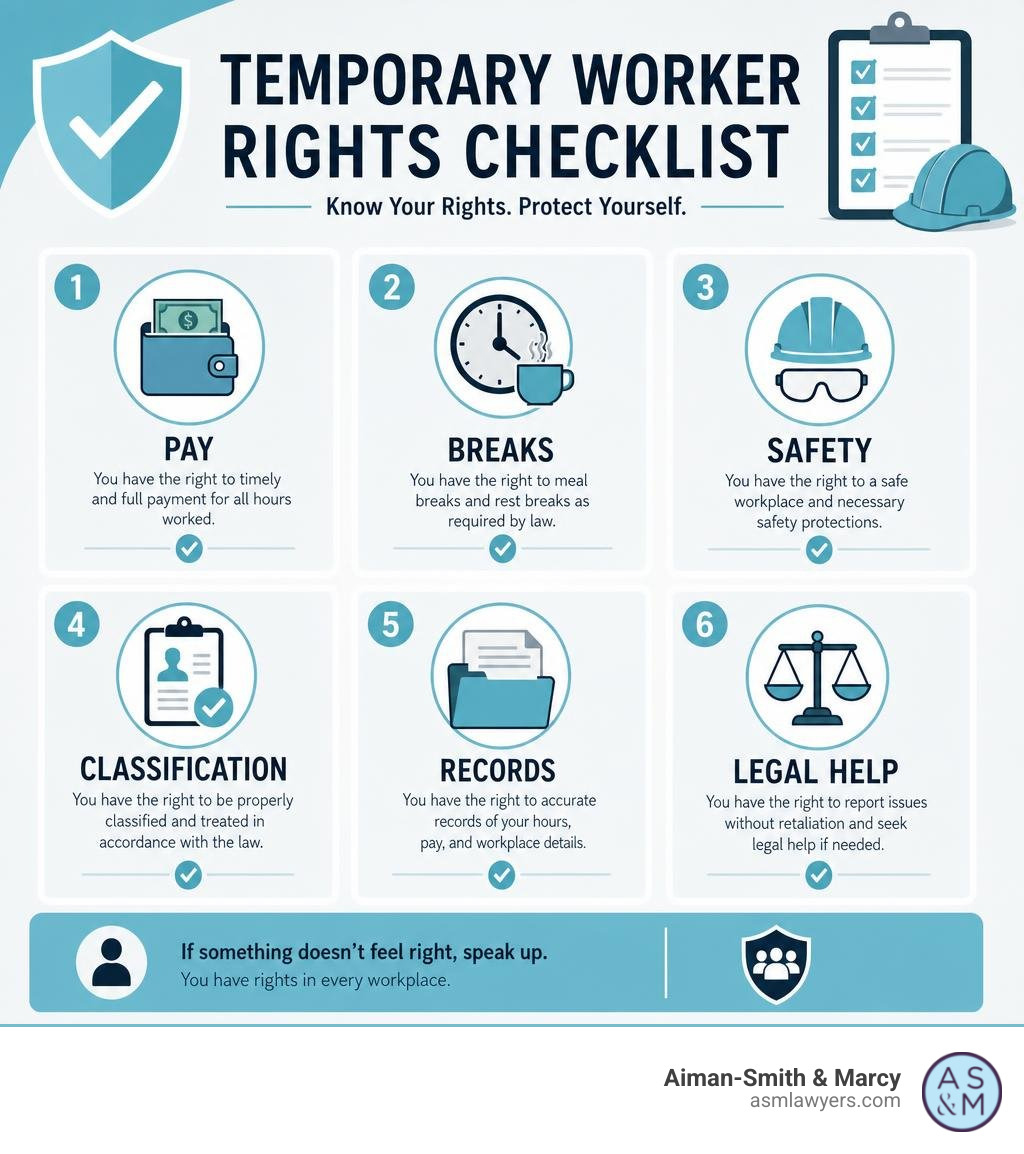
- Know who employs you — the staffing agency, the worksite company, or both may affect your legal options.
- Confirm your classification — most temporary workers performing controlled work should be employees, not independent contractors.
- Watch wage-and-hour protections — overtime, meal breaks, rest breaks, and off-the-clock work still matter.
- Document safety and training — temporary workers are entitled to safe conditions and appropriate protective equipment.
- Keep records — save schedules, texts, paystubs, time records, assignment terms, and supervisor instructions.
Businesses often turn to temporary staffing when demand spikes, an employee goes on leave, or a project has a short deadline. For workers, that speed can create confusion: you may be recruited by one company, supervised by another, and told your role is temporary, contract-based, or app-based. Those labels do not erase workplace rights.
How a worker is classified, who carries workers’ compensation, and whether the staffing agency and worksite company are joint employers can determine whether that worker receives lawful wages, breaks, safety protections, and legal remedies — especially in California, where labor laws are strict.
This guide explains what temporary workers and job seekers should know before, during, and after an assignment.
What is a Temporary Employee and Why Should Workers Care?
A temporary employee is hired for a defined, limited period or project. Temporary status does not remove key workplace protections, including lawful pay, breaks, safety rights, anti-discrimination protections, and workers’ compensation.

There is no blanket federal or California statutory rule that automatically caps how long a private employer can keep someone classified as a temporary worker. Still, a long-running “temporary” assignment can raise legal questions if the label is used to deny wages, benefits, breaks, workers’ compensation coverage, or other protections.
Temporary roles can arise in many situations, but the reason for the assignment does not erase the worker’s rights:
- Seasonal demand: Holiday, harvest, tourism, or retail rushes still require lawful pay, breaks, safety protections, and non-discriminatory treatment.
- Employee leave coverage: Filling in for another employee does not make unpaid overtime, missed breaks, or unsafe conditions acceptable.
- Specialized projects: Short-term document review, warehouse, skilled trade, or administrative projects still require proper classification and lawful working conditions.
- Workforce gaps: Sudden staffing needs should still come with clear terms, correct wage treatment, and appropriate safety training.
Temporary does not mean unprotected. For a deeper California overview, read our guide on what you Need Know Temporary Employee In California.
Staffing Agencies vs. Direct Hiring: What It Means for Workers
Temporary workers are often hired directly by a worksite company or placed through a staffing agency. That choice affects who issues paychecks, controls daily work, handles scheduling, and may be legally responsible if something goes wrong.
Direct hiring means the worksite company usually handles hiring paperwork, payroll, training, scheduling, supervision, and compliance directly.
In a staffing agency arrangement, the agency may serve as the Employer of Record, handling recruiting, payroll, and workers’ compensation coverage. But the worksite company may still control assignments, safety conditions, and break practices.
For workers, the agency model can create confusion. You may receive pay from the agency, report to a worksite supervisor, and rely on both entities for safe and lawful conditions. If an agency assignment later becomes permanent, conversion fees or hourly thresholds — such as a 560-hour trial period in some temp-to-hire agreements — may affect timing.
Common staffing models include:
- Project staffing: A group of workers is placed for a high-volume, short-term need.
- Temp-to-hire: The company evaluates a worker before making a permanent offer.
- Direct placement: The agency recruits for a permanent role, and the employer pays a placement fee.
Workers should track who controls the schedule, signs the paycheck, supervises the work, and responds to wage, break, safety, or discrimination issues. Specialized agencies such as Temporary Staffing Solutions | Hire Top Talent Fast with Vaco may connect companies with pre-vetted professionals, but workers should still understand who is responsible for workplace rights.
| Feature | Direct Hiring | Staffing Agency Model |
|---|---|---|
| Who hires the worker | Worksite company | Staffing agency, often for another worksite |
| Payroll & benefits | Worksite company | Usually the agency |
| Daily supervision | Worksite company | Often the worksite company |
| Risk to watch | Misclassification, unpaid wages, missed breaks, unsafe conditions | Joint-employment confusion, wage violations, unsafe conditions, unclear complaint process |
Knowing Your Rights: How Temp Work Must Comply with California Law
Temporary labor arrangements can obscure serious legal risks for workers. In California, a company cannot simply label a temporary worker a “1099 contractor” to avoid payroll taxes, workers’ compensation insurance, overtime, or other protections.
Under California’s AB5 legislation, workers are presumed to be employees unless the hiring entity satisfies the ABC test:
- A: The worker is free from the hiring entity’s control and direction.
- B: The worker performs work outside the hiring entity’s usual business.
- C: The worker is customarily engaged in an independently established trade or business of the same nature.
If a temporary warehouse picker, retail clerk, or construction laborer is controlled like an employee but classified as a 1099 contractor, the worker may be misclassified. For more detail, see our article on why Ca Temporary Workers You Are Not Contractors If.
Temporary workers must also be authorized to work in the United States through Form I-9 verification and should be covered by workers’ compensation from day one.
Navigating the Legal Risks of Joint Employment and Misclassification
Even if a staffing agency classifies workers as W-2 employees, the worksite company is not always shielded from liability. Under joint employment, both the staffing agency and worksite company may be liable for labor law violations.
If the agency fails to pay overtime, or worksite managers fail to provide compliant meal and rest breaks, affected workers may have claims against one or both entities. In California:
- Meal breaks: Non-exempt workers must receive a 30-minute, uninterrupted meal break for shifts over 5 hours.
- Rest breaks: Workers must receive a net 10-minute paid rest break for every 4 hours worked.
- Overtime: Non-exempt workers must receive 1.5 times their regular rate for hours over 8 in a day or 40 in a week.
Temporary workers should not be denied basic rights because an assignment is short-term or agency-based. To understand the consequences, read our guide on the risks of a Misclassified Temporary Worker.
Red Flags to Watch for on a Temporary Assignment
Before or during an assignment, watch for:
- Unclear employment status: Know whether you are treated as a W-2 employee or 1099 contractor, and question any classification that does not match the actual control and duties.
- Confusing pay arrangements: Keep records showing whether pay comes from the agency, worksite company, or another entity.
- Missing hours, breaks, or overtime: Save your own records of hours worked, meal breaks, rest breaks, overtime, and off-the-clock work.
- Insufficient safety training: Temporary workers should receive the same safety training and protective equipment as permanent staff.
- No clear assignment terms: Keep offer letters, assignment descriptions, time records, texts, emails, and supervisor instructions.
If something feels inconsistent — for example, you are called an independent contractor but controlled like an employee — consider getting legal advice before the problem grows.
Sourcing and Vetting: What Temporary Workers Should Watch For
Modern staffing agencies use digital screening and onboarding tools to place workers quickly. These systems can make assignments easier to access, but they may also require workers to submit personal information, sign documents, and accept terms before understanding who is responsible for pay, safety, and workplace protections.

Onboarding may include skills assessments, background checks, I-9 and credential verification, tax documents, and safety training. Each step can affect privacy, eligibility, assignment placement, and legal rights. Workers should understand what they are signing and whether the agency or worksite company is responsible for wages, breaks, safety equipment, and complaints.
On-Demand Staffing Apps and Worker Classification Risks
Many agencies now offer on-demand staffing apps, such as PeopleReady’s JobStack, that let companies request, schedule, and approve temporary staff quickly.
Some gig-style platforms, such as Jobono — Temporary Workforce on Demand, operate as marketplaces matching businesses with 1099 independent contractors rather than W-2 employees.
That distinction matters. If an app or platform treats you as an independent contractor while controlling your schedule, duties, pay, and worksite conditions, you may be missing protections California law provides to employees. Always look closely at the underlying employment model.
Temporary employment can be a deliberate career choice, offering schedule flexibility, skill-building, career exploration, and possible pathways to permanent employment.
Those benefits do not erase the need for strong legal protections. Temporary workers may still face unpaid overtime, missed breaks, unsafe conditions, retaliation, discrimination, or misclassification. Explore our resources on The Pros And Cons Of Temporary Work and Your Rights As A Temporary Worker to understand when a flexible job may cross the line into unlawful treatment.
Frequently Asked Questions about Temporary Staffing
How long can a temporary employee legally work at one company?
There is no single federal or California statute that automatically sets a maximum length for every private-sector temporary assignment. The issue is usually whether the worker’s actual duties, control, pay practices, benefits treatment, break practices, safety conditions, or classification are lawful.
Who is responsible for workers’ compensation for agency-placed temps?
Generally, the staffing agency, as the Employer of Record, provides workers’ compensation coverage. Because the worksite company controls the daily work environment, it may also face liability under joint-employment laws if unsafe conditions lead to injury. Report injuries promptly and keep records of where, when, and how they occurred.
What is the typical markup fee charged by temporary staffing agencies?
Staffing agency markup fees often range from 30% to 75% above the worker’s hourly pay rate. Workers may not pay that markup directly, but the model can help explain agency, worksite, and temp-to-hire terms.
Conclusion
Temporary work can offer flexibility, income, experience, and a path into permanent employment. But those benefits must be balanced against the legal realities of California employment law.
Aiman-Smith & Marcy is a plaintiff-side employment and consumer fraud law firm. From its Oakland office, the firm represents individuals in workplace and consumer disputes, including misclassification, unpaid wages, denied breaks, unsafe conditions, retaliation, discrimination, and other employee-rights violations.
If you suspect your temporary staffing arrangement is crossing the line into legal exposure, contact us today to review your situation. To learn more, read Are You A Temporary Worker Or A Misclassified Employee.


