
Why Your Exempt vs Non-Exempt Status Determines Whether You Get Paid for Every Hour You Work
Understanding exempt vs non-exempt status is one of the most important — and most misunderstood — areas of employment law in the United States. Your classification decides whether your employer must pay you overtime, track your hours, and guarantee you minimum wage protections under the Fair Labor Standards Act (FLSA).
Here is the quick answer:
| Exempt | Non-Exempt | |
|---|---|---|
| Overtime pay required? | No | Yes — 1.5x for 40+ hours/week |
| Minimum wage guaranteed? | No | Yes |
| Hours tracked by employer? | Not required | Required |
| How paid? | Fixed salary (usually) | Hourly or salary |
| Default status under FLSA? | No | Yes — all employees start here |
A few things most people get wrong:
- Being paid a salary does not make you exempt. You must also pass a duties test and meet a minimum salary threshold.
- Your job title means nothing. The law looks at what you actually do every day, not what it says on your business card.
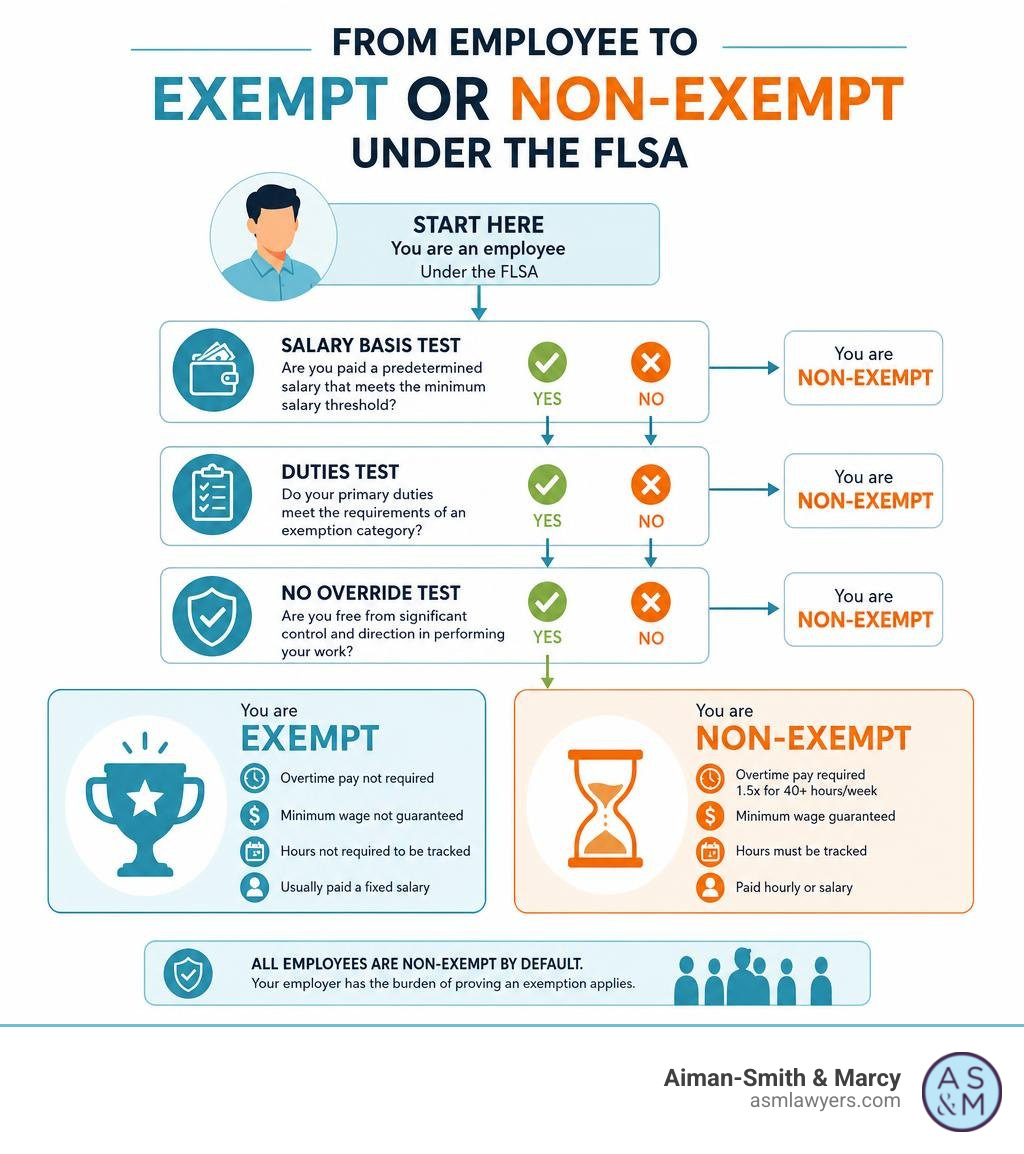
- All employees are non-exempt by default. Your employer carries the burden of proving an exemption applies.
If you suspect your employer has misclassified you, you are not alone — and the financial consequences can be significant. Unpaid overtime adds up fast, and the law may entitle you to recover years of back pay plus additional damages.
Let’s through exactly how this classification works, what the tests are, and what your rights are if something has gone wrong.
What is the Fundamental Difference in Exempt vs Non-Exempt Status?
At its core, the difference between exempt vs non-exempt status boils down to a single question: Is your time protected by federal and state wage-and-hour laws, or has your employer legally opted out of those protections by meeting specific legal criteria?

Under the Fair Labor Standards Act (FLSA), which has governed American workplaces since 1938, non-exempt employees are entitled to basic, non-negotiable rights. These include receiving at least the federal or state minimum wage for all hours worked and earning overtime pay (at least 1.5 times their regular rate) for any hours worked beyond 40 in a single workweek.
Exempt employees, on the other hand, are “exempted” from these protections. Their employers are not legally required to pay them overtime, regardless of whether they work 40, 50, or 80 hours in a week. To compensate for this lack of overtime, the law theoretically requires that exempt employees receive a guaranteed, stable salary that meets a certain financial baseline, alongside performing high-level job duties.
Many workers believe that if they are paid a salary, they are automatically exempt. This is a costly misconception. In reality, there is a large category of “salaried non-exempt” workers—people who receive a fixed salary but do not meet the legal criteria for an exemption. These workers must still track their hours and receive overtime pay when they work more than 40 hours a week.
Because the law assumes every worker is entitled to overtime, all employees are classified as non-exempt by default. If an employer wants to classify you as exempt, they must prove that your position meets three strict legal tests. If you are questioning your own classification, you can learn more about whether you are truly exempt by reading our guide: Are You Exempt, Really?.
The Three-Part FLSA Test for Exemption
To legally classify an employee as exempt, an employer cannot simply point to a signed contract or a high-sounding job title. Under federal law, the employer must prove that the employee’s position satisfies three distinct tests:
- The Salary Level Test: The employee must earn at least a minimum specified amount of money.
- The Salary Basis Test: The employee must be paid a predetermined, fixed salary that does not fluctuate based on the quality or quantity of the work performed.
- The Duties Test: The employee’s actual, primary job responsibilities must involve specific professional, administrative, executive, computer, or outside sales tasks.
The burden of proof rests entirely on the employer. If a dispute arises, the employer must produce evidence showing that your job satisfies every single element of these three tests. If even one prong of the test is not met, the exemption fails, and you are legally non-exempt.
The Salary Level Test and Exempt vs Non-Exempt Status in 2026
The salary level test establishes the absolute minimum compensation required to deny an employee overtime pay. In recent years, this threshold has been the subject of intense political and legal battles.
In April 2024, the Department of Labor (DOL) issued a final rule designed to significantly raise the federal salary thresholds. However, in late November 2024, a federal judge in the Eastern District of Texas vacated that rule in its entirety. As a result, as we navigate July 2026, the federal salary threshold has reverted to the 2019 standard.
Currently, under federal law, the minimum salary threshold for the standard white-collar exemptions is $684 per week, which translates to $35,568 annually. If you earn less than $684 per week, you are automatically non-exempt under federal law, regardless of your job duties.
For highly compensated employees (HCEs), who are subject to a relaxed duties test, the federal threshold is $107,432 annually. For a comprehensive look at how these federal standards operate in the current legal landscape, you can consult the Exempt vs Non-Exempt Employees 2026: FLSA Classification Guide.
The Salary Basis Test and Permissible Deductions
The salary basis test requires that an exempt employee receive a guaranteed, predetermined salary each pay period. This salary cannot be reduced because of variations in the quality or quantity of work performed. If you work 10 hours in a week or 60 hours, your base salary must remain exactly the same.
If an employer docks your pay for slow business days, partial-day absences, or minor mistakes, they are violating the salary basis test. Under the law, improper deductions can destroy the exemption entirely, not just for that pay period, but for all employees in similar roles. This converts the affected workers to non-exempt status and exposes the employer to massive overtime liabilities.
However, the DOL does allow a few narrow, permissible deductions from an exempt employee’s salary:
- Full-day absences for personal reasons other than sickness or disability.
- Full-day absences due to sickness or disability, if the deduction is made in accordance with a bona fide sick leave plan.
- Penalties imposed in good faith for infractions of safety rules of major significance.
- Unpaid disciplinary suspensions of one or more full days imposed in good faith for infractions of workplace conduct rules.
Under the “Safe Harbor” rule, an employer may avoid losing the exemption if they have a clearly communicated written policy prohibiting improper deductions, reimburse the employee for any isolated mistakes, and commit to future compliance. To protect yourself from wage theft, it is vital to understand the boundaries of what your employer can and cannot do. For a deep dive into these protections, read our detailed articles on What Your Employer Can’t Do If You Are Exempt (Part 1) and What Your Employer Can’t Do If You Are Exempt (Part 2).
The Duties Test: Job Titles vs. Actual Responsibilities
The duties test is the most complex of the three prongs, and it is where the vast majority of misclassification disputes occur. Employers frequently make the mistake of assuming that giving a worker a manager title or a fancy description automatically makes them exempt.
The law is clear: job titles are entirely irrelevant. What matters is your “primary duty”—the principal, most important duty that you actually perform day in and day out.
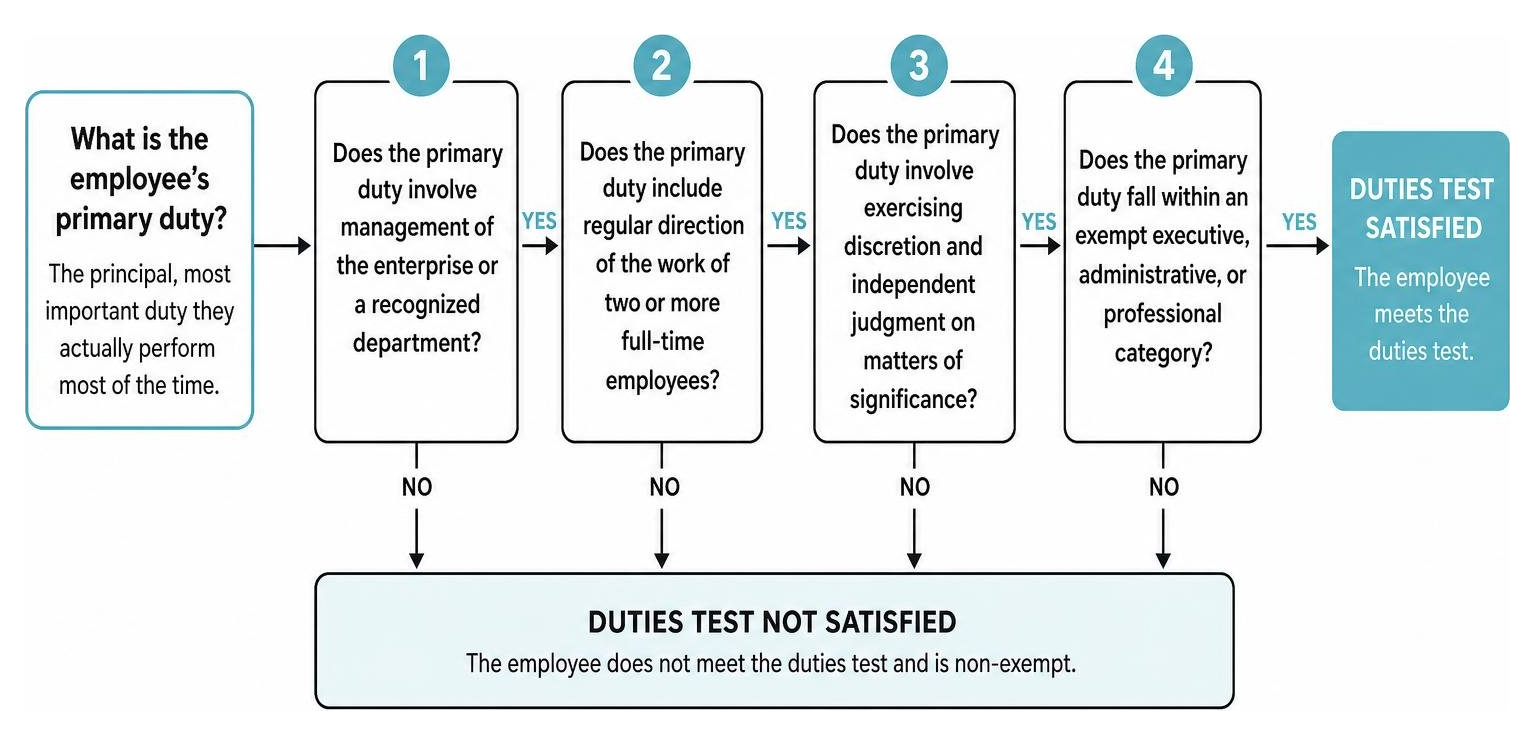
To qualify for a white-collar exemption, your primary duty must involve high-level tasks that require specialized knowledge, executive leadership, or the exercise of “discretion and independent judgment on matters of significance.” If your daily schedule consists mostly of routine, clerical, or manual tasks, you fail the duties test.
Many supervisors are misclassified because they spend 80% of their day performing the exact same manual labor as their hourly subordinates, despite having “manager” printed on their shirts. If you suspect this is happening to you, check out our guide on Supervisors Mislabeling Exempt: Check Your Duties.
Specific Exemption Categories and State-Specific Nuances
The FLSA group exemptions into several “white-collar” categories. Each category has its own specific duties test that must be met alongside the salary tests.

- Executive Exemption: The employee’s primary duty must be managing the enterprise or a recognized department. They must regularly direct the work of at least two full-time employees (or the equivalent in part-time workers) and must possess the authority to hire or fire, or their recommendations on hiring, firing, and promotion must be given particular weight.
- Administrative Exemption: The primary duty must be the performance of office or non-manual work directly related to the management or general business operations of the employer or the employer’s customers. Crucially, their primary duty must include the exercise of discretion and independent judgment on matters of significance. This is not for routine data entry or bookkeeping; it is for roles that make operational decisions.
- Professional Exemption: This is split into “learned professionals” and “creative professionals.” Learned professionals must perform work requiring advanced knowledge in a field of science or learning customarily acquired by a prolonged course of specialized intellectual instruction (e.g., lawyers, doctors, registered nurses, CPAs). Creative professionals must perform work requiring invention, imagination, originality, or talent in a recognized artistic or creative field.
- Computer Employee Exemption: Applies to computer systems analysts, programmers, software engineers, or similarly skilled workers. They can be paid on a salary basis or an hourly basis of not less than $27.63 per hour. Their primary duty must involve the application of systems analysis techniques, or the design, development, documentation, creation, or modification of computer systems or programs.
- Outside Sales Exemption: The employee’s primary duty must be making sales or obtaining orders, and they must regularly and customarily work away from the employer’s physical place of business. Notably, there is no minimum salary threshold requirement for outside sales employees.
- Highly Compensated Employees (HCE): Under federal rules, if an employee earns more than $107,432 annually, they are subject to a much simpler duties test. They only need to perform at least one of the exempt duties of an executive, administrative, or professional employee to be classified as exempt.
For a broader comparative analysis of these categories, you can review Exempt Vs. Nonexempt Employees: What’s The Difference?.
Workers Categorically Excluded from Exempt vs Non-Exempt Status Exemptions
Some workers are entirely excluded from white-collar exemptions, regardless of how much money they make or their job titles. The FLSA explicitly states that these exemptions do not apply to manual laborers or “blue-collar” workers who perform work involving repetitive operations with their hands, physical skill, and energy. Carpenters, electricians, mechanics, plumbers, construction workers, and assembly-line workers are always non-exempt and always entitled to overtime.
Similarly, first responders are categorically non-exempt. This includes police officers, detectives, firefighters, paramedics, emergency medical technicians (EMTs), and park rangers. Because their primary duties involve protecting public safety, preventing crimes, and performing rescue operations rather than administrative or executive management, they must be paid overtime for all hours worked over 40 in a workweek.
State-Level Variations: California, New York, and Washington
While the FLSA sets the federal baseline, many states have established their own labor laws that are far more protective of workers. When federal and state laws conflict, employers must follow the standard that is most favorable to the employee.
As an Oakland-based law firm, we frequently represent workers navigating the incredibly strict landscape of California labor law. California differs from federal law in several massive ways:
- Stricter Duties Test: Under federal law, an employee can be exempt if their “primary duty” is exempt, even if they spend a large portion of their day on non-exempt tasks. In California, the “primarily engaged in” rule applies. An employee must spend more than 50% of their actual work hours performing exempt duties. If an assistant manager spends 60% of their shift stocking shelves and ringing up customers, they are non-exempt under California law, regardless of federal rules.
- Higher Salary Thresholds: California ties its exempt salary threshold directly to the state minimum wage. In 2026, with California’s minimum wage at $16.90 per hour for all employers, the minimum exempt salary is twice the state minimum wage, which equals $1,352.00 per week or $70,304.00 annually.
- Daily Overtime: Unlike the federal weekly standard, non-exempt workers in California must receive overtime pay (1.5x) for any hours worked beyond 8 in a single workday, and double-time pay for any hours worked beyond 12 in a single workday.
- No Highly Compensated Exemption: California does not recognize the federal “Highly Compensated Employee” exemption. High earners must still pass the strict 50% duties test.
Other states also enforce higher standards. In Washington, the 2026 weekly threshold is $1,541.70 ($80,168.40 annually). In New York, the weekly threshold for executive and administrative exemptions is $1,275.00 ($66,300 annually) in New York City and its surrounding counties.
If you work in California, you are covered by some of the strongest wage protections in the nation. To understand how these rules apply to you, read our comprehensive guide on the Exempt vs Non-Exempt Classification of Workers in California.
Employer Misclassification and the 2026 DOL Reclassification Guidance
Employee misclassification is one of the most common forms of wage theft. Whether done intentionally to cut labor costs or accidentally due to a misunderstanding of complex laws, the consequences for employers are severe.
If an employer misclassifies you as exempt, they can be held liable for:
- Back pay for all unpaid overtime hours.
- Liquidated damages (which double the unpaid wage amount as a penalty).
- Civil monetary penalties.
- The employee’s attorney fees and legal costs.
The statute of limitations for recovering these unpaid wages is generally two years, but it extends to three years if the violation is proven to be “willful.” In California, workers can often go back up to four years under the state’s Unfair Competition Law.
In early 2026, the Department of Labor issued DOL Opinion Letter FLSA2026-1, which clarified a major point of confusion regarding reclassification. The letter confirmed that employers always have the right to voluntarily classify an otherwise exempt employee as non-exempt as a matter of business judgment. The FLSA only prohibits misclassifying non-exempt workers as exempt.
If your employer realizes they have made a mistake, they can reclassify you to non-exempt status. However, they must immediately begin tracking your hours, paying you overtime, and resolving any historical unpaid wages. If you believe your employer has misclassified your role, you can find more information about filing a claim by reading our article on Exempt Employee Misclassification.
Frequently Asked Questions
Can an employer choose to classify an otherwise exempt employee as non-exempt?
Yes. As confirmed by the Department of Labor in DOL Opinion Letter FLSA2026-1, employers are entirely free to classify any employee as non-exempt, even if that employee easily passes the salary level, salary basis, and duties tests for an exemption.
Classifying a worker as non-exempt simply means the employer is choosing to provide them with the extra protections of minimum wage and overtime pay. This is a lawful business decision. However, once an employer makes this choice, they must strictly follow all non-exempt requirements, including keeping precise records of all hours worked and paying overtime at the proper rate.
Does paying an employee a salary automatically make them exempt?
No. This is perhaps the single most common myth in the American workplace. Earning a salary is merely a method of payment; it is not a legal status.
To be exempt, you must be paid a salary and earn at least the minimum legal threshold ($684/week federally, $1,352/week in California) and spend your time performing exempt job duties. If you are paid a salary but do not meet the duties test, you are a “salaried non-exempt” employee. Your employer must still track your hours and pay you overtime for any work exceeding 40 hours in a week (or 8 hours in a day in California).
What are the consequences of misclassifying an employee?
The consequences of misclassification are financially devastating for employers and highly beneficial for the affected workers who seek justice. Under the FLSA and California law, a misclassified employee can sue to recover all unpaid overtime wages.
In addition to back wages, courts frequently award “liquidated damages,” which are equal to the amount of unpaid wages (essentially doubling your recovery). Employers must also pay interest, civil penalties, and the employee’s attorney fees. Because misclassification often affects entire departments, these cases frequently turn into class-action lawsuits involving millions of dollars in recovered wages.
Conclusion
Determining your exempt vs non-exempt status doesn’t have to drive you crazy, but it does require looking past job titles and pay structures to examine the actual reality of your workday. If you are working long hours without overtime pay, your employer may be violating state and federal laws.
At Aiman-Smith & Marcy, we are an Oakland-based boutique law firm specializing in employment law. Our collaborative team of attorneys has spent over 25 years working together to protect workers from wage theft, unpaid overtime, and illegal misclassification. We understand the complex interplay between federal FLSA rules and California’s highly protective labor standards.
If you believe your rights have been violated, or if you want to understand your legal options under California law, we are here to help. Contact us today for a professional consultation, or read our comprehensive guide on Exempt vs Non-Exempt Classification of Workers in California to learn more about your rights.


